Added to this site · 2026-09-16
Geometric Aesthetics of Combination Patterns in Hand-Building Mahjong
AI-assisted draft translation. Terminology is under review; please refer to the Chinese original if anything is unclear.
Mahjong scoring patterns can be divided into aesthetic patterns, or tile-structure patterns, and non-aesthetic patterns according to whether they concern the beauty of the tiles. Non-aesthetic patterns can be further divided into entirely luck-driven chance-based patterns, such as heavenly and earthly wins, Last Tile Draw, and Win On Kong; and difficulty-based patterns, such as Concealed Hand, edge, closed, and pair waits, and Last Tile. Four Seas Mahjong follows the principle that beauty is the criterion for selecting patterns; difficulty is the basis for assigning their values. It chiefly includes aesthetic patterns and chance-based patterns that make play more entertaining, while excluding pure difficulty-based patterns unrelated to tile structure.
Aesthetic patterns can be divided further into whole-hand patterns and combination patterns. The basic winning structure is four melds and a pair; the principal special structures are Seven Pairs and All Unrelated.
Whole-hand patterns require every set in the hand—chow, pung, or pair—to satisfy a particular aesthetic condition.
- In terms of suit, Pure One-Suit requires every tile to belong to the same numbered suit: characters, dots, or bamboo. All Types requires the basic structure's four melds and pair to belong respectively to characters, dots, bamboo, dragons, and winds.
- In terms of meld structure, four chows make All Sequences, while four pungs make All Triplets.
- In terms of rank, a hand in which every chow, pung, and pair contains a terminal qualifies for Outside Hands. Similarly, if every set contains a particular rank, it satisfies Every Set Contains One Rank, also called Mantingfang.
Combination patterns require only some of the sets—chows, pungs, or pairs—to satisfy particular aesthetic conditions. For example, Pure Straight requires three chows in one suit with ranks 123, 456, and 789, without restricting the remaining meld and pair. Little Three Dragons requires two pungs and a pair of the three dragons, without restricting the other two melds.
Once a combination pattern imposes aesthetic conditions on all four melds and the pair, as with Pure Terminal Sequences and Silver Ladder, it restricts every tile and might seem to become a whole-hand pattern. However, the structural justification for these patterns still derives from the beauty of subsets of melds, consistently with the lower patterns in their families. They therefore remain classified as combination patterns.
Let us explore the geometric aesthetic elements of combination patterns. Arrange ranks one through nine in each of the three suits as a 9 × 3 rectangular array.
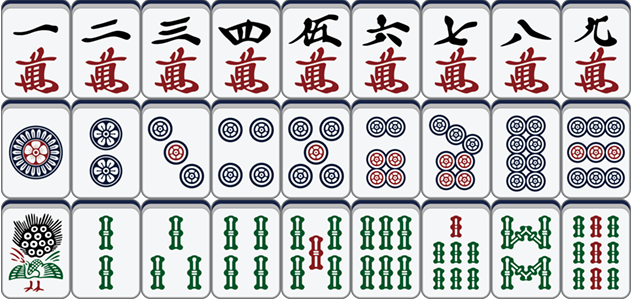
Chow combinations
Ranks one through nine within one suit can be viewed as a horizontal dimension. Pure Straight, with 123, 456, and 789 in one suit, forms a long horizontal line. The three suits form a vertical dimension. Three Similar Sequences, such as 345 in characters, dots, and bamboo, forms a long vertical line. Similarly, Assorted Straight, with 123, 456, and 789 across three suits, can be viewed as a diagonal. We can extend this reasoning to identify the geometric elements of major chow combinations involving three or four melds.
| Geometric element | Diagram | Pattern | Tile example |
|---|---|---|---|
| One horizontal line |  | Pure Straight |  |
| One vertical line |  | Three Similar Sequences | 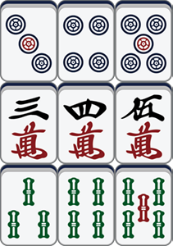 |
| One diagonal |  | Assorted Straight | 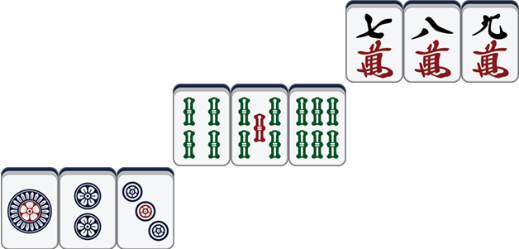 |
| Two short horizontal lines |  | Half Straight Twice | 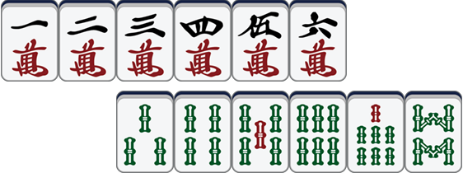 |
| Two short vertical lines |  | Mirrored Sequences | 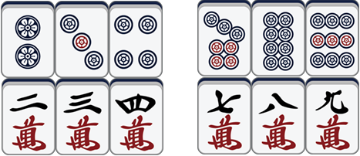 |
| One square |  | Mirrored Half Straight | 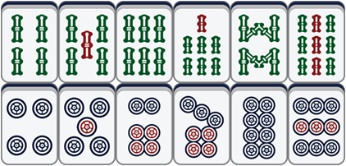 |
| One small point |  | Three Identical Sequences | 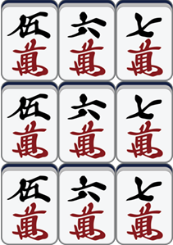 |
| One large point |  | Three Shifted Sequences | 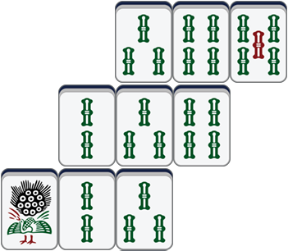 |
| Two small points |  | Two Identical Sequences Twice | 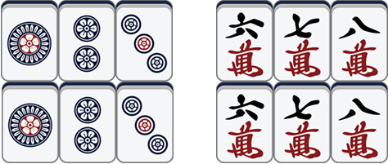 |
| Two large points |  | Two Shifted Sequences Twice | 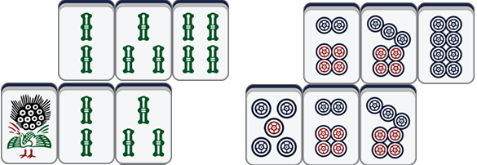 |
The table shows the geometric elements of chow combinations. Half Straight Twice and Mirrored Sequences correspond respectively to two short horizontal lines and two short vertical lines. Mirrored Half Straight, which combines both, resembles a square. Three Identical Sequences consists of three chows with the same suit and ranks, corresponding to a single point in the array. Three Shifted Sequences moves two of the chows slightly to either side, corresponding to a larger point. By the same reasoning, Two Identical Sequences Twice and Two Shifted Sequences Twice resemble two small points and two large points respectively.
Pung combinations
The following table gives analogous geometric elements for pung combinations. Because identical pungs cannot occur within one suit, there are no pung equivalents of Three Identical Sequences or Three Shifted Sequences.
| Geometric element | Diagram | Pattern | Tile example |
|---|---|---|---|
| One horizontal line | | Three Consecutive Triplets |  |
| One vertical line | | Three Similar Triplets | 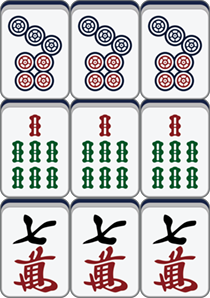 |
| One diagonal | | Assorted Three Consecutive Triplets | 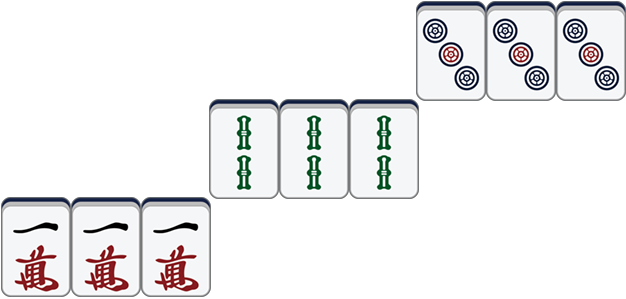 |
| Two short horizontal lines | | Two Consecutive Triplets Twice | 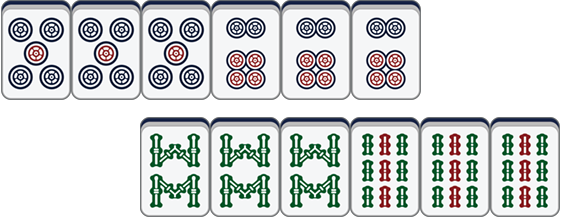 |
| Two short vertical lines | | Mirrored Triplets | 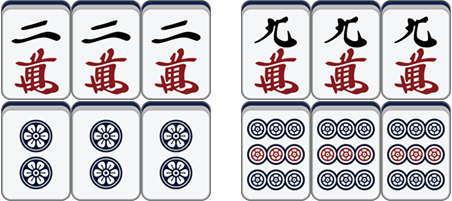 |
| One square | | Two Consecutive Triplets Twice + Mirrored Consecutive Triplets | 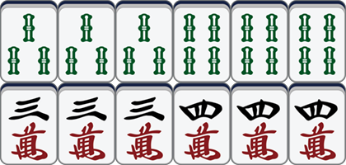 |
Chow–pung combinations
The Four Seas Expanded Edition introduced three new hand-building families: same-suit consecutive chow–pung combinations, three-suit consecutive chow–pung combinations, and three-suit matching-rank chow–pung combinations. These combine chows and pungs within a single combination pattern for the first time. Like pure chow or pung combinations, chow–pung combinations have corresponding geometric elements in the tile array.
| Geometric element | Diagram | Pattern | Tile example |
|---|---|---|---|
| One horizontal line | | Horizontal Cross | 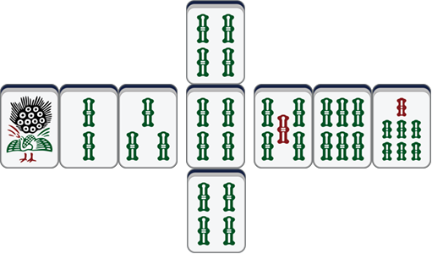 |
| One horizontal line | | Horizontal H | 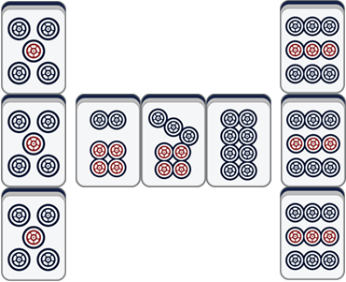 |
| One vertical line | | Vertical H, Vertical Cross | 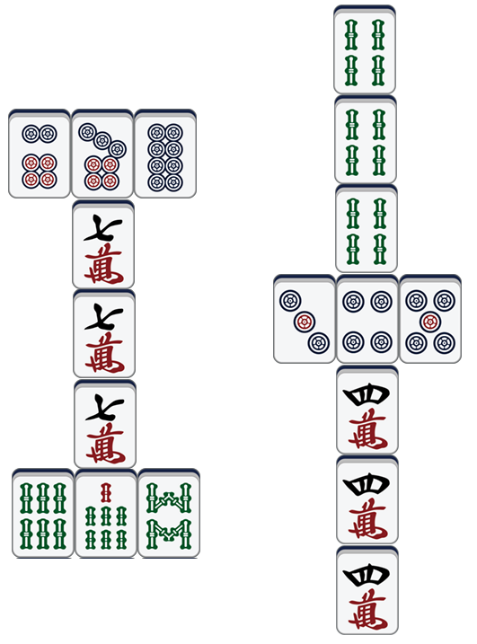 |
| One diagonal | | Assorted Cross | 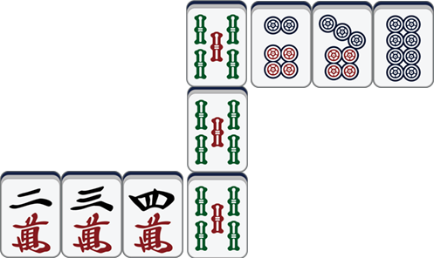 |
| One diagonal | | Assorted H | 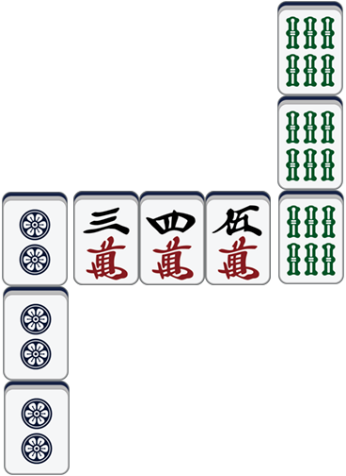 |
| Two short horizontal lines | | Consecutive T Twice | 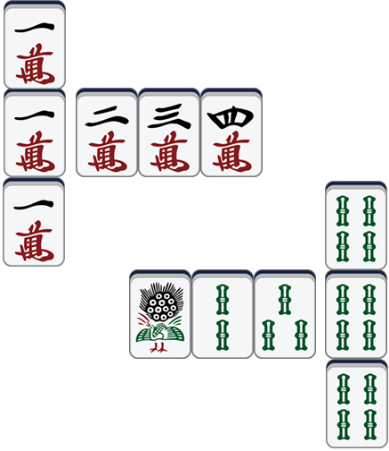 |
| Two short vertical lines | | Assorted T Twice | 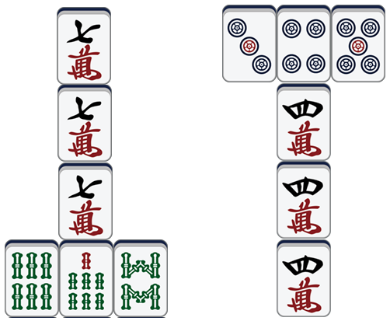 |
| One square | | Consecutive T Twice + Assorted T Twice | 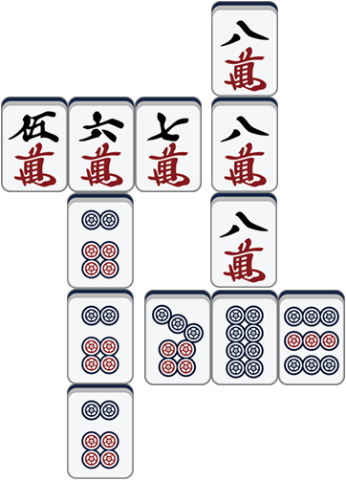 |
Summary
Putting the geometric elements of all three types of combination pattern together produces the following table. The first six elements appear in all three types. The point elements associated with identical and shifted chows are unique to chow combinations.
| Geometric element | Chow combinations | Pung combinations | Chow–pung combinations |
|---|---|---|---|
| One horizontal line | Pure Straight | Three Consecutive Triplets | Horizontal Cross, Horizontal H |
| One vertical line | Three Similar Sequences | Three Similar Triplets | Vertical H, Vertical Cross |
| One diagonal | Assorted Straight | Assorted Three Consecutive Triplets | Assorted Cross, Assorted H |
| Two short horizontal lines | Half Straight Twice | Two Consecutive Triplets Twice | Consecutive T Twice |
| Two short vertical lines | Mirrored Sequences | Mirrored Triplets | Assorted T Twice |
| One square | Mirrored Half Straight | Two Consecutive Triplets Twice + Mirrored Triplets | Consecutive T Twice + Assorted T Twice |
| One small point | Three Identical Sequences | ||
| One large point | Three Shifted Sequences | ||
| Two small points | Two Identical Sequences Twice | ||
| Two large points | Two Shifted Sequences Twice |
We have arranged ranks one through nine in three suits into a 9 × 3 array and mapped most Four Seas combination patterns to geometric elements within it. As discussed in Aesthetic Criteria for Hand-Building Mahjong, these horizontal, vertical, and diagonal elements arise from combinations of suit, meld structure, and rank along four dimensions: identity, symmetry, completeness, and continuity. For example, the horizontal element of Pure Straight represents a shared suit and ranks that are consecutive, complete, and symmetric. The two short vertical lines of Mirrored Sequences represent symmetric structures and suits, together with identical ranks.
Examining these geometric qualities reveals similarities in the composition and structural justification of chow combinations, pung combinations, and the newly created chow–pung combinations. Moreover, these geometric qualities allow us to select aesthetically appropriate patterns systematically and with clear justification. Pattern selection no longer has to be random or unstructured. Individual patterns become an interconnected system, rather than isolated, unrelated entries.
This systematic approach makes patterns more beautiful and interesting. It also gives players clear principles for understanding the pattern system and building hands, helping them better understand and master the rules.
Originally published in Chinese on Zhihu · Zhihu revision 2024-12-31