Added to this site · 2026-09-15
Four Seas Mahjong Design: Looking Back and Ahead, Part I
AI-assisted draft translation. Terminology is under review; please refer to the Chinese original if anything is unclear.
This article offers an interim review of Four Seas Mahjong: why I began designing it, how its rules have been refined, and where their development might lead.
Origins
During the COVID-19 lockdowns, a few friends who lived nearby could only get together for indoor games. We tried the card game Shuangsheng, Carcassonne, Sanguosha, and other tabletop games. But once we tried mahjong, we stopped playing the others. In card games such as Shuangsheng and Dou Dizhu, each deal is random, but once the cards have been dealt, the quality of your hand is already determined. Board games can take considerable effort to learn, yet once their familiar routines are mastered, the motivation to replay them may fade. Mahjong, by contrast, has extremely simple basic rules while offering endless variation.
That diversity also appears in its many rulesets. Almost every region of China has its own local mahjong rules, so deciding which rules to use is the first problem when people from different places sit down together. We tried Sichuan Mahjong and a northern ruleset requiring either a concealed hand or a self-draw, but neither quite satisfied us. After some searching, we began our journey with Zung Jung Mahjong.
We chose Zung Jung for two main reasons. First, as a competitive ruleset, it offered much more enjoyment through hand-building than regional rules focused solely on the excitement of gambling, making it very suitable for gatherings of family and friends. Second, it was the easiest competitive ruleset to learn, and the most welcoming to casual players like us trying something new. We considered Chinese Official Mahjong and Riichi Mahjong but rejected both. The deterrent effect of Chinese Official Mahjong's 81 patterns and high eight-point minimum scarcely needs explaining. Riichi was somewhat easier to approach, but its highly complicated han-and-fu scoring and numerous restrictions made it difficult for beginners to start playing in person simply by reading the rules, without an experienced player to guide them.
The book A Historical View of Mahjong: Zung Jung examines the historical development of different mahjong rules and explains the thinking behind Zung Jung. It presents many insightful ideas, including hand-building as a direction for modern mahjong; identifies problems in past and existing rules, such as dealer privileges, base points, excessive pattern rewards, and excessive restrictions; and introduces original mechanisms such as the Zung Jung payment system, pattern classification, and principles for adding combined patterns.
Even Zung Jung's 44 patterns take time to understand and memorize if you know only mahjong's basic rules. At first, we printed several copies of its scoring table and referred to them while playing. Because we used a rule requiring a scoring pattern to win, we often encountered hands that we did not know how to turn into eligible wins. Calling a pung of scoring honors could feel like finally gaining the “freedom to win.”
For players whose previous experience was limited to regional rules emphasizing kongs and luck, Zung Jung's hand-building system opened a new world: the pleasure of building valuable hands. Its five main routes—Full Flush and Half Flush, All Pungs, Outside Hand, Pure Straight, and Mixed Triple Chow—offer combinations of beauty and difficulty that players can deliberately pursue. After many games and growing familiarity, however, the available patterns and routes began to feel limited. For a hand-building ruleset, Zung Jung's selection criteria were too restrictive. Its 44 patterns did not offer a substantial expansion over Riichi, and we wanted more opportunities to build hands.
We therefore began adding compatible patterns from Chinese Official Mahjong, Hong Kong and Guangdong rules, and other systems to the Zung Jung table. We started with the Pure Shifted Chows series and gradually added more. Initially, this was essentially an enhanced Zung Jung. Once enough patterns had been added, however, the point assignments, minimum winning requirements, and rules for combining scores also had to change. It had become a new homemade ruleset rather than merely a revision of Zung Jung.
Development
Many players have published homemade rules based on Chinese Official Mahjong, Riichi, or Guangdong New Style Mahjong. Even wholly new designs tend to show the influence of these competitive systems. I had not seen a revision based on Zung Jung, yet, as discussed in Hand-Building Mahjong: Origins and Improvements, Zung Jung provides an excellent foundation for a hand-building ruleset.
Our rules had already undergone many internal iterations before publication. The first scoring table is shown below.
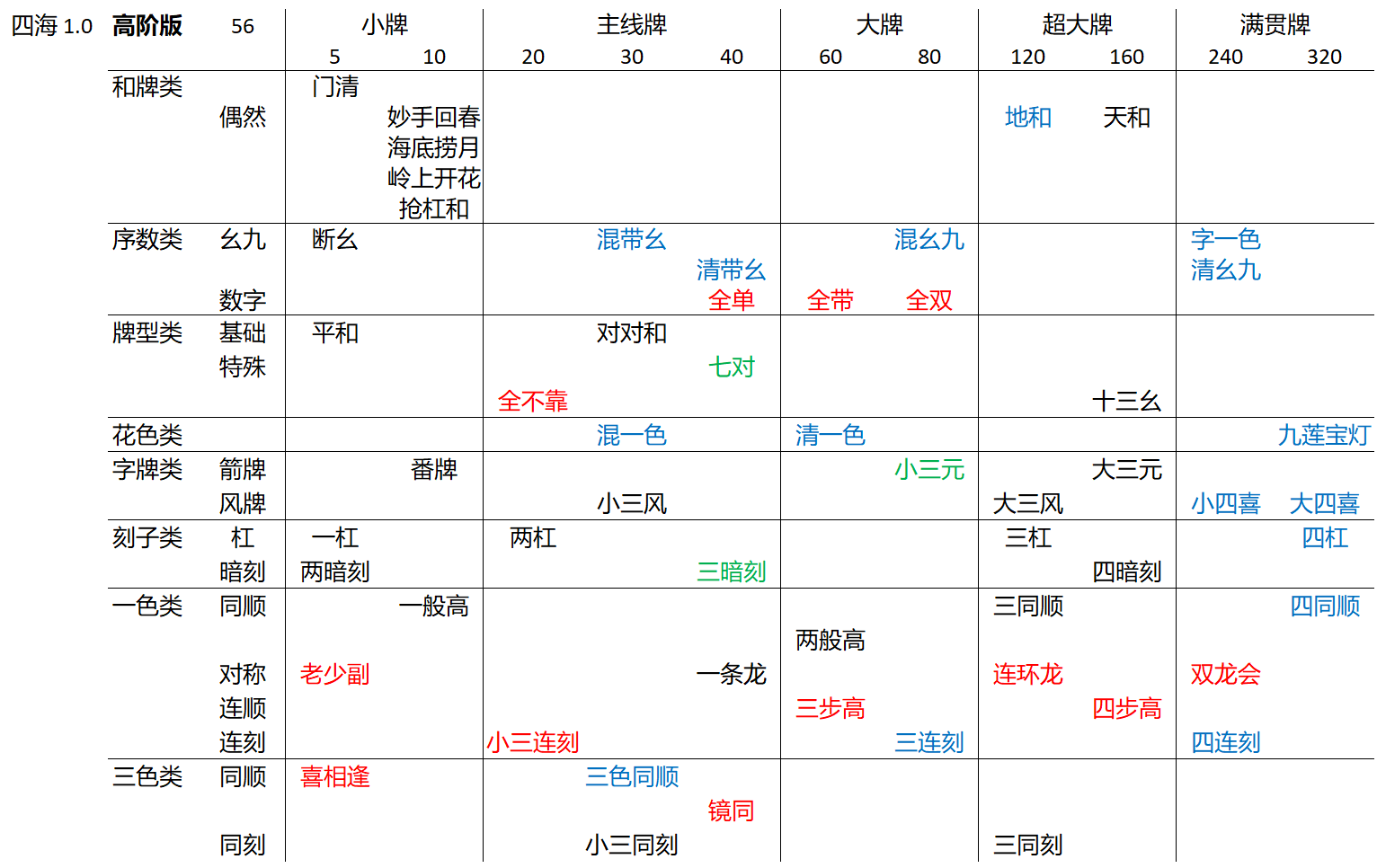
Red marks patterns added to Zung Jung, green marks increased values, and blue marks decreased values.
The first version happened to contain exactly 56 patterns, recalling a song lyric about the brothers and sisters of China's 56 ethnic groups belonging to one family. “One Family across the Four Seas” was also an alternative name for Pure Quadruple Chow, the most difficult pattern. Together with the hope that the rules would spread widely, this inspired the name Four Seas Mahjong. The earliest versions retained a maximum of 56 patterns. As more series were introduced, that total was exceeded, and there was no reason to preserve it. The Intermediate version at the time of writing happens to contain 56 patterns, a fitting tribute to the original.
Comparing the original table with the later one shows how thoroughly Four Seas Mahjong changed through iteration. Repeated refinement preserved and improved Zung Jung's strengths while correcting or filling its shortcomings. The search for a more systematic and reasonable ruleset also led to innovations and original ideas. I outline them below.
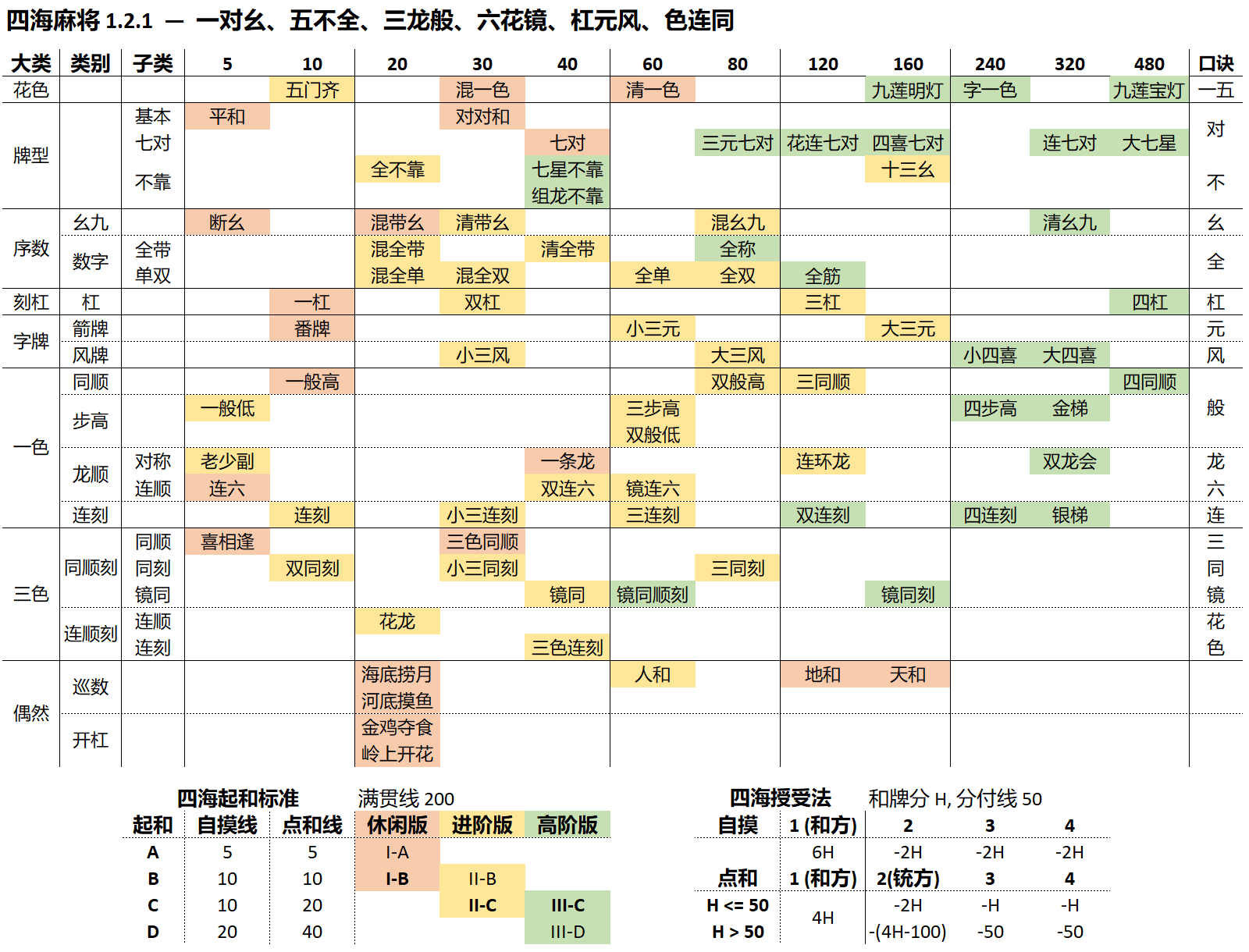
This illustration uses the watermark-free version 1.2.1 original from Word; the corresponding Zhihu illustration is Advanced version 2.1.
1. The hand-building philosophy
Alan Kwan, author of A Historical View of Mahjong: Zung Jung, first set out the hand-building philosophy in writing, arguing that hand-building is a principal source of mahjong's enjoyment and the direction of its future development. I strongly agree. Many homemade rulesets are also moving in this direction. Yet Kwan's own Zung Jung rules do not fulfill that philosophy. His approach is to select patterns strictly, assign them scientifically justified values, and then leave players free to decide whether to pursue a large hand or race to a quick win according to their tiles and the situation. With no minimum score, or a low minimum, however, 70% of Zung Jung wins are actually small hands won in a race. The results do not emphasize hand-building. Zung Jung focuses on matching scores to beauty and difficulty, without being concerned about whether the resulting play actually produces hand-building.
Four Seas defines hand-building as follows: the rules should encourage players to build valuable hands with beauty and difficulty, rather than repeatedly race to cheap wins. Moreover, hand-building must remain grounded in actually winning, within a four-player contest in which the first player to complete a winning hand wins. Its opportunities should not be increased by artificially lowering the standards or difficulty of large hands. Only then can those hands express their patterns' difficulty, beauty, rarity, and value. What is the point of building a large hand if it has been devalued?
Patternless wins and small hands are easy to complete. Without a minimum winning requirement, quick small hands can eliminate the possibility of larger ones. Hand-building and winning requirements thus appear to conflict. Four Seas raises the minimum to a point between small hands and main-route hands, allowing a main-route hand to qualify directly, while making small hands harder to qualify. After removing difficulty-based patterns prone to excessive rewards, a hand without a main-route pattern must combine smaller patterns to reach the minimum; assembling those smaller patterns is comparable in difficulty to completing a main-route hand on its own. This is still hand-building in a race: a race for main-route hands, or equally difficult combinations of smaller patterns. Once the minimum difficulty is set at the main-route level, the probability of completing still larger patterns also increases. This practical setting of the minimum winning score reconciles the classic tension between hand-building and winning requirements.
2. Criteria for selecting patterns
Zung Jung's philosophy is that points should reflect a hand's beauty and difficulty, making the rationale behind a pattern the most important criterion for including it. Yet the author's explanation of that rationale is neither clear nor complete. It invokes consistency, systematic beauty, symmetry, traditional patterns, the strength of a rationale, prevalence, and other highly subjective and unsystematic measures. Some selections are also contradictory. For example, All Sequences is said to lack an element of difficulty and therefore not fit the hand-building philosophy, yet its prevalence is used to justify including it, alongside Concealed Hand and All Simples, in a separate category.
Four Seas first distinguishes three types: aesthetic patterns (tile-pattern-based scoring), difficulty-based patterns, and chance-based patterns. It identifies difficulty-based patterns as a principal source of excessive rewards in earlier rulesets, and therefore selects aesthetic patterns, supplemented by chance-based patterns for variety. To define beauty, Four Seas identifies three elements—suit, hand structure, and tile rank—and four dimensions: sameness (consistency), symmetry, completeness, and continuity. These provide the aesthetic basis for selecting patterns.
Aesthetic dimensions of Four Seas Advanced patterns
| Dimension | Suit | Hand structure | Tile rank |
|---|---|---|---|
| Sameness | One-suit series | All Sequences, All Triplets, Seven Pairs | Terminals in every set, one rank in every set, matching triplets, matching sequences |
| Symmetry | Mirrored Sequences, Mirrored Triplets, Mirrored Sequences and Triplets | Two pairs of identical sequences, two pairs of shifted sequences, two short straights, two pairs of consecutive triplets | Straight series, terminals in every set, one rank in every set |
| Completeness | Three-suit series, all five tile types, three dragons / four winds / seven honors | Thirteen Orphans | Straight series, Nine Gates |
| Continuity | Shifted sequences, consecutive triplets, straight series, consecutive seven pairs |
Zung Jung divides patterns into ten categories according to their rationale, then into series in which patterns have higher- and lower-order relationships. Four Seas develops this idea: hand-building and pattern selection should operate at the level of whole series, rather than individual patterns. Patterns in the same series share a rationale, so its small, main, and large patterns should be included as fully as possible. In combination patterns, for example, the smallest combination involves two sets; above it are three sets, two pairs of sets, and four sets. Each aesthetic rationale can therefore correspond to a whole series, making selection more objective and systematic.
Combination patterns in Four Seas Advanced
| 2 sets | 3 sets | 2 sets × 2 | 4 sets | 4 sets + pair |
|---|---|---|---|---|
| Two identical sequences | Three identical sequences | Two pairs of identical sequences | Four identical sequences | |
| Two shifted sequences | Three shifted sequences | Two pairs of shifted sequences | Four shifted sequences | Golden Ladder |
| Short straight | Pure straight | Two short straights | ||
| Terminal sequences | Pure straight | Mirrored Sequences + two pairs of terminal sequences (Shuang Piao) | Golden Bridge | Pure Terminal Sequences |
| Consecutive triplets | Three consecutive triplets | Two pairs of consecutive triplets | Four consecutive triplets | Silver Ladder |
| Mixed double chow | Mixed triple chow | Mirrored Sequences | ||
| Two matching triplets | Three matching triplets | Mirrored Triplets |
3. Scoring through classification
Combining scores when a winning hand contains multiple patterns is a difficult part of mahjong rules, especially systems with many patterns. Chinese Official Mahjong's five scoring principles are complex and ambiguous; combined with exclusions in individual pattern definitions, they are hard to master. Although its 81 patterns are grouped into nine series or categories, that grouping is essentially classification for its own sake. Zung Jung divides 44 patterns into ten categories and then into series. Within a series, classification resolves the inclusion of lower patterns within higher ones; scores from different series are all added. The principle is simple, but it produces peculiar assignments—such as a 155-point heavenly hand because it must include five points for concealment—and as many as 16 scoring levels. It also does not accommodate large numbers of patterns well: one reason for omitting small patterns such as Mixed Double Chow is that they complicate score calculation.
Four Seas develops Zung Jung's classification and introduces a classified scoring table with a pattern series in each row and a scoring level in each column, replacing the traditional list organized only by point value. The Four Seas table groups series by their rationale into three levels—major groups, categories, and subcategories—and follows two principles for each group of sets: “no reuse within the same category” and “do not add patterns already included.” This combines the strengths of the two systems and makes scoring combinations clear and simple.
With this systematic table, Four Seas reduces the number of scoring levels to 12 while expanding to 81 patterns and 21 series. It offers six sequence routes, six triplet routes, and six whole-hand routes, summarized by the Chinese mnemonic “一对幺、五不全、三龙般、六花镜、杠元风、色连同.”
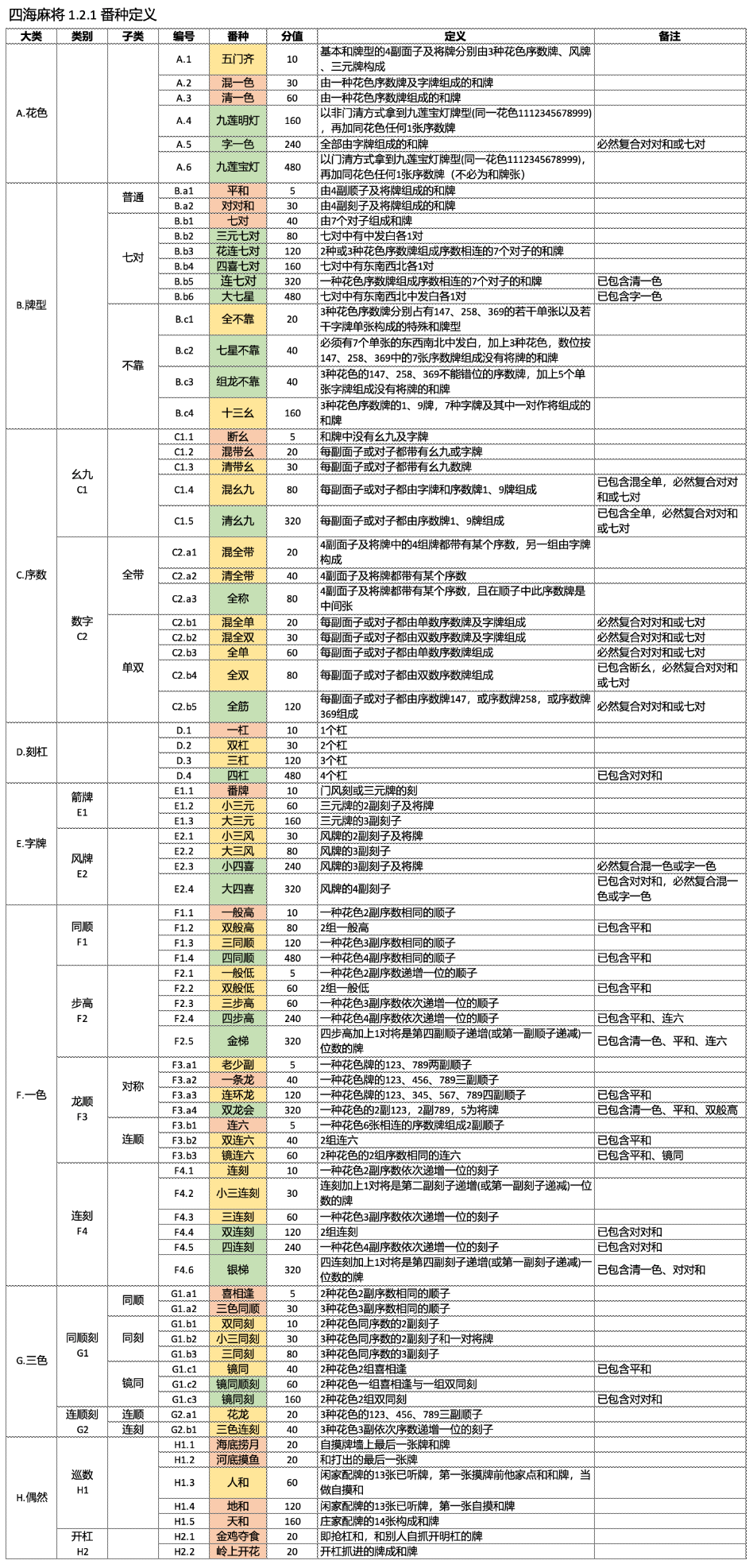
This illustration uses the watermark-free version 1.2.1 original from Word, retaining its historical pattern names and scores.
4. Reasonable competitive play
Zung Jung's payment system combines full-discarder payment with shared small-hand payments and capped payments by the other players for large hands. It first explicitly distinguishes the discarder liability of large and small hands, resolving the tension between the discarder and non-discarders in earlier payment systems. Four Seas builds on this with a 2:1:1 payment ratio on discard wins, together with shared payments for small hands and capped other-player payments for large hands. It systematically distinguishes three kinds of responsibility: self-draw versus discard wins, discarder versus non-discarders, and dealing into large versus small hands. This makes gains and losses more reasonable and supports competitive play. (See A Reasonable Payment System for Hand-Building Mahjong.)
Because Four Seas sets a minimum score to encourage hand-building, competitive fairness calls for compensation for players with poor starting hands. Otherwise, hand-building is being forced at the expense of competition. Four Seas introduces a self-draw minimum at half the standard discard-win minimum, giving players with poor starting tiles or unhelpful draws a chance to win by self-draw. It also provides the option of changing one's tiles defensively, adding another dimension of skill.
5. Easy to learn
Besides the tension between hand-building and racing to win, mahjong has a second tension: ease of learning versus depth. As discussed in What Makes an Ideal Mahjong Ruleset?, more complex rules are harder for newcomers, while simple rules may lack depth. To address this, Four Seas was designed from the outset with three levels: a Casual version for newcomers, an Advanced version pursuing hand-building and competition, and an Intermediate version bridging the two. The self-draw and discard-win minimums, the number of pattern series, and their difficulty are set accordingly. The principle is to introduce series and difficulty gradually, with each level containing only patterns that players might encounter while learning and practicing its rules. The table below compares pattern counts, minimum scores, and other measures across the three levels. The rules also allow mixed-level play, helping experienced players introduce newcomers and support their progress.
| Measure | Casual | Intermediate | Advanced |
|---|---|---|---|
| Number of patterns | 20 | 56 | 81 |
| Pattern series | 9 | 22 | 22 |
| Highest pattern | Pure One-Suit | Big Three Dragons | Nine Gates |
| Highest point value | 60 | 160 | 480 |
| Minimum winning scores | 5/10 | 10/20 | 20/40 |
Originally published in Chinese on Zhihu · Zhihu revision 2024-12-31