Added to this site · 2026-09-16
Head-Bump and Multiple Winners: A Better Way to Resolve Competing Wins
AI-assisted draft translation. Terminology is under review; please refer to the Chinese original if anything is unclear.
Mahjong's basic interactions are claiming a chow, pung, kong, or win. Winning differs fundamentally from the other three. Chows, pungs, and kongs are operations within a hand; in most rules, a win ends that hand. There are exceptions, such as Sichuan's Blood Battle to the End, where a winner leaves play and the remaining players continue, so a win does not end the hand.
Another distinction is that several players can theoretically win on the same tile, while only one player can make a given chow, pung, or kong claim. Only the next player may chow a discard. Pungs and kongs may be claimed from any opponent, but require three or four identical tiles, so only one player can have the necessary tiles. A pung may outrank a competing chow, but two players cannot compete to chow, or both to pung, the same discard. Several players can, however, win on it. Because this determines who wins, every game must establish how competing win claims are resolved. The two usual methods are head-bump and multiple winners on one discard. Let us examine both.
Head-bump has a straightforward rationale: there is only one tile. It cannot be given to player A and then player B; only one player can take it to complete a fourteen-tile hand. The first eligible player in counterclockwise turn order wins. Later claimants are blocked, however large their hands might be. The principal loser is the later claimant, who changes from a winner to a non-winner. In rules where all three opponents pay, such as Chinese Official Mahjong, the blocked claimant not only receives nothing but actually loses points. This is highly unreasonable and frustrating.
Suppose a player is waiting on a very large pattern, such as Big Three Dragons, with exposed Red and Green Dragon pungs. White Dragon is then an obvious danger tile. Another player may have held a White Dragon until it became a pair wait. If that player's claim blocks the Big Three Dragons win, the outcome is unfair to the large-hand player and too lenient toward the discarder. The discarder has played an obviously dangerous tile without receiving a corresponding penalty, which does not improve mahjong's competitive quality.
The alternative is multiple winners: a single discard can complete several hands, and the discarder pays all the winners. This resolves the claimants' problem but can punish the discarder excessively. Three players can theoretically win on one discard, requiring three simultaneous payments. The discarder bears responsibility for failing to recognize a tile dangerous to all three, but one lost hand may effectively lose the entire game. Multiple full wins amplify chance and are therefore often used in gambling-oriented rules. Competitive mahjong, such as Chinese Official and Zung Jung, generally seeks to prevent one luck-driven hand from determining an entire match, so it tends to use head-bump rather than multiple winners.
Both methods have problems. Four Seas proposes a new approach: score priority without excluding wins. When several players can win, the payment calculation uses the highest winning hand score. Claimants are considered in counterclockwise order and receive the portion of their hand score exceeding the preceding winning score. A player whose score is lower receives nothing, but also pays nothing.
Here is a recent double-win example from the Four Seas platform:
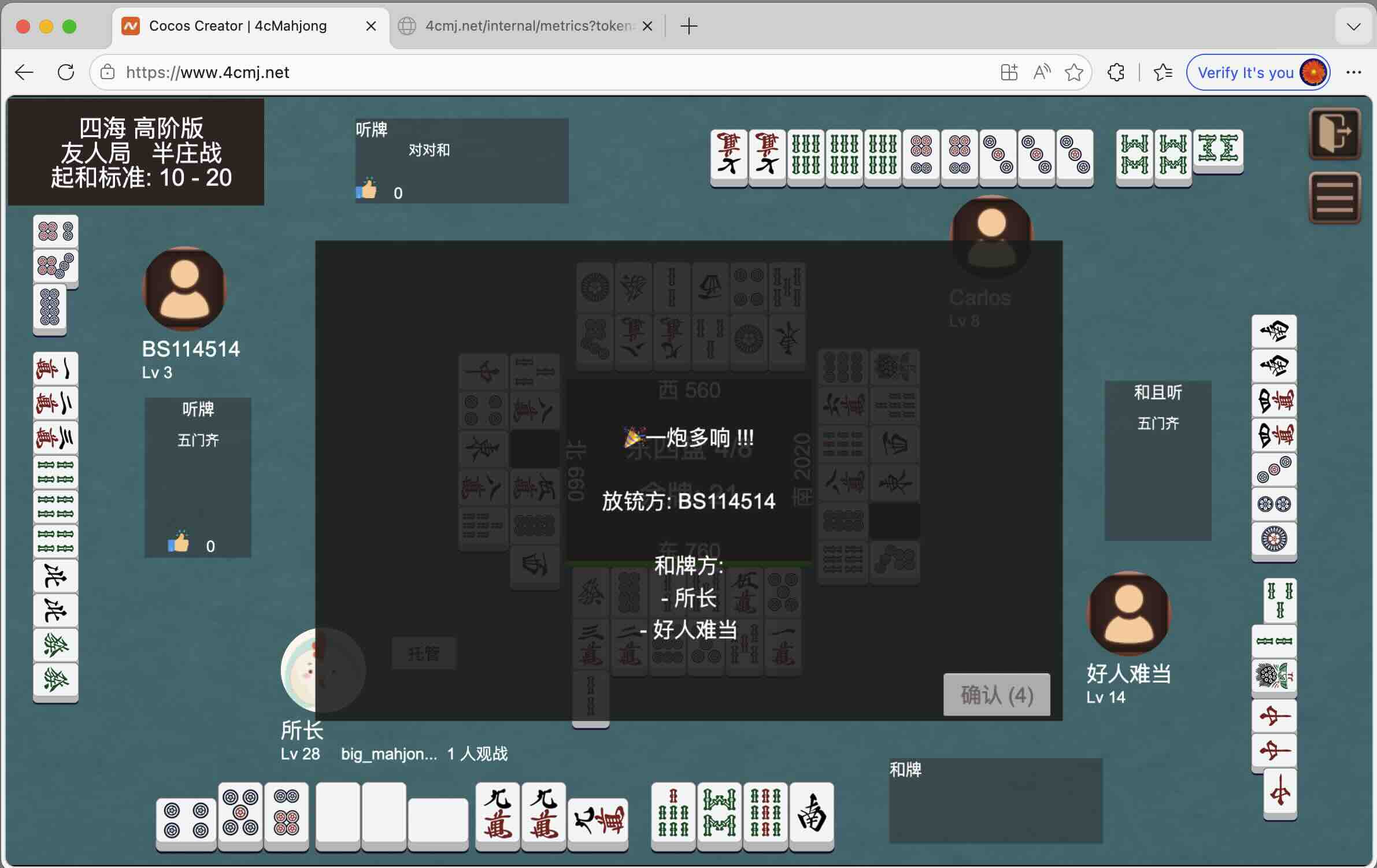
North discards South wind. East and South both win, with hand scores of thirty and forty-five respectively.
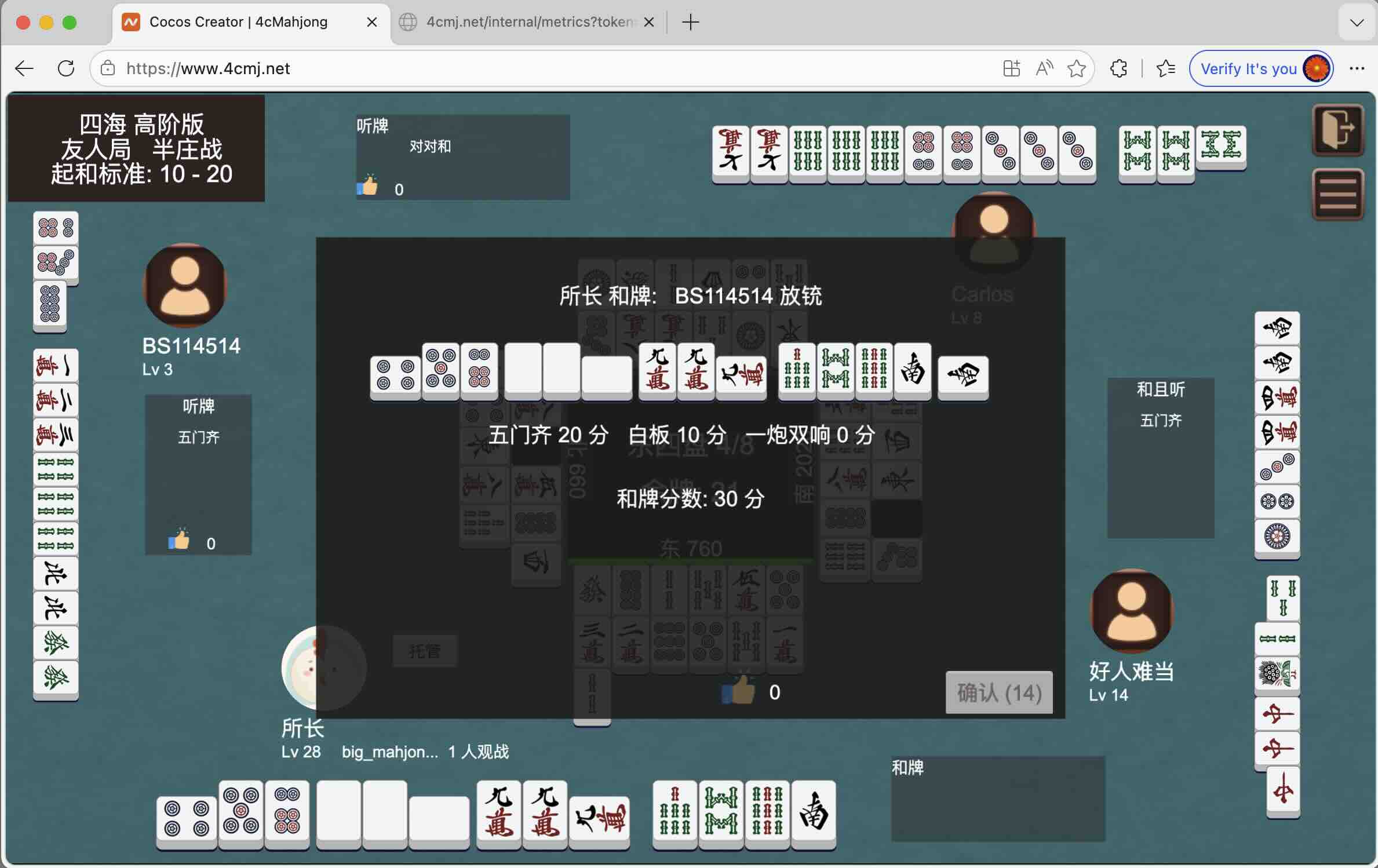
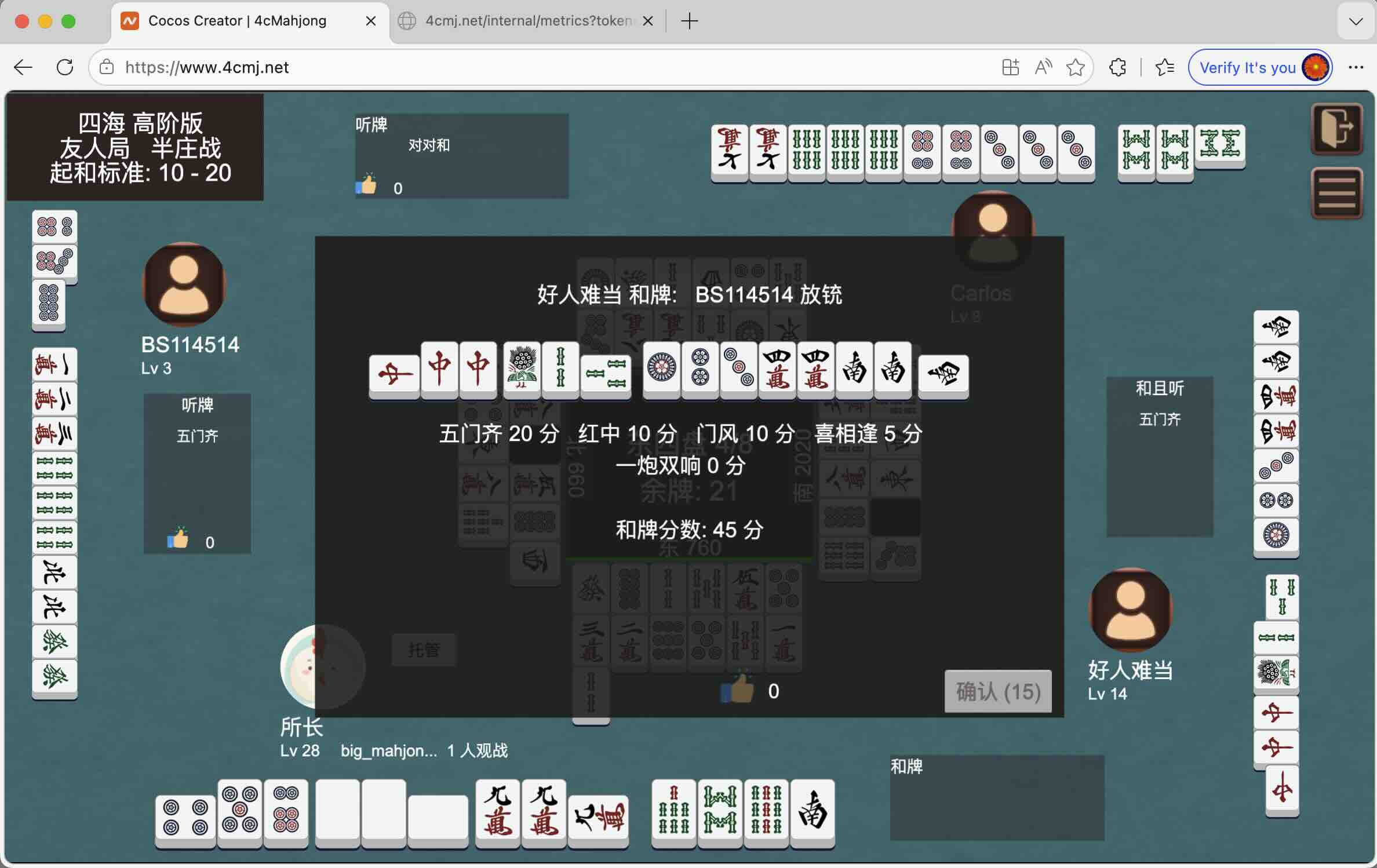
The highest hand score is forty-five, so North's payment is calculated for a forty-five-point discard win.
Under Four Seas payments, the winner of a discard win receives four times the hand score.
East comes first in turn order. With a thirty-point hand, East receives 30 × 4 = 120 points.
South follows with forty-five, exceeding East by fifteen. Those fifteen points are South's effective winning score: 15 × 4 = 60 points received.
Under Four Seas payments, West, who neither discarded the winning tile nor won, also pays one hand-score amount, capped at fifty points. The highest winning score is forty-five, so North pays forty-five points.
Finally, the discarder's loss is 120 + 60 − 45 = 135 points. The four players' results are shown below.
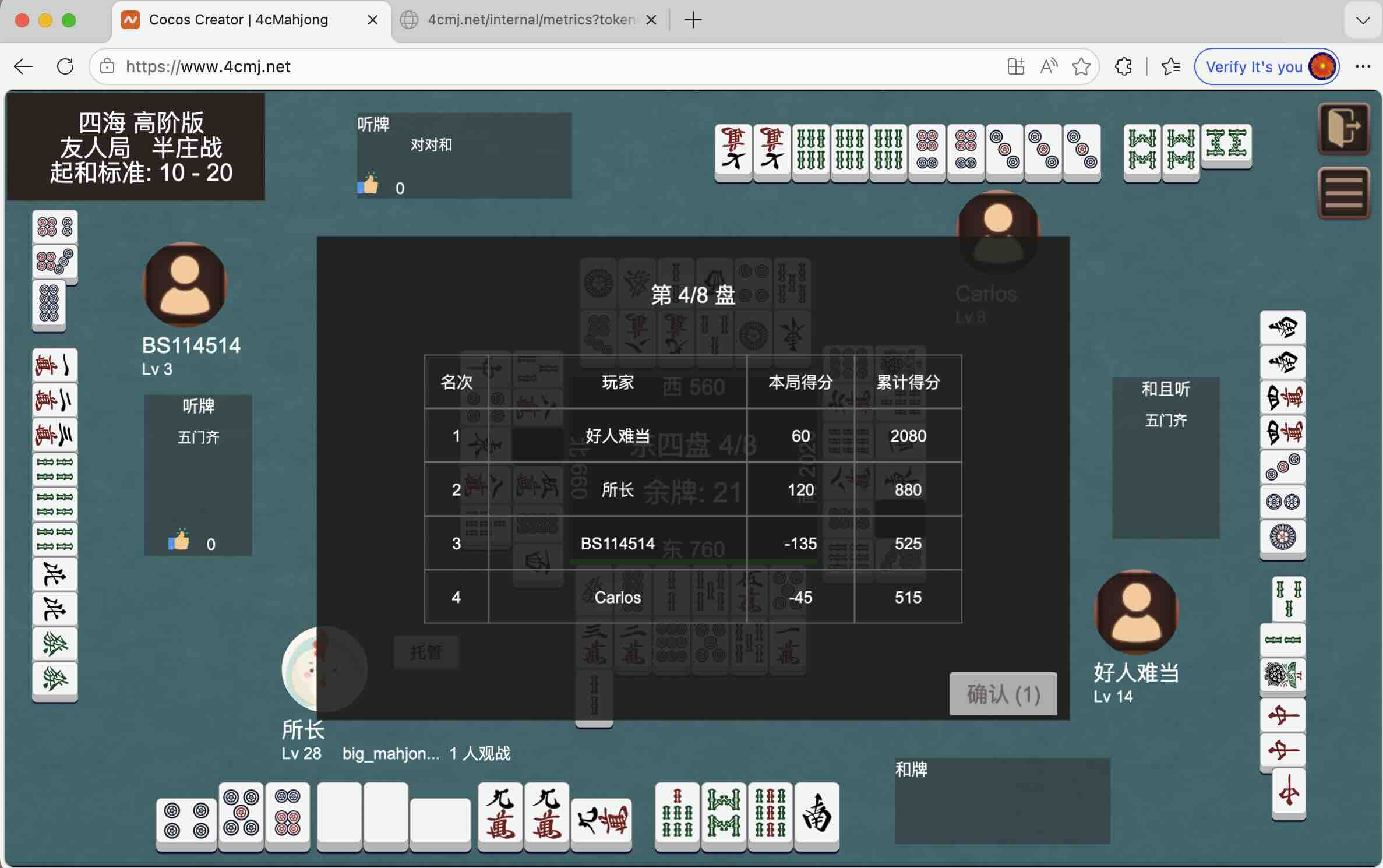
We can use this example to compare the three methods. The table considers both the original case and the case with East's and South's hand scores reversed.
| Hand scores | Method | North (discarder) | East | South | West |
|---|---|---|---|---|---|
| East 30, South 45 | Head-bump | -60 | 120 | -30 | -30 |
| East 30, South 45 | Score priority without excluding wins | -135 | 120 | 60 | -45 |
| East 30, South 45 | Multiple full wins | -250 | 120 | 180 | -50 |
| East 45, South 30 | Head-bump | -90 | 180 | -45 | -45 |
| East 45, South 30 | Score priority without excluding wins | -135 | 180 | 0 | -45 |
| East 45, South 30 | Multiple full wins | -250 | 180 | 120 | -50 |
In either case, East, the first winner, receives the same amount. West, who neither wins nor deals in, is also affected only slightly. The main impact falls on the discarder and the second winner. The different methods essentially distribute gains and losses between those two players.
Moving from head-bump to score priority without excluding wins, and then to multiple full wins, increases the discarder's loss and transfers the extra points to the second winner. Under head-bump, the second claimant still loses points, just like West, effectively denying the achievement of winning. Under multiple full wins, the discarder's loss almost doubles. Score priority without excluding wins lies between these extremes and ensures that even a second winner with a smaller hand than the first does not lose points.
This Four Seas innovation considers the responsibilities and interests of the discarder and all winners, offering a more balanced arrangement that is easier for everyone to accept.
Originally published in Chinese on Zhihu · Zhihu revision 2026-05-10