Added to this site · 2026-09-16
The Height of Four Seas Aesthetics: Patterns Containing the Character Zhong
AI-assisted draft translation. Terminology is under review; please refer to the Chinese original if anything is unclear.
A New Aesthetic Element in Four Seas Mahjong: Linked Sequences and Triplets in One Suit and The Beauty of Four Seas Patterns: Names Inspired by Six Ancient Ritual Jades explored two-meld, three-meld, two-meld-times-two, and four-meld forms. Here we look for higher and more beautiful patterns.
Linked Dragon (连龙)
(Note: in the updated version 2.0, Linked Dragon as a separate pattern was replaced by Pure One-Suit plus All Consecutive.)
Four Consecutive T links two sequences and two triplets in one suit across eight ranks. If the pair consists of the remaining rank in that suit, the result is two sequences, two triplets, and a pair covering all nine ranks consecutively. For example:
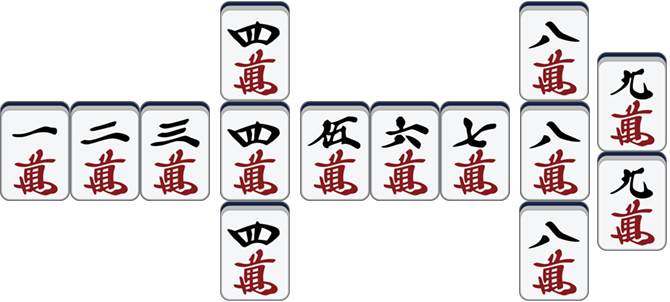
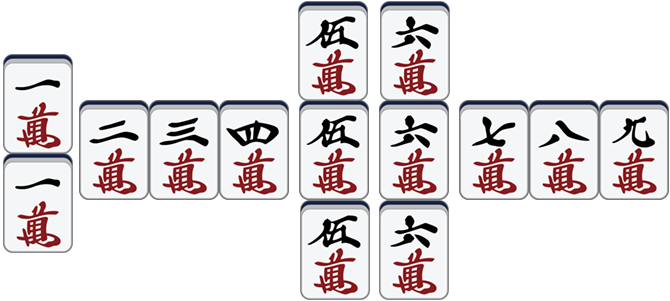
These examples add a pair at the remaining rank to Four Consecutive T. More generally, two sequences, two triplets, and a pair together occupy nine ranks. The five groups can be placed in any order while maintaining uninterrupted coverage of all nine ranks in one suit. Since Pure Straight likewise covers all nine ranks of a suit, this pattern can be called Linked Dragon.
As a whole-hand pattern, Linked Dragon can combine with several sequence, triplet, and linked sequence–triplet patterns:
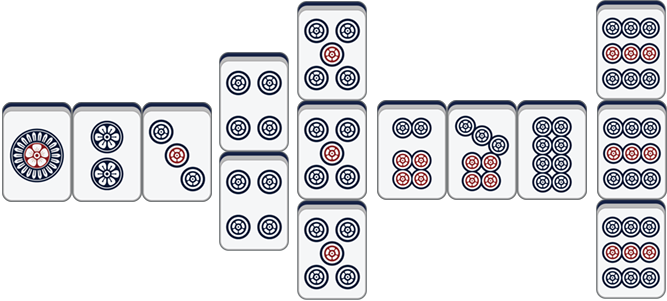
Linked Dragon + Horizontal H
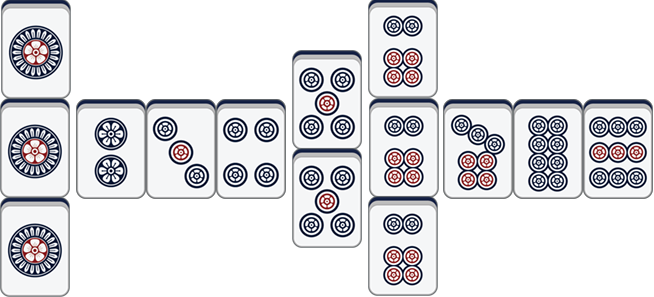
Linked Dragon + Consecutive T Twice
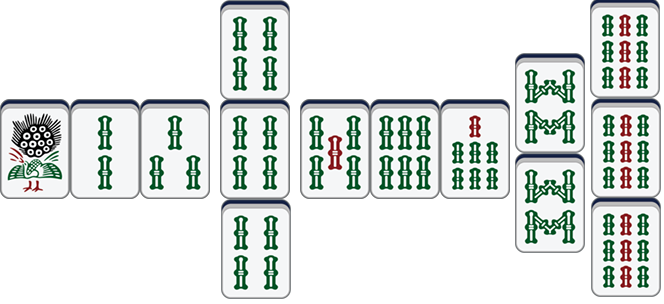
Linked Dragon + Horizontal Cross
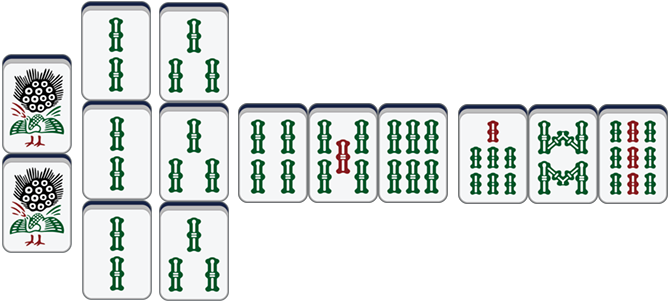
Linked Dragon + Little Three Consecutive Triplets + Consecutive T + Half Straight
King Straight (王龙)
We have established Linked Dragon as a family based on continuity: two sequences, two triplets, and a pair in one suit covering all nine ranks. Combinatorial counting gives thirty different orders for these five groups; the examples above illustrate some of them. Among all these configurations, two are symmetric across the full range of ranks 1–9 and have greater aesthetic appeal.
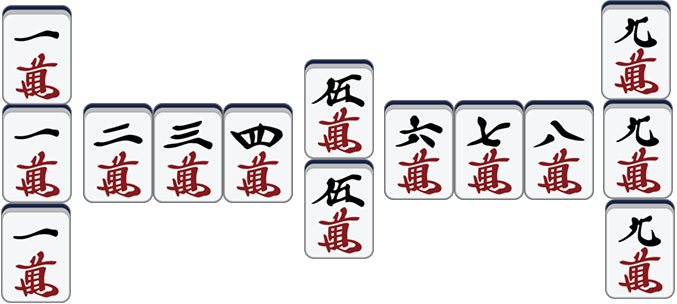
King Straight 1 (大王龙)
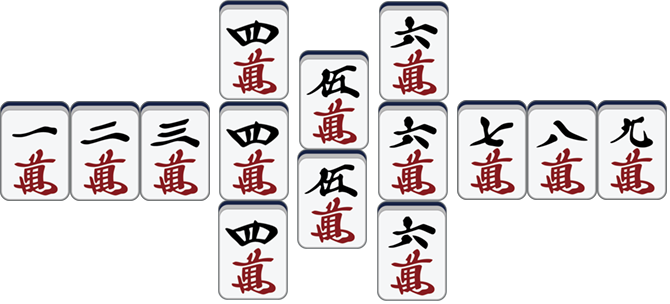
King Straight 2 (小王龙)
The first is a form of Nine Gates: the nine-gates structure with an additional five. The second is a new, perfectly balanced pattern. Rotating the first arrangement ninety degrees produces a shape resembling 王, the Chinese character for “king.” In the second, the central 4–5–6 arrangement also resembles 王 after rotation. They are therefore collectively named King Straight, with the first called the greater form and the second the lesser form.
Big China (大中华)
Adding a pair in the same suit to Four Consecutive T produced the more beautiful Linked Dragon and King Straight families. Can adding a pair to Jade Cube or Jade Disc produce something even more striking? When the pair matches the middle rank of Jade Cube, the entire arrangement forms the Chinese character 中. Like Jade Cube, it can begin at any of five ranks, 1 through 5.
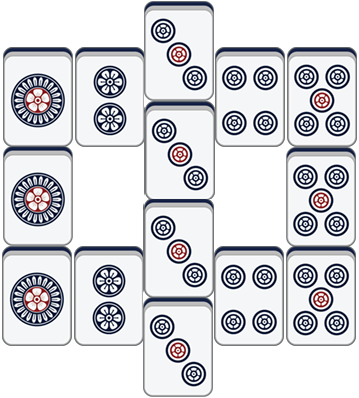
Big China
Fourteen tiles fit precisely into the character 中, zhong, which means “middle” or “center” and is the first character in the Chinese name for China. This pattern's exceptional beauty and difficulty evoke mahjong's Chinese cultural inheritance. I propose naming it Big China.
This completes the linked sequence–triplet family in one suit. Its values generally rise with difficulty:
Consecutive T: 5; Horizontal Cross: 40; Horizontal H: 60; Consecutive T Twice: 60; Four Consecutive T: 80.
Linked Dragon: 120; Jade Cube: 160; Jade Disc: 240; King Straight: 240; Big China: 480.
Originally published in Chinese on Zhihu · Zhihu revision 2024-12-31