Added to this site · 2026-09-16
The Beauty of Four Seas Patterns: Names Inspired by Six Ancient Ritual Jades
AI-assisted draft translation. Terminology is under review; please refer to the Chinese original if anything is unclear.
This article follows A New Aesthetic Element in Four Seas Mahjong: Linked Sequences and Triplets in One Suit, exploring other four-meld combinations in this new family.
Unlike combinations consisting entirely of sequences or triplets, the two-meld Consecutive T has left and right forms. Four Consecutive T has four structures: sequence–triplet–sequence–triplet, sequence–triplet–triplet–sequence, triplet–sequence–triplet–sequence, and triplet–sequence–sequence–triplet. In fact, one Left Consecutive T and one Right Consecutive T in the same suit, totaling four melds, can also form several more beautiful arrangements. These are explored below.
Four new forms
The first form combines a Right Consecutive T starting at rank 1 (111p 234p) with a Left Consecutive T starting one rank farther right, at rank 2 (234p 555p). Here, p denotes dots. Together they make a rectangle five tiles long and three tiles high, enclosing an opening three by one. The two sequences form Two Identical Sequences and make two sides of the rectangle, while the triplets make the other two. Its difficulty and beauty exceed those of the four Four Consecutive T forms. It spans five ranks and can begin at any rank from 1 through 5.
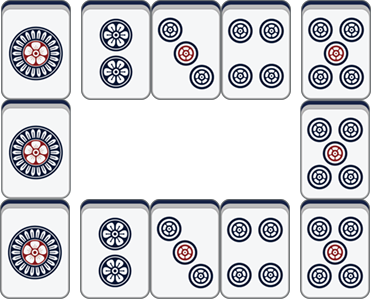
Form 1
For the second form, move the Right Consecutive T in form 1 one rank to the right, so that it begins at the same rank as the Left Consecutive T. This produces a four-by-four square with a two-by-two opening. Both the six and nine of bamboo occur four times without forming a kong, giving two Tile Hogs. This makes form 2 harder than form 1.
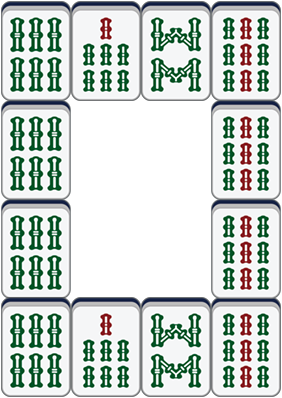
Form 2
Moving the Right Consecutive T in form 2 another one or two ranks to the right produces forms 3 and 4 below. Their central openings become progressively smaller, while their shapes retain central symmetry and radiate outward. Both also contain two Tile Hogs, putting them in the same difficulty class as form 2—an order of magnitude harder than form 1.
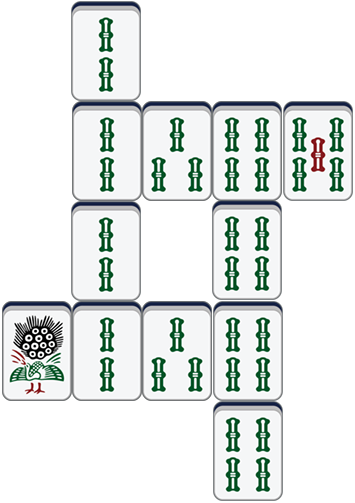
Form 3
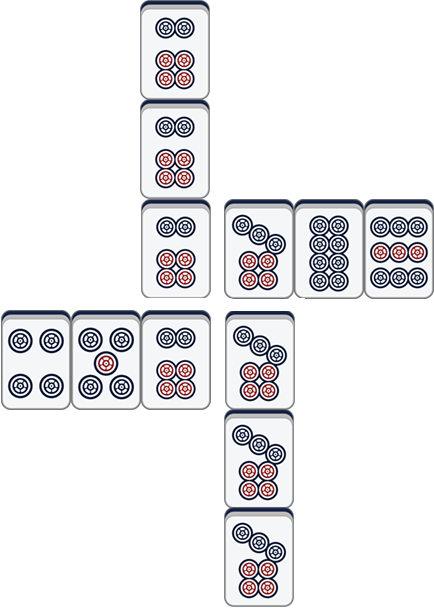
Form 4
These four beautiful and difficult forms are four-meld combinations in the same linked sequence–triplet family. They satisfy its structural rationale and deserve inclusion in Four Seas Expanded. Unlike the straightforward links of Consecutive T Twice and Four Consecutive T, these forms deserve carefully chosen names worthy of their beauty and difficulty.
Naming the patterns
Mahjong is a valuable inheritance of Chinese traditional culture. These four beautiful forms can be likened to precious treasures. Few objects were more highly esteemed in ancient China than jade, associated with good fortune, spiritual qualities, the gentle virtues of an exemplary person, and the owner's social standing.
Jade was fashioned into ritual objects, among which the most important were the bi disc and cong tube. A bi is a flat circular jade with a central hole. A cong has a square exterior, a circular central opening, and decoration around its outer surfaces. The ancient Chinese conception of a round heaven and square earth underlies the use of bi in rites for heaven and cong in rites for earth.
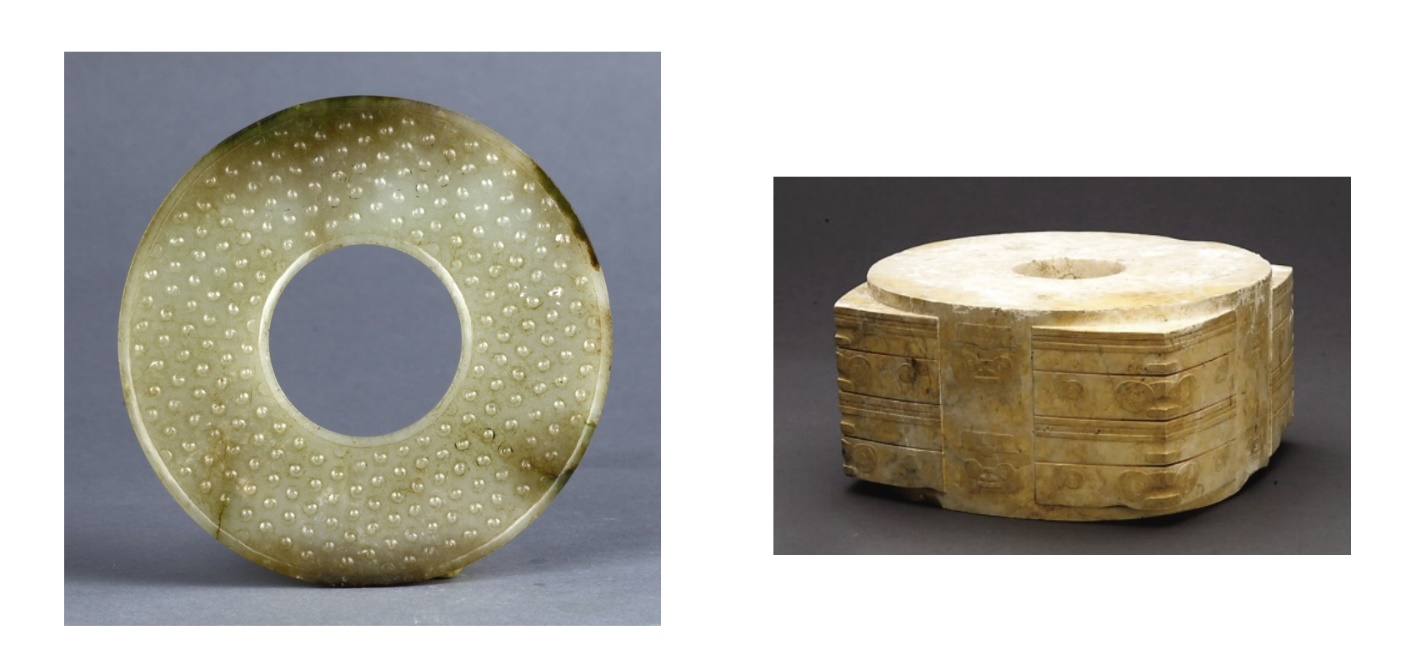
Now consider form 2. Its horizontal, vertical, and diagonal spans each contain four tiles, with a central opening two tiles across. It can be perceived as a square or a circle surrounding a circular opening, resembling a bi disc.
Form 1, five tiles long and three high, resembles a cong viewed from the side.
Forms 3 and 4, like form 2, contain two Tile Hogs and have similar difficulty. They can be viewed as transformations of form 2 with a smaller opening and a wider surrounding band.
Today, ring-shaped jades are often broadly called bi. Historically, apart from the notched jue, flat ring-shaped jades were distinguished as bi, huan, and yuan.
The “Explaining Utensils” chapter of the Erya states: “肉倍好谓之璧,好倍肉谓之瑗,肉好若一谓之环。”
Here, rou means the width of the surrounding band, and hao the diameter of the opening. When the band is twice the opening, the object is a bi; when the opening is twice the band, it is a yuan; when they are equal, it is a huan. The illustration compares their proportions and examples.
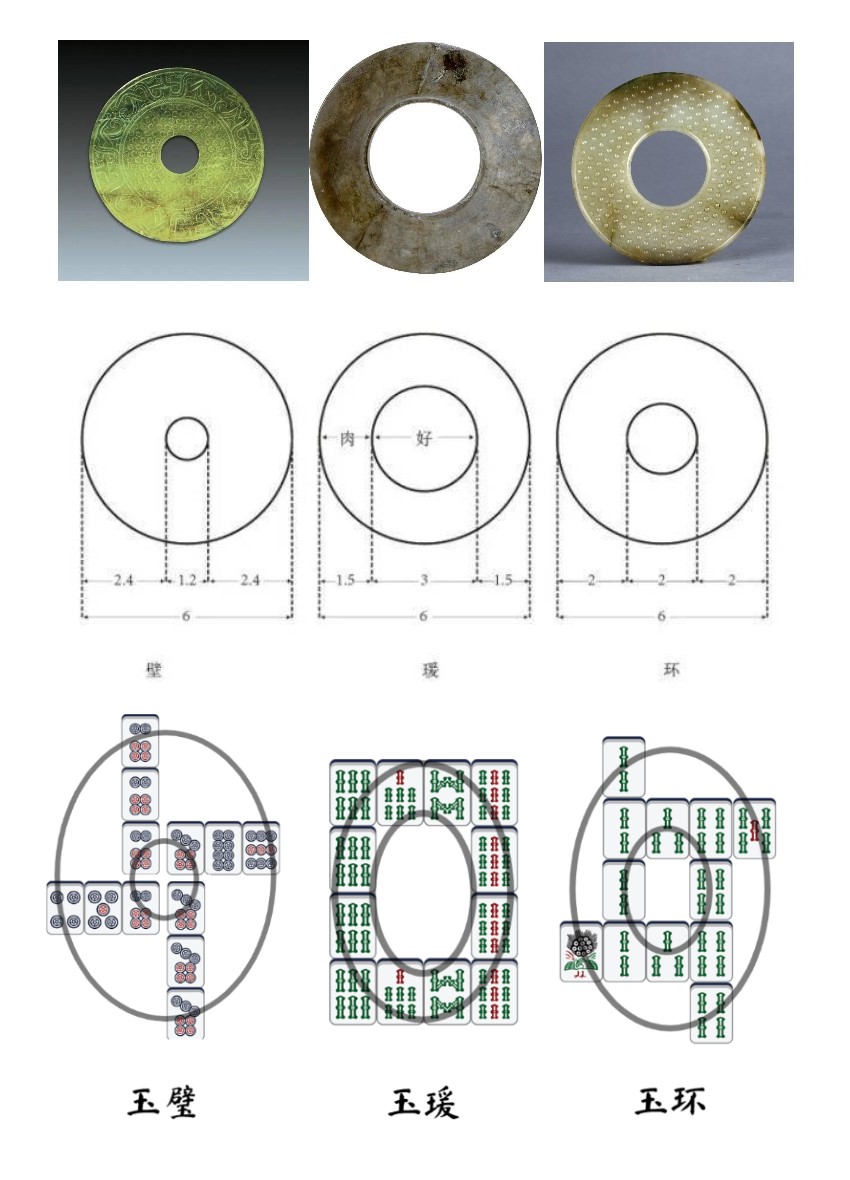
Forms 2–4 likewise come in three configurations with different relationships between opening and band. Adding circular outlines makes their resemblance to these jade types striking. It is a remarkable coincidence: the aesthetically meaningful forms produced by one Left and one Right Consecutive T correspond to the cong and to the three ring-shaped jades. We therefore call form 1 Jade Cube (玉琮, named after the cong), and group forms 2–4 under the single scoring pattern Jade Disc (玉璧). These two treasured objects give their names to the newly defined patterns.
Four Consecutive T
Having named the four new forms Jade Disc and Jade Cube, we can revisit the four configurations of Four Consecutive T through the same lens.
Ancient Chinese ritual jades were grouped as the “six objects.” The “Great Minister of Rites” section of the Rites of Zhou describes them:
以玉作六器,以礼天地四方,
以苍壁礼天,以黄琮礼地,
以青圭礼东方,以赤璋礼南方,以白琥礼西方,以玄璜礼北方。
Six jade objects honor heaven, earth, and the four directions: an azure bi for heaven, a yellow cong for earth, a green gui for the east, a red zhang for the south, a white hu for the west, and a dark huang for the north.
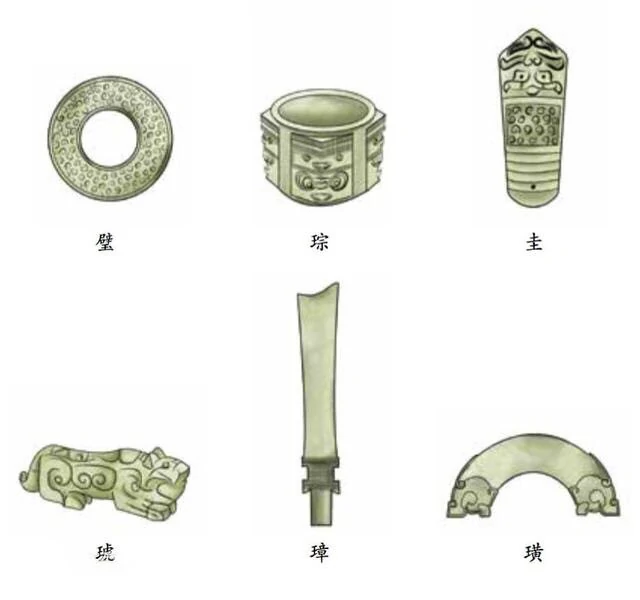
The six ritual jades
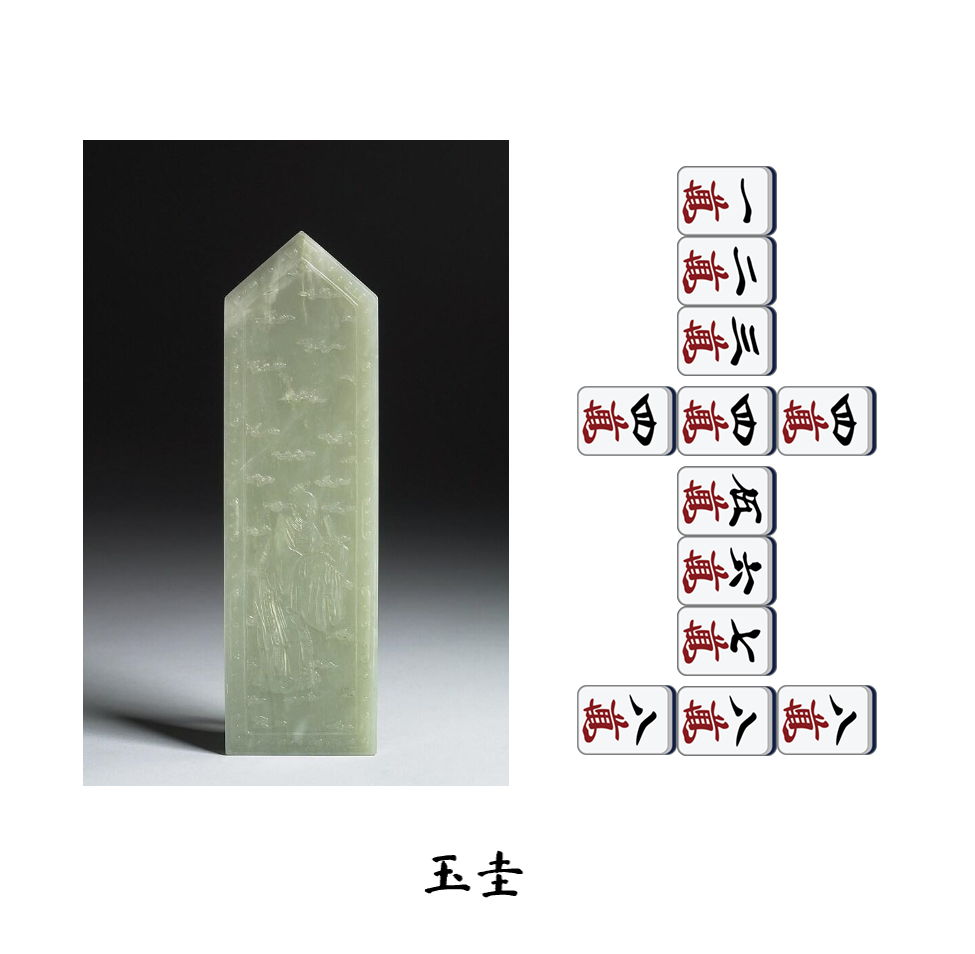
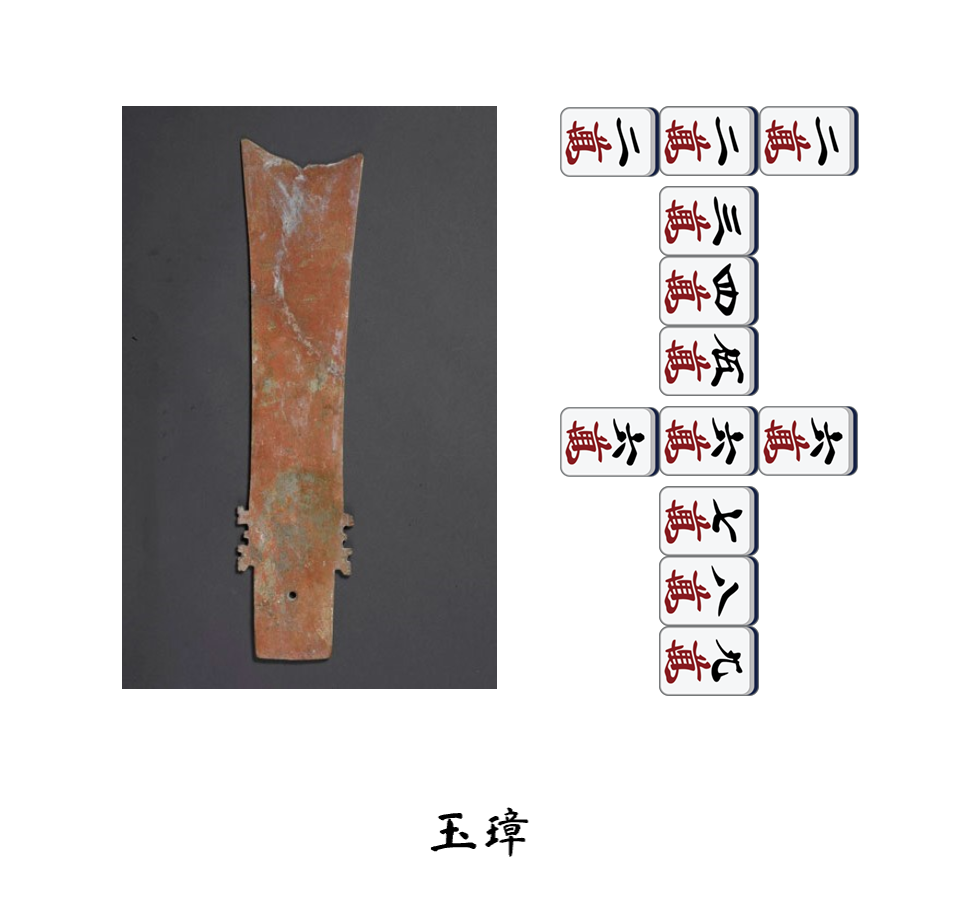
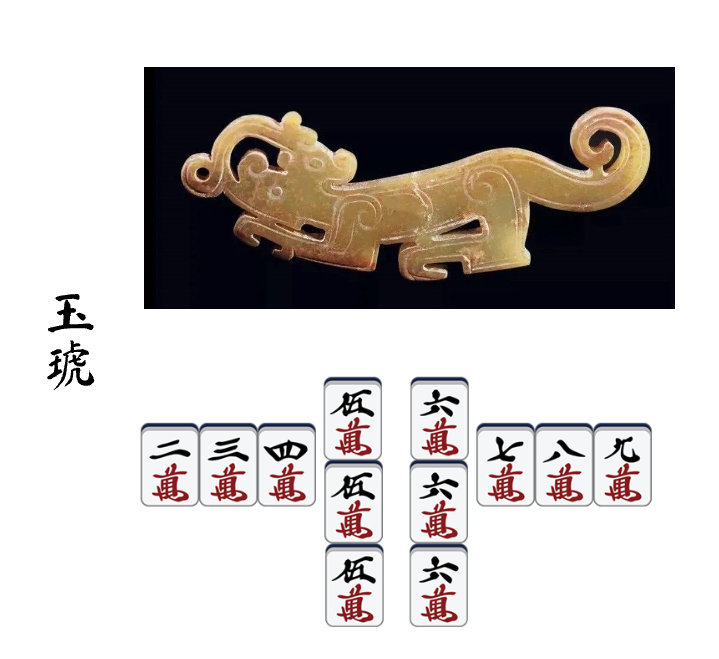
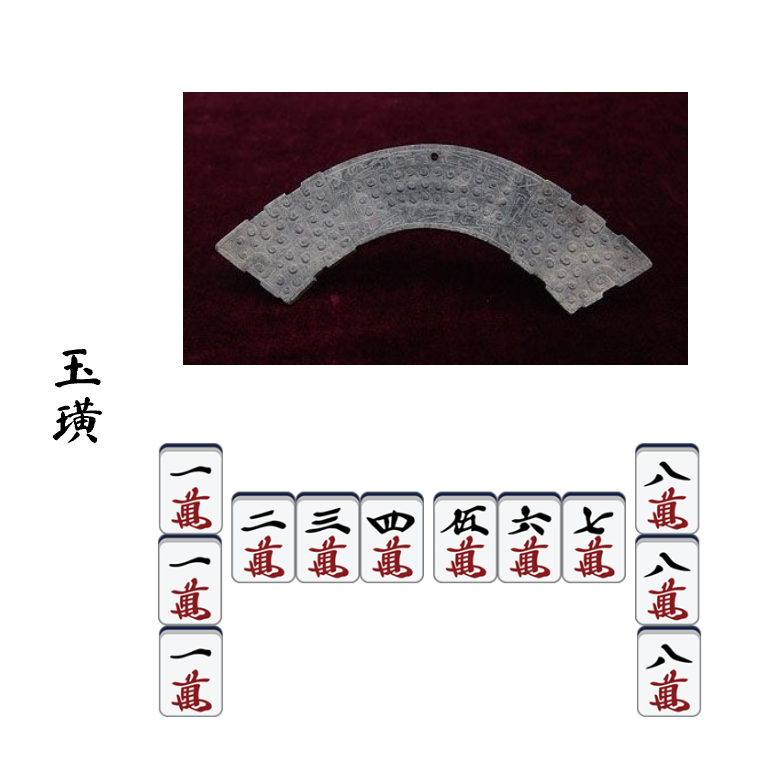
Alongside the bi for heaven and the cong for earth are four jades for the directions: gui, zhang, hu, and huang. Slightly rearranging the four forms of Four Consecutive T gives each a resemblance to one of these objects.
Bi: an object of authority for honoring heaven
The bi is the most familiar ancient jade form: a flat disc with a hole at its center. It appeared early among ritual objects and remained in use longest, earning its place at the head of the six. Since heaven was conceived as round, the bi was used in rites for heaven.
Cong: an auspicious object for honoring earth
A cong has a square exterior and round interior. These hollow jade tubes vary in height and were specifically used in rituals honoring earth.
Gui: a tablet of audience for honoring the east
Gui tablets have two principal shapes: a flat-topped type, flat at both ends, and a pointed type with a flat base. Their earliest purpose was as tokens of status granted by the Zhou king to regional lords, who carried them when attending court as a sign of solemnity.
Zhang: a blade-shaped object for honoring the south
A zhang immediately resembles a sword. This flat, elongated jade has a perforation at one end and an oblique blade at the other. It originally served as an offering to mountain and water deities during hunts. It was buried at the foot of a mountain when hunting there, or cast into water when hunting by a river, to seek divine protection.
Hu: a token of trust for honoring the west
The hu was the last of the six forms to appear. It is a tiger-shaped jade with rich decoration and intricate carving in the round, relief, and incised lines. Its fine, difficult-to-reproduce workmanship helped make it a token of trust. The tiger tally used to authorize troop movements developed from this form.
Huang: an ornamental object for honoring the north
Huang are the most numerous and varied of the six ritual jade types. Their principal shapes are semicircular plaques and narrower arcs. Early examples were pendants worn by ritual specialists and also symbolized women in the Neolithic period. They later developed from personal accessories into decorative objects.
In ritual importance, the ordering is bi for heaven > cong for earth > the four directional jades.
In hand-building difficulty, the corresponding ordering is Jade Disc > Jade Cube > Four Consecutive T.
This is another fitting coincidence.
The four new forms made from Left and Right Consecutive T possess considerable beauty and difficulty. Ancient ritual jade names provide Jade Disc for three configurations and Jade Cube for the fourth. The four configurations of Four Consecutive T also resemble gui, zhang, hu, and huang—a correspondence that almost feels destined.
Originally published in Chinese on Zhihu · Zhihu revision 2024-12-31