Added to this site · 2026-09-16
A New Aesthetic Element in Four Seas Mahjong: Linked Sequences and Triplets in One Suit
AI-assisted draft translation. Terminology is under review; please refer to the Chinese original if anything is unclear.
Four Seas Mahjong's Advanced Edition contains 81 scoring patterns, including 75 structural patterns across twenty hand-building families. Each family rests on a structural rationale—an aspect of beauty in a mahjong hand. These aesthetics concern suit, hand structure, and tile rank along four dimensions: identity, symmetry, completeness, and continuity. Pure Straight, for example, comprises consecutive sequences in one suit; Three Similar Triplets uses triplets of the same rank in three suits; and All Types completes the five tile categories of characters, dots, bamboo, dragons, and winds. See The Scope and Standards of Hand-Building Aesthetics.
One way to enhance the enjoyment and hand-building possibilities of Four Seas is to discover aesthetically meaningful patterns beyond the existing twenty families. Starting from a traditional pattern, I identified a new element consistent with these aesthetic principles, developing it into four families and nearly twenty new patterns. These expand the available routes and introduce several particularly beautiful limit hands.
A traditional pattern
The following example shows an uncommon traditional pattern: Horizontal Cross, whose Chinese name, 双飞燕, means “two flying swallows.”

Its definition is “a triplet of rank 4, 5, or 6, flanked by two sequences that extend consecutively before and after that rank without containing it.” Neither the usual arrangement nor the definition immediately reveals the central feature. Arrange the triplet vertically, as below, and the pattern becomes clear: a sequence, a triplet, and another sequence in one suit, covering consecutive ranks without overlap. The two sequences resemble a swallow's outstretched wings.
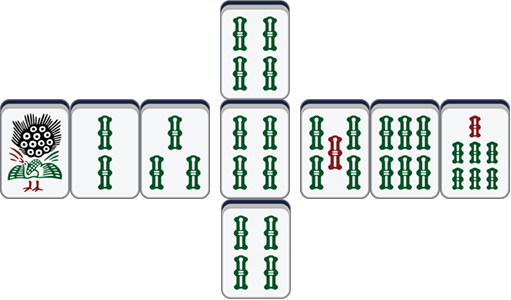
Existing combination patterns generally use only sequences, as in Three Similar Sequences and Half Straight Twice, or only triplets, as in Three Consecutive Triplets and Big Three Dragons. Horizontal Cross combines both. It exploits the fact that sequences and triplets can cover consecutive ranks: a sequence spans three ranks, while a triplet occupies one. Horizontal Cross spans seven ranks in one suit, so it can begin at rank 1, 2, or 3.
If sequence–triplet–sequence forms Horizontal Cross, the same principle allows triplet–sequence–triplet to form another pattern, called Horizontal H.
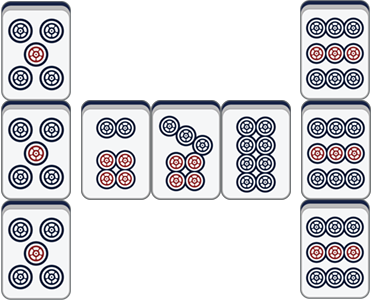
Horizontal H also uses three melds, but spans five ranks and can therefore begin at any rank from 1 through 5.
Both patterns link three melds of sequences and triplets in one suit. Linked sequences and triplets in one suit thus become a new aesthetic element. This structural rationale brings the two meld types together, increasing the role and scope of triplets in a scoring landscape dominated by sequence combinations.
Comparison with other one-suit combinations
Whether a family belongs in a ruleset—particularly one such as Four Seas, already containing 75 structural patterns in twenty families—depends not only on its intrinsic beauty, but also on its overlap and relationships with existing patterns and its effect on the entire hand-building system. For example, three or four triplets spaced two ranks apart in one suit have some beauty and difficulty, but overlap heavily with All Odd and All Even. Those whole-hand patterns cover more possibilities, so separately rewarding the spaced triplets adds little and risks duplicate rewards. Mixed Shifted Chows is another example: it has limited beauty and difficulty, readily changes into Mixed Triple Chow or Mixed Straight, and greatly expands the share of three-suit routes. This imbalance helps explain why three-suit patterns account for so many wins in Chinese Official Mahjong.
The table compares the tile positions and quantities used by three-meld combinations in one suit:
| Pattern / rank | 1 | 2 | 3 | 4 | 5 | 6 | 7 | 8 | 9 |
|---|---|---|---|---|---|---|---|---|---|
| Pure Straight | 1 | 1 | 1 | 1 | 1 | 1 | 1 | 1 | 1 |
| Three Linked Sequences | 1 | 1 | 2 | 1 | 2 | 1 | 1 | ||
| Horizontal Cross | 1 | 1 | 1 | 3 | 1 | 1 | 1 | ||
| Three Shifted Sequences | 1 | 2 | 3 | 2 | 1 | ||||
| Horizontal H | 3 | 1 | 1 | 1 | 3 | ||||
| Three Identical Sequences | 3 | 3 | 3 | ||||||
| Three Consecutive Triplets | 3 | 3 | 3 |
Pure Straight spans nine ranks, Three Shifted Sequences spans five, and Three Identical Sequences and Three Consecutive Triplets span three. Horizontal Cross spans seven, filling the gap between Pure Straight and Three Shifted Sequences. Moving from Pure Straight to Horizontal Cross, from Horizontal Cross to Three Shifted Sequences, or from Three Shifted Sequences to Three Identical Sequences changes four tiles each time.
Another seven-rank pattern is Three Linked Sequences, corresponding to Pure Shifted Chows with a two-rank step in Chinese Official Mahjong. It consists entirely of sequences and readily changes into one-step Three Shifted Sequences or three-step Pure Straight. Like Mixed Shifted Chows, it is excessively flexible while offering less difficulty and beauty. Moreover, Three Linked Sequences and Three Shifted Sequences can both occur in a hand such as 123 234 345 567. This creates scoring questions and demonstrates their substantial overlap. Horizontal Cross, by contrast, includes a triplet; restrictions on changing between triplets and sequences make its construction more distinct. For a pattern spanning seven ranks, Horizontal Cross therefore offers advantages over Three Linked Sequences.
Horizontal H and Three Shifted Sequences both span five ranks, but emphasize different tiles. Three Shifted Sequences requires repeated tiles in the middle three ranks, whereas Horizontal H needs triplets at the two ends. They differ by eight tiles, making them complementary rather than overlapping.
Horizontal Cross and Horizontal H fill gaps in the existing routes, offering new opportunities for different starting hands without excessive overlap or easy conversion into existing patterns.
The linked sequence–triplet family
Hand-building mahjong treats the family, rather than the individual scoring pattern, as the unit of construction. Having established that Horizontal Cross and Horizontal H fit both the aesthetic principles and the broader system, we should identify their lower and higher forms and build a complete family.
Two-meld combinations
The lower two-meld form has two possibilities: sequence followed by triplet, or triplet followed by sequence. Because the shape resembles the Chinese character 丁, it is named Consecutive T. Sequence–triplet is Left Consecutive T, while triplet–sequence is Right Consecutive T.
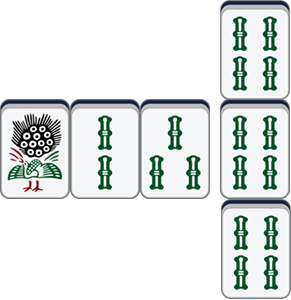
Left Consecutive T
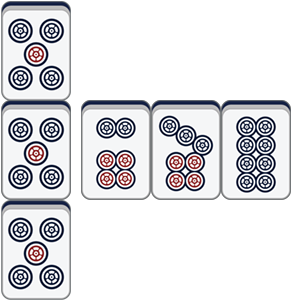
Right Consecutive T
Two melds, twice
With Consecutive T established as the two-meld unit, higher forms can be developed systematically. Consecutive T Twice contains two such groups, without requiring the same suit or the same left/right orientation. The two examples above together form this pattern. Like Two Identical Sequences Twice and Half Straight Twice, it usually involves two suits.
| Left Consecutive T | Right Consecutive T |
|---|---|
| |
Consecutive T Twice
Four-meld combinations
Unlike combinations consisting entirely of sequences or triplets, linked sequence–triplet patterns can have multiple structures because the meld types span different numbers of ranks. Two-meld Consecutive T already has left and right forms. Similarly, four melds can follow sequence–triplet–sequence–triplet or triplet–sequence–triplet–sequence:
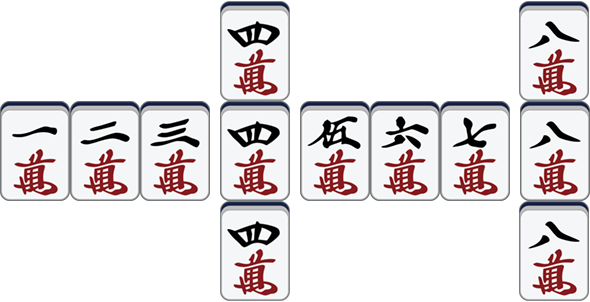
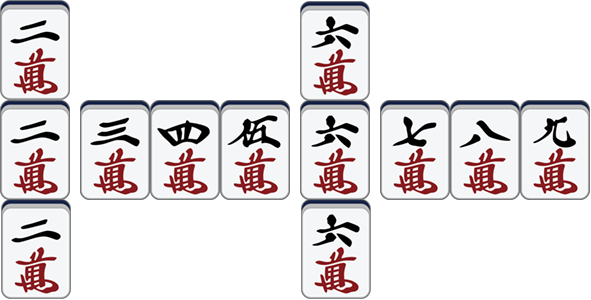
Sequence–triplet–triplet–sequence and triplet–sequence–sequence–triplet have the same combination count, difficulty, and aesthetic standing. They share the same rationale: two sequences and two triplets in one suit, arranged in different orders to cover consecutive ranks without overlap.
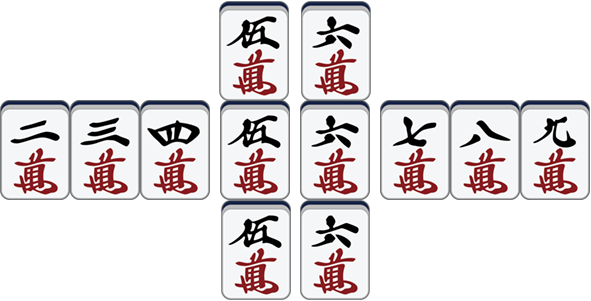
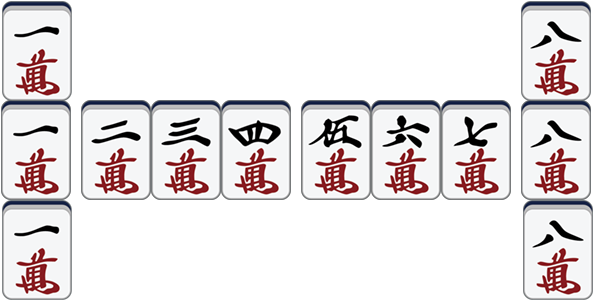
These four forms are collectively called Four Consecutive T. It must be distinguished from Consecutive T Twice: Four Consecutive T requires one suit and complete continuity across all four melds. Consecutive T Twice requires only two internally linked groups, whose suits and ranks need not relate. Four Consecutive T necessarily contains Consecutive T Twice and is its higher form.
Starting from Horizontal Cross, this article introduced linked sequences and triplets in one suit as a new aesthetic element and began constructing its family systematically: two-meld Consecutive T; three-meld Horizontal Cross and Horizontal H; two-meld-times-two Consecutive T Twice; and four-meld Four Consecutive T.
Originally published in Chinese on Zhihu · Zhihu revision 2024-12-31