Added to this site · 2026-09-16
Concealed Discard: An Original Four Seas Mahjong Mechanism
AI-assisted draft translation. Terminology is under review; please refer to the Chinese original if anything is unclear.
Mahjong combines attack and defense. Trying to complete your own hand is attack; delaying other players' wins, especially avoiding dealing in, is defense. Good rules balance the two. Players should neither pursue their own win while ignoring all three opponents nor make avoiding a deal-in so important that they readily abandon their own hand. Every decision should weigh the rewards and risks of attack and defense to maximize the expected return.
A common dilemma arises when you are building a large hand and are ready, or one tile away from ready, but draw a tile that is probably dangerous and could give an opponent a large win. Abandoning your hand feels disappointing, while discarding the dangerous tile risks dealing in. Suppose you are ready with Pure One-Suit in dots and can clearly see that the player after you is building Pure One-Suit in characters. You draw a character tile. Neither keeping it and giving up your win nor risking the discard feels good. The other player may face the same dilemma: when building Pure One-Suit, fewer than one in three draws will be in the desired suit. If both players fold, the hand may well end in an exhaustive draw.
Each player's choice may be reasonable when seeking the highest expected return. Yet from the perspective of hand-building mahjong—completing more large hands and increasing the win rate—it is a lose–lose outcome. Could a better mechanism reduce frustration, increase both winning scores and the win rate, and also enrich competition?
Four Seas Mahjong proposes a new mechanism: Concealed Discard. Once per hand at most, each player may discard a tile face down in a designated position. Unlike a normal discard, its identity is hidden, and nobody may claim it for a sequence, triplet, kong, or win. The next player draws from the wall and play continues. If nobody wins during normal play, concealed discards are revealed in the order in which they were made. Each is treated as a discard by its original player, and the other three may claim it to win, but not to form a sequence, triplet, or kong. A win on a concealed discard scores half the normal amount. This way of winning is evocatively called Silver Lining. To ensure that there is a final discard after the last wall tile, the player who draws that last tile cannot conceal their final discard. Concealed discards are revealed and checked for wins only after nobody claims the final ordinary discard.
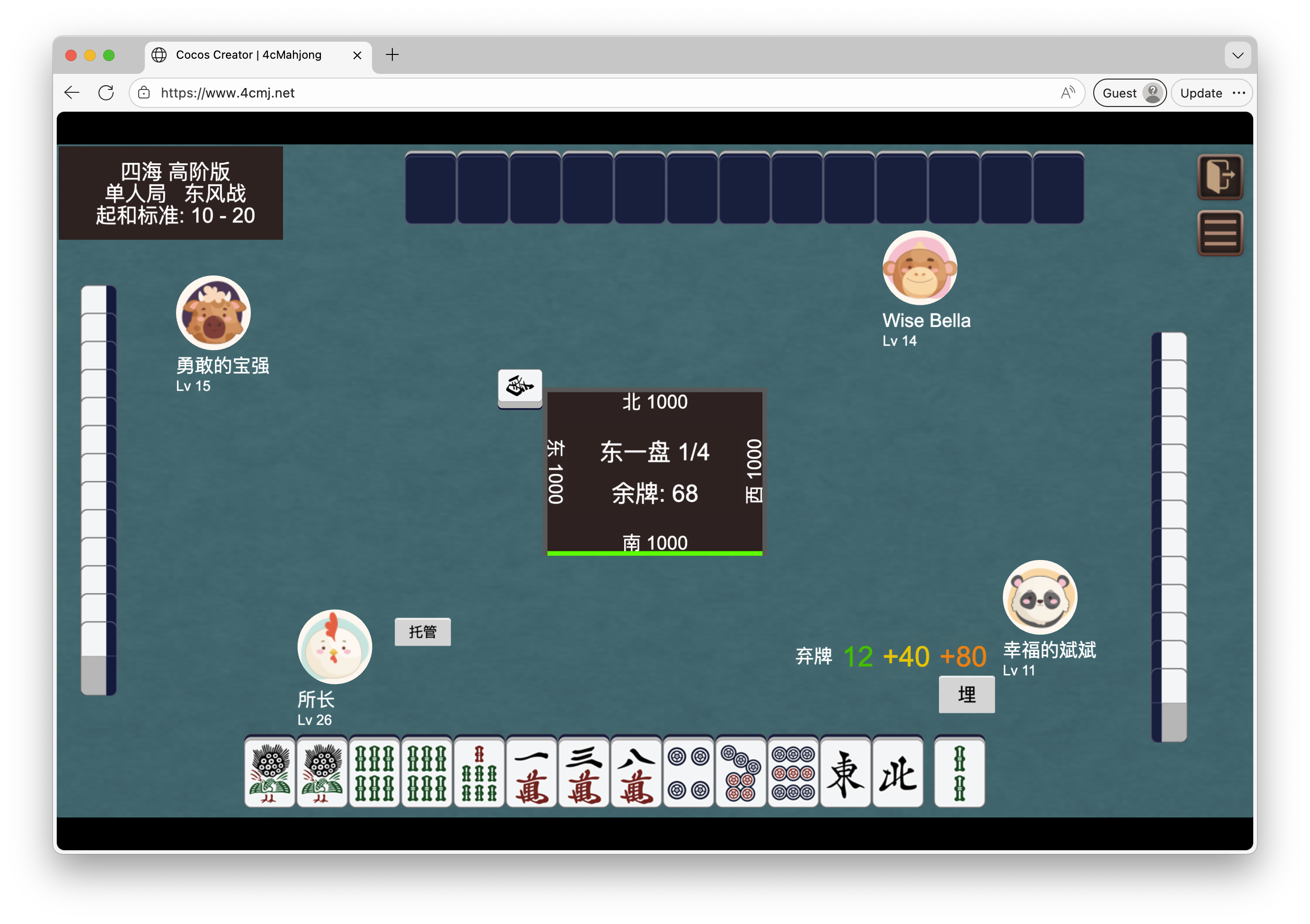
On the Four Seas platform, the “埋” button appears during your turn and disappears after you use it.
In the dilemma above, a player can judge the tile's danger and conceal it to get through the turn, hoping to complete their own hand before the wall runs out. Even if the concealed tile later deals in, the loss is halved. Risk is reduced while the potential reward increases substantially. Players gain more opportunities to build and complete large hands instead of being forced to fold, improving the enjoyment of play.
For a player waiting on the concealed tile, the eventual win pays only half. But the decision to conceal it suggests that the tile is particularly dangerous—for example, an unseen tile late in the hand—or that the wait is conspicuous, as with Pure One-Suit. Without this mechanism, the opponent might simply fold, making the win even less likely. A concealed discard does not prevent a self-draw win or a win on another player's discard, and it will still be revealed if ordinary play ends without a winner. The mechanism thus trades half the score for an increased chance of winning.
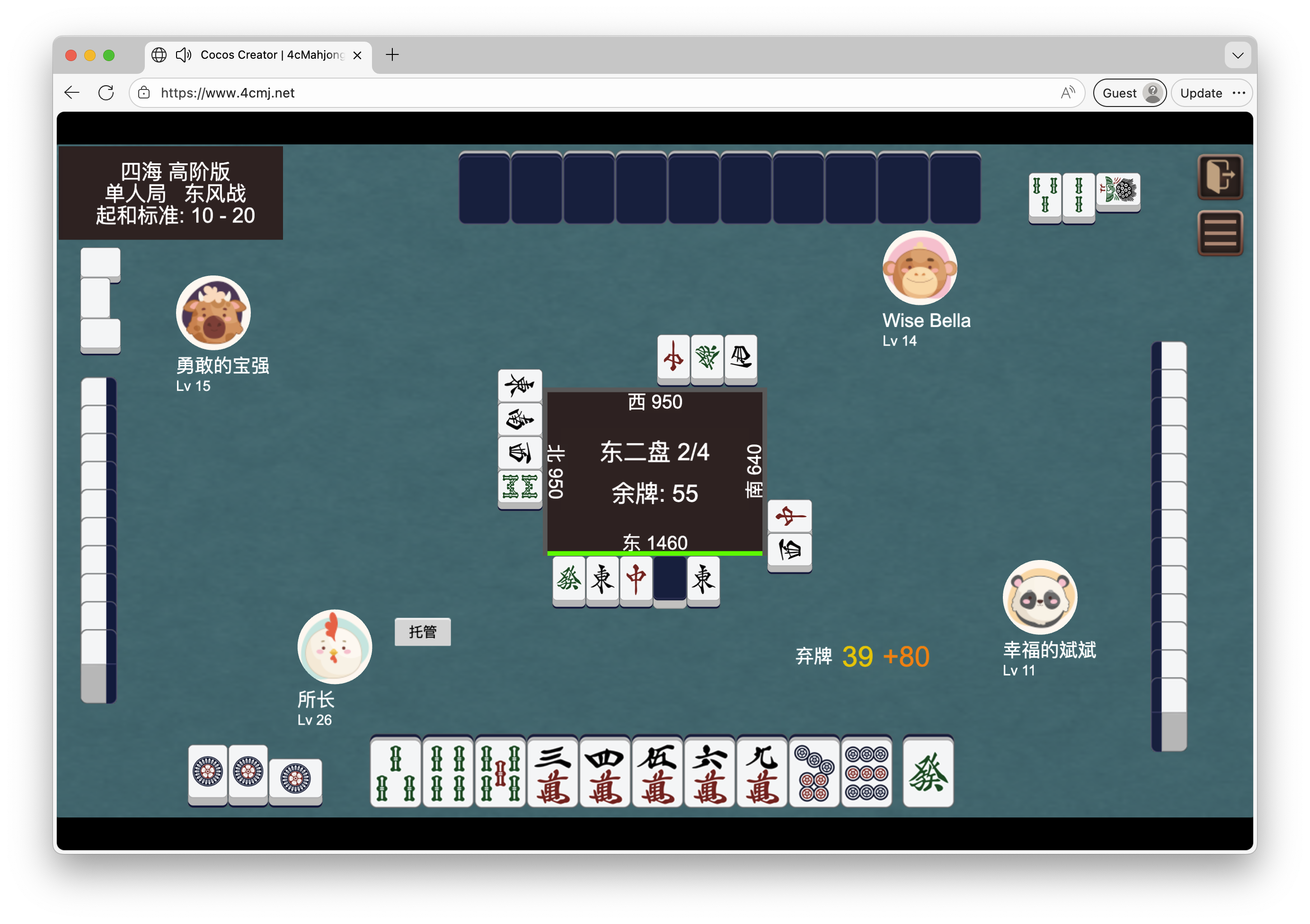
The concealed tile is placed face down neatly among the player's other discards and revealed at the end of the hand.
Concealed Discard encourages closer attention to attack–defense decisions, particularly dangerous tiles. Each player has only one opportunity per hand, but faces three opponents pursuing different patterns and waiting on different tiles. Estimating when each opponent becomes ready, their hand value and waits, and comparing these with the risk and reward of your own hand all influence when and what to conceal. Because a concealed tile that deals in still costs half the normal amount, folding without using the option is sometimes better. Without changing mahjong's basic mechanism or pace, Concealed Discard adds meaningful choices and depth, strengthens the interaction between attack and defense, and expands the skills available to players.
Across games, revealing concealed tiles at the end raises the win rate and reduces exhaustive draws. Our preliminary statistics for Four Seas games using this rule put Silver Lining at 4–5% of hands. The exhaustive-draw rate fell from about 15% to about 11%, roughly matching the frequency of wins on concealed discards.
The mechanism also encourages hand-building and larger hands, noticeably increasing average winning scores. Wins on concealed discards are often high-scoring hands such as Pure One-Suit or All Terminals and Honors. Revealing concealed tiles in order at the end also creates a sense of ceremony. The winner is naturally delighted. Although the player who concealed the tile has dealt in, correctly identifying an opponent's dangerous tile validates their judgment, and their loss is halved. In that sense, they are not simply a loser either. Concealed Discard can produce a three-way benefit: for the winner, the discarder, and the game itself.
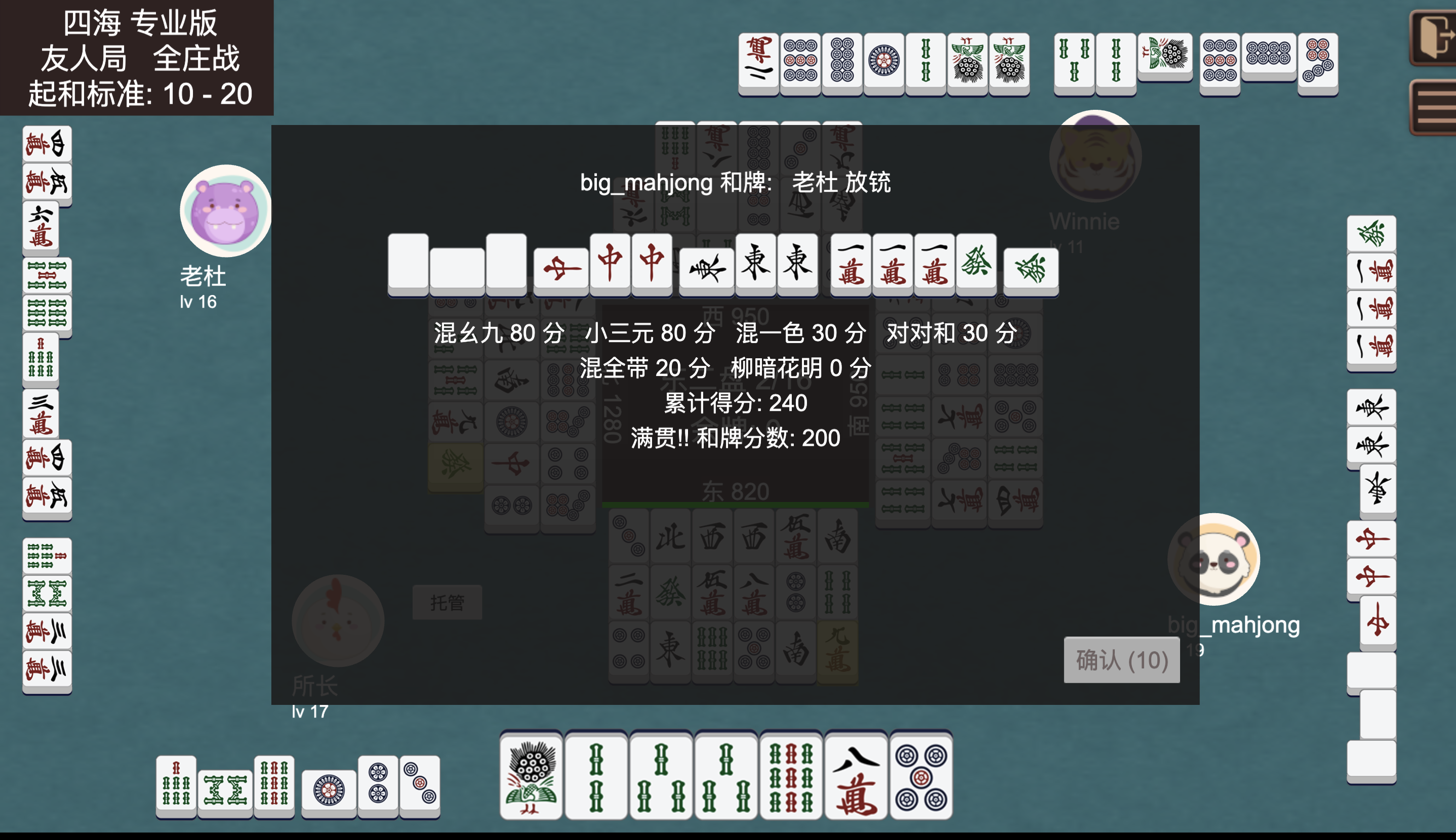
Concealed tiles are revealed and highlighted after play. Silver Lining appears in the pattern list with zero points to facilitate statistical tracking.
In our experience playing Four Seas, the mechanism has been widely welcomed. Implementing it on an online platform requires a separate set of program modules. It was among the features most repeatedly requested for the Four Seas platform.
Four Seas Mahjong's original Concealed Discard mechanism increases both the overall win rate and winning scores, adds strategic depth, and makes the balance between attack and defense more enjoyable.
Originally published in Chinese on Zhihu · Zhihu revision 2026-03-10