Added to this site · 2026-09-16
Four Seas Standard Rules Explained: Winning Requirements and Competition
AI-assisted draft translation. Terminology is under review; please refer to the Chinese original if anything is unclear.
See also:
Four Seas Mahjong (Standard): A Competitive Hand-Building Ruleset
Four Seas Standard Rules Explained: Scoring Patterns
The previous article presented the aesthetically compelling large hands included in Four Seas Standard. This article considers how the rules of play can help players build and complete those hands.
Raising the minimum winning score
First, the minimum winning score needs to rise. A higher threshold naturally raises the average score of winning hands and therefore increases the number of large hands. The chart below shows the distribution of winning scores for Chinese Official Mahjong on one platform. With an eight-point minimum, the median winning score is approximately eleven points, just above the threshold. This assumes an unchanged win rate, however: raising the threshold also increases the average number of turns needed to win and the frequency of exhaustive draws.
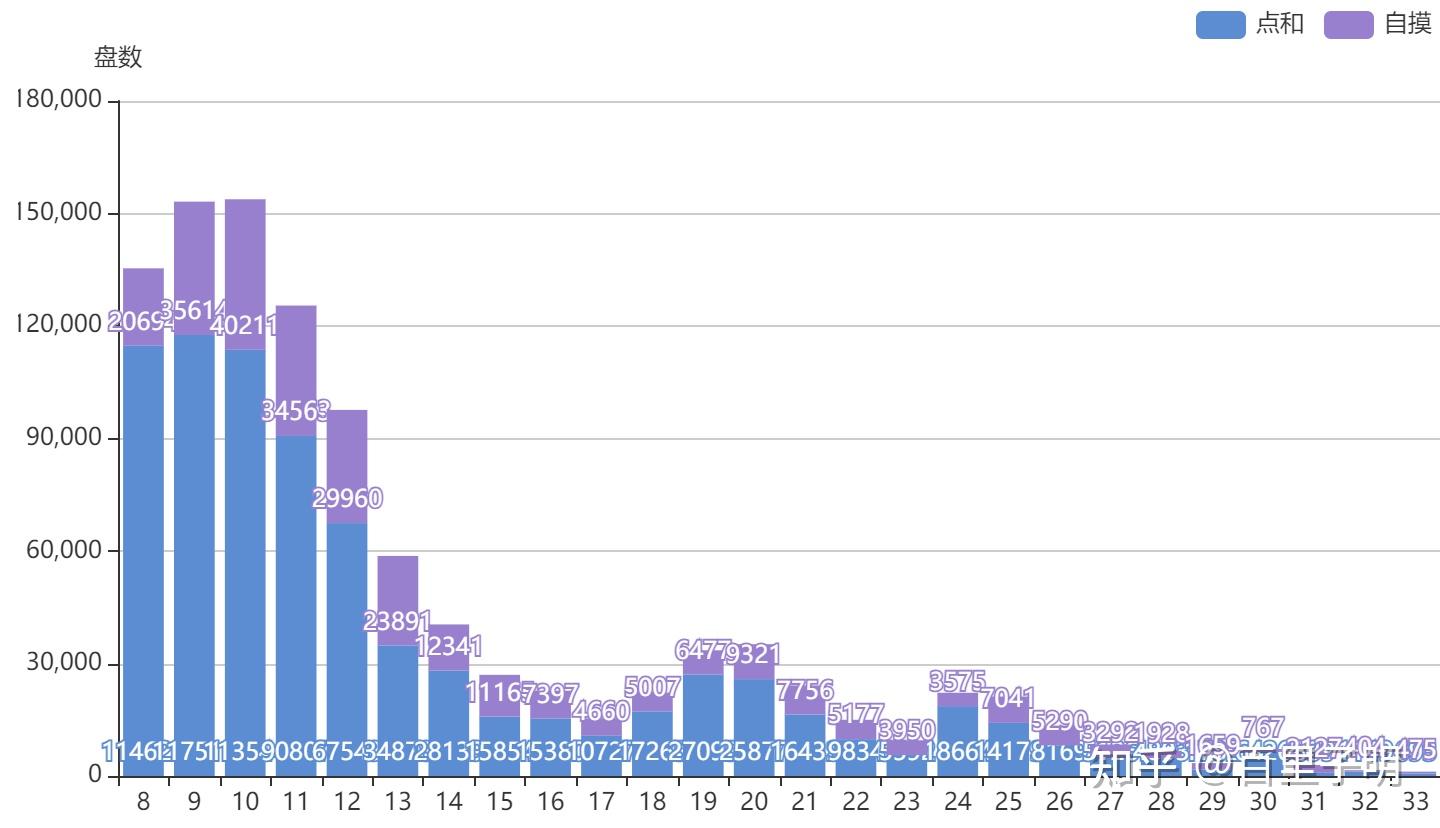
Second, removing the dead wall helps increase the win rate and reduce exhaustive draws. Its fourteen tiles give each player more than three additional opportunities to draw. Even with this measure, the minimum cannot be raised indefinitely. Higher-scoring hands have fewer possible combinations and are harder to complete. If the threshold makes it difficult for any of the four players to win within the usual twenty-odd turns, too many drawn hands will undermine both enjoyment and competition.
Four Seas Mahjong Standard Edition 3.1
| Class | Category | Subcategory | 5 | 10 | 20 | 30 | 40 | 60 | 80 | 120 | 160 | 240 | 320 | 480 |
|---|---|---|---|---|---|---|---|---|---|---|---|---|---|---|
| Suit | All Types | Mixed One-Suit | Pure One-Suit | Melded Nine Gates | All Honors | Nine Gates | ||||||||
| Pattern | basic | All Sequences | All Triplets | |||||||||||
| Seven Pairs | Seven Pairs | Seven Consecutive Pairs | Seven Honor Pairs | |||||||||||
| Seven Pairs | Seven Pairs with One Quad | Seven Pairs with Two Quads | Seven Pairs with Three Quads | |||||||||||
| special | All Unrelated | Seven All Unrelated | Five Honors and Knitted Straight | Thirteen Orphans | ||||||||||
| special | Honors and Plaid Tiles | |||||||||||||
| Number | terminal | All Simples | Mixed Outside Hand | Pure Outside Hand | All Terminals and Honors | All Terminals | ||||||||
| linked | Mixed Linked | All Linked | All Symmetric | |||||||||||
| oddeven | Mixed Odd | Mixed Even | All Odd | All Even | All Knitted | |||||||||
| consecutive | Mixed Consecutive | All Consecutive | ||||||||||||
| Quad | Quad | One Quad | Two Quads | Three Quads | Four Quads | |||||||||
| Honor | Dragon | Value Honor | Three-Dragon Pairs | Little Three Dragons | Big Three Dragons | |||||||||
| wind | Little Three Winds | Big Three Winds | Little Four Winds | Big Four Winds | ||||||||||
| wind | Three-Wind Pairs | Four-Wind Pairs | ||||||||||||
| One-Suit | identical Seq | Two Identical Sequences | Two Identical Sequences Twice | Three Identical Sequences | Four Identical Sequences | |||||||||
| shifted seq | Two Shifted Sequences | Three Shifted Sequences | Four Shifted Sequences | Silver Ladder | ||||||||||
| shifted seq | Two Shifted Sequences Twice | |||||||||||||
| straight | symmetric | Two Terminal Sequences | Pure Straight | Golden Bridge | Pure Terminal Sequences | |||||||||
| straight | consec seq | Half Straight | Half Straight Twice | Mirrored Half Straight | ||||||||||
| consec trip | consec trip | Little Three Consecutive Triplets | Three Consecutive Triplets | Two Consecutive Triplets Twice | Four Consecutive Triplets | Gold Ladder | ||||||||
| identical seq/trip | Tile Hog | Tile Hog Twice | Tile Hog + | Tile Hog ++ | ||||||||||
| consec seq/trip | consecutive T | Horizontal Cross | Horizontal H | Four Consecutive T | Jade Cube | Jade Disc | Big China | |||||||
| consec seq/trip | Consecutive T Twice | King Straight | ||||||||||||
| Three-Suit | identical seq/trip | identical Seq | Two Similar Sequences | Three Similar Sequences | ||||||||||
| identical seq/trip | identical trip | Two Similar Triplets | Little Three Similar Triplets | Three Similar Triplets | ||||||||||
| identical seq/trip | Mirrored | Mirrored Sequences | Mirrored Sequences and Triplets | Mirrored Triplets | ||||||||||
| consec seq/trip | consec seq | Assorted Straight | ||||||||||||
| consec seq/trip | consec trip | Assorted Three Consecutive Triplets | ||||||||||||
| chance | turn | Last Tile Draw | Blessing of Man | Blessing of Earth | Blessing of Heaven | |||||||||
| turn | Last Tile Claim | |||||||||||||
| Kong | Robbing a Kong | |||||||||||||
| Kong | Win by Kong Replacement |
| Winning level | Self-draw minimum | Discard-win minimum | Editions |
|---|---|---|---|
| I | 0 | 0 | A-I |
| II | 5 | 5 | A-II、B-II |
| III | 10 | 10 | B-III、C-III |
| IV | 10 | 20 | C-IV、D-IV |
| V | 20 | 50 | D-V |
A: Beginner; B: Basic; C: Intermediate; D: Standard. Payment threshold: 50 (25 for Basic); limit-hand threshold: 200.
| Outcome | Winner | Discarder | Each other opponent |
|---|---|---|---|
| Self-draw | +6H | — | All three pay 2H each |
| Discard win, H ≤ F | +4H | −2H | −H |
| Discard win, H > F | +4H | −(4H−2F) | −F |
H is the hand score and F the payment threshold (50 or 25).
Four Seas Standard retains threshold IV from Intermediate—10 points for self-draw and 20 for a discard win—and adds threshold V: 20 for self-draw and 50 for a discard win. The lower self-draw requirement mainly supports defensive changes of plan. For now, consider the discard-win threshold. Four Seas divides scoring patterns into five value bands: small patterns (5–10), main patterns (20–40), large patterns (60–80), very large patterns (120–160), and limit patterns (240–480). Main patterns are the well-grounded, moderately difficult, sufficiently valuable members of their respective families. Thresholds IV and V bracket this main-pattern band.
Under threshold IV, any main pattern worth at least 20 points qualifies on its own. The threshold thus lies at the bottom of the main-pattern band. Combinations of small patterns can also reach 20, as discussed in the articles on Four Seas Intermediate.
Under threshold V, main patterns worth 20–40 cannot qualify alone; additional small patterns are needed. Large patterns at 60 points or more, including Seven Pairs, Pure One-Suit, and patterns in the identical- and shifted-sequence families, can qualify directly. Consider the routes individually:
1. Mixed One-Suit: at 30 points, it needs another 20, which can come from Value Honor and Two Identical Sequences.
2. All Triplets: it likewise needs another 10 points. It combines with every triplet-combination pattern and is also needed for those patterns to reach the 40-point winning threshold.
3. All Unrelated: Standard adds Seven All Unrelated at 40 and Five Honors and Knitted Straight at 60 above the 30-point All Unrelated pattern, preserving discard-win possibilities for this family. All Unrelated selects fourteen tiles from sixteen and has a three-tile wait, but cannot combine with other patterns. If all nine numbered tiles are already present when the hand becomes ready, all three waits can win on a discard as Five Honors and Knitted Straight. Otherwise, a discard can be claimed if it completes Five Honors and Knitted Straight; other completions can still win by self-draw under the 20-point threshold. This keeps the family viable as a hand-building route.
4. Mixed Outside Hand: worth 30, with Pure Outside Hand above it at 40. The outside-hand family does not automatically qualify without further thought, but can usually combine with All Sequences, Two Similar Sequences, Three Similar Sequences, Mirrored Sequences, or Value Honor to reach the threshold.
5. Mixed Linked: worth 20, with All Linked above it at 40. Like the outside-hand family, this family can combine with All Sequences, Two Similar Sequences, Three Similar Sequences, or Little Three Similar Triplets.
6. Three Similar Sequences: worth 30 and needs another 20. It can combine with Mixed Outside Hand, Mixed Linked, or All Types.
7. Assorted Straight: worth 20 and still needs another 20. All Sequences, Two Similar Sequences, and Half Straight together provide only 15, so a reliable route requires All Types plus Value Honor or a kong. This is one of the harder main sequence routes to qualify with in Standard.
8. All Types: a 20-point main route that can combine with Mixed Outside Hand, Mixed Linked, Assorted Straight, or Three Similar Sequences.
9. Combining Half Straight Twice with Mirrored Sequences produces Mirrored Half Straight, whose 60 points already exceed the 40-point threshold.
10. Pure Straight: worth 40 and can combine with Two Similar Sequences and All Sequences.
Comparing the two thresholds with Chinese Official Mahjong at eight and sixteen points
How do these thresholds affect competitive skill and tactics, and how do they compare with two versions of Chinese Official Mahjong? To compare their winning requirements, we first need to put Chinese Official, Zung Jung, and Four Seas pattern values on a common scale. We can use Chinese Official Mahjong's scale and divide Zung Jung and Four Seas values by five.
| Pattern | Four Seas | Four Seas ÷ 5 | Chinese Official | Zung Jung ÷ 5 | Main-route marker |
|---|---|---|---|---|---|
| All Sequences | 5 | 1 | 2 | 1 | |
| All Simples | 5 | 1 | 2 | 1 | |
| Two Similar Sequences | 5 | 1 | 1 | ||
| Half Straight | 5 | 1 | 1 | ||
| Two Shifted Sequences | 5 | 1 | |||
| Two Terminal Sequences | 5 | 1 | 1 | ||
| One Voided Suit | 1 | ||||
| No Honors | 1 | ||||
| Pung of Terminals or Honors | 1 | ||||
| Self-Draw | 1 | ||||
| Edge, Closed, or Pair Wait | 1 | ||||
| Value Honor | 10 | 2 | 2 | 2 | |
| All Types | 10 | 2 | 6 | Shared | |
| One Quad | 10 | 2 | 1–2 | 1 | |
| Two Identical Sequences | 10 | 2 | 1 | 2 | |
| Two Similar Triplets | 10 | 2 | 2 | ||
| Concealed Hand | 2 | 1 | |||
| Tile Hog | 2 | ||||
| Mixed Outside Hand | 20 | 4 | 4 | 8 | Shared |
| Assorted Straight | 20 | 4 | 8 | Shared | |
| All Unrelated | 20 | 4 | 12 | Shared | |
| Mixed Linked | 20 | 4 | Four Seas | ||
| Little Three Consecutive Triplets | 20 | 4 | |||
| Fully Concealed Hand | 4 | ||||
| Last Tile | 4 | ||||
| Mixed One-Suit | 30 | 6 | 6 | 8 | Shared |
| All Triplets | 30 | 6 | 6 | 6 | Shared |
| Three Similar Sequences | 30 | 6 | 8 | 7 | Shared |
| Two Quads | 30 | 6 | 4–8 | 4 | |
| Pure Outside Hand | 30 | 6 | 10 | Four Seas | |
| Little Three Winds | 30 | 6 | 6 | ||
| Little Three Similar Triplets | 30 | 6 | 6 | ||
| Mixed Shifted Chows | 6 | Chinese Official | |||
| Melded Hand | 6 | ||||
| Pure Straight | 40 | 8 | 16 | 8 | Shared |
| Seven Pairs | 40 | 8 | 24 | 6 | Shared |
| All Linked | 40 | 8 | 16* | Four Seas | |
| Assorted Three Consecutive Triplets | 40 | 8 | 8 | ||
| Seven Honors and Knitted Tiles | 40 | 8 | 24 | ||
| Five Honors and Knitted Straight | 40 | 8 | 24 | ||
| Mirrored Sequences | 40 | 8 | Four Seas | ||
| Half Straight Twice | 40 | 8 | Four Seas | ||
| Reversible Tiles | 8 | Chinese Official | |||
| Chicken Hand | 8 | ||||
| Pure One-Suit | 60 | 12 | 24 | 16 | |
| Little Three Dragons | 60 | 12 | 64 | 12 | |
| Three Consecutive Triplets | 60 | 12 | 24 | 20 | |
| Three Shifted Sequences | 60 | 12 | 16 | Shared | |
| Two Shifted Sequences Twice | 60 | 12 | Four Seas | ||
| Upper / Lower Four | 12 | Chinese Official |
The “Main-route marker” column replaces the original chart's colors: yellow identifies whole-hand and sequence-combination main routes shared by Four Seas and Chinese Official Mahjong, red identifies those unique to Four Seas, and blue those unique to Chinese Official Mahjong.
After normalization, Mixed One-Suit, All Triplets, and Three Similar Sequences have very similar values across the three rulesets, at six to eight points. Four Seas develops Zung Jung's approach, so their values are close, with only minor adjustments to some patterns. Both differ considerably from Chinese Official Mahjong. In the latter, Seven Pairs, Pure Straight, Pure One-Suit, All Unrelated, and Little Three Dragons are overvalued relative to their combination counts and construction difficulty. The resulting imbalance in its scoring system is already widely recognized.
The next table compares how small hands and main patterns qualify under four winning thresholds. Each is discussed below.
| Route | Four Seas IV (10–20) | Chinese Official 8 | Four Seas V (20–50) | Chinese Official 16 |
|---|---|---|---|---|
| Small-pattern combinations | × | × | ||
| Main pattern alone | × | × | × | × |
| Main pattern plus small patterns | × | × | ||
| Two main patterns combined | × | × | ||
| Main pattern cannot qualify | × |
Under Four Seas Standard's lower threshold IV—10 for self-draw and 20 for a discard win, equivalent to two and four on the normalized scale—the main patterns in all eighteen families, comprising six sequence, six triplet, and six whole-hand families, qualify directly. Numerous combinations of small patterns qualify too. Compared with Intermediate C-IV, Standard D-IV adds triplet-combination and mixed sequence–triplet families. Keeping threshold IV therefore simply expands the patterns available to build. Players can first pursue main routes, then consider combinations of small patterns; if essential tiles become unavailable, they can also change plans and seek a two-point self-draw on the normalized scale.
Standard IV covers a wider range of random starting hands. It supports both the construction of patterns across different families and the combination of small patterns, requiring a broad but moderate range of skills. Its varied play makes it suitable for recreational play and general competition.
Chinese Official Mahjong normally requires eight points. Patterns worth six or less need additional small patterns. These include the major whole-hand patterns Half Flush, All Pungs, and Outside Hand, together with the particularly prevalent Mixed Shifted Chows and All Types. Most other main patterns already exceed the minimum. Its base payment and triple self-draw reward strongly encourage racing to an eight-point win. It also offers numerous patterns based on circumstances or difficulty rather than hand structure or aesthetics. Examples include Self-Drawn and Edge, Closed, or Single Wait at one point; Concealed Hand and Tile Hog at two; Fully Concealed Hand and Last Tile at four; and Melded Hand at six. These difficulty-based patterns can combine without mutual restrictions, making two extra points relatively easy to obtain. With the overvalued Mixed Shifted Chows and All Types as well, the difficulty of winning is similar to Four Seas D-IV even though some main patterns require supplements.
Four Seas threshold V—20 for self-draw and 50 for a discard win, equivalent to four and ten on the normalized scale—is only slightly above Chinese Official Mahjong's eight-point minimum numerically, but much harder to reach. Small-pattern combinations alone cannot qualify: Four Seas has no small difficulty-based patterns, and its small patterns are structural or aesthetic, have low values, and impose mutual constraints. Main patterns worth 20–40 require supplements. Only large patterns at 60 or more, such as Pure One-Suit, Seven Pairs, Three Shifted Sequences, and Two Identical Sequences Twice, qualify alone. Pure Straight needs another 10 points from small patterns, whereas Assorted Straight with All Types and Value Honor requires two main patterns. The same applies to 20-point main patterns such as Mixed Outside Hand and Mixed Linked: small patterns alone are insufficient, and another main pattern is needed. Chinese Official Mahjong's eight-point threshold does not require such combinations of two main patterns. When changing plans defensively, the 20-point self-draw line serves as threshold V's winning requirement: any main pattern qualifies by self-draw. D-V also has no dead wall, and precise assessment of the remaining wall calls for trained memory and analysis. Its higher requirements therefore suit competitive players with greater experience and familiarity with the rules.
Although Chinese Official Mahjong officially uses an eight-point minimum, some dissatisfied enthusiasts have introduced a sixteen-point variant that has become quite popular. It encourages large hands and eliminates the dominance of Mixed Shifted Chows and All Types. Its disadvantage is a sharp reduction in viable routes. Only Pure Straight, Seven Pairs, and Pure Shifted Chows among the main patterns qualify directly at sixteen; Full Flush is a larger hand beyond that band. Few combinations involving six- or eight-point patterns reach sixteen. All Pungs with Half Flush still needs four more points, for example, while All Types with Mixed Straight or Mixed Triple Chow needs two. Many six- and eight-point patterns consequently have little chance of winning, substantially reducing flexibility and variety while increasing exhaustive draws. From a competitive perspective, fewer routes, the disappearance of small-pattern combinations, and simpler attack–defense decisions cut the game's technical content in half. Four Seas D-V, by comparison, raises the skill requirement without reducing the main hand-building routes.
Four Seas Standard's lower 10–20 threshold accommodates a broad range of starting hands and offers variety through both large-hand construction and small-pattern combinations, making it suitable for general recreational play. The higher 20–50 threshold demands greater skill and encourages larger hands, making it more suitable for professional competition.
Originally published in Chinese on Zhihu · Zhihu revision 2026-08-25