Added to this site · 2026-09-16
Rules That Change Mahjong Play, Part III: Three-Player Mahjong
AI-assisted draft translation. Terminology is under review; please refer to the Chinese original if anything is unclear.
Mahjong is normally a four-player game, yet a table is often one player short. Three-player mahjong therefore arose naturally. Japanese sanma, Ka Wuxing, Korean mahjong, and Malaysian mahjong are among its more systematic forms. Each adjusts four-player mahjong while trying to retain a comparable experience.
Why reduce the tile set?
The three suits, seven honor types, calls, and four-melds-and-a-pair structure evolved for four players. If three players used the whole set, each would draw substantially more tiles, lengthening a hand and raising the chance of winning. Three-player rules therefore remove at least one suit so that the number of tiles available per player remains closer to the four-player game.
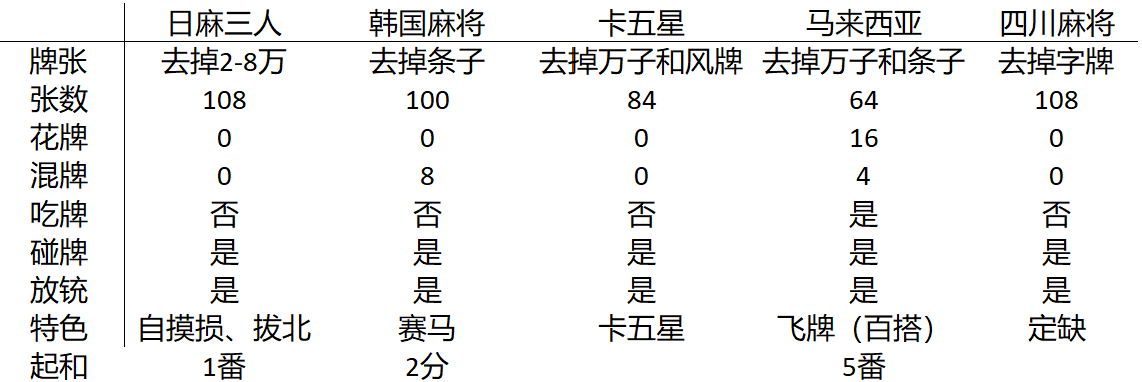
Removing a suit also reduces complexity. With two suits and honors, the tile types fall from 34 to 25. The source estimates that the chance of drawing a pair rises from about 0.02 to 0.03; a fourteen-tile one-suit-plus-honors holding becomes far more likely. Repeated-tile and one-suit patterns therefore become easier.
To compensate, most three-player rules prohibit chows and allow pungs only. Chow is an efficient way to construct sequences; prohibiting it raises winning difficulty, but restricts Pure Straight and other sequence routes while relatively favoring flushes and triplet hands.
Regional special rules
Japanese sanma can produce a *tsumo loss*: when four-player payment relations are retained, self-draw can score less than a discard win for the same hand.
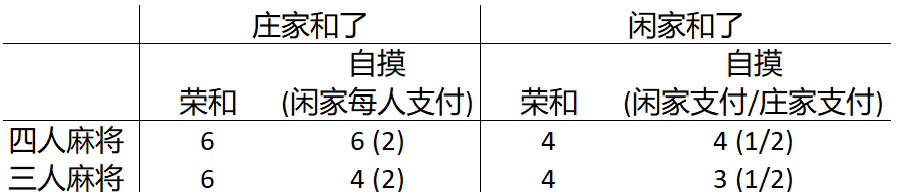
North has no corresponding player in sanma, so it is often treated as a revealed kita-dora: the player exposes North, draws a replacement tile, and receives one han. Because it is exposed and replaced, it resembles a flower more than an ordinary dora.
Ka Wuxing takes its name from a 4–6 wait on five. Korean mahjong includes open riichi and a "horse-racing" countdown payment. Malaysian mahjong retains only circles and honors, adds sixteen flowers and four wildcard "flying" tiles, and permits chows. Apart from the historical connection between Korean and Japanese mahjong, these rules are largely independent examples of convergent development.
Comparing Japanese three-player and four-player mahjong
Tenhou monthly data show overall draw rates near ten percent in both formats, while individual winning rates are around 30 percent in sanma and 22 percent in four-player mahjong.
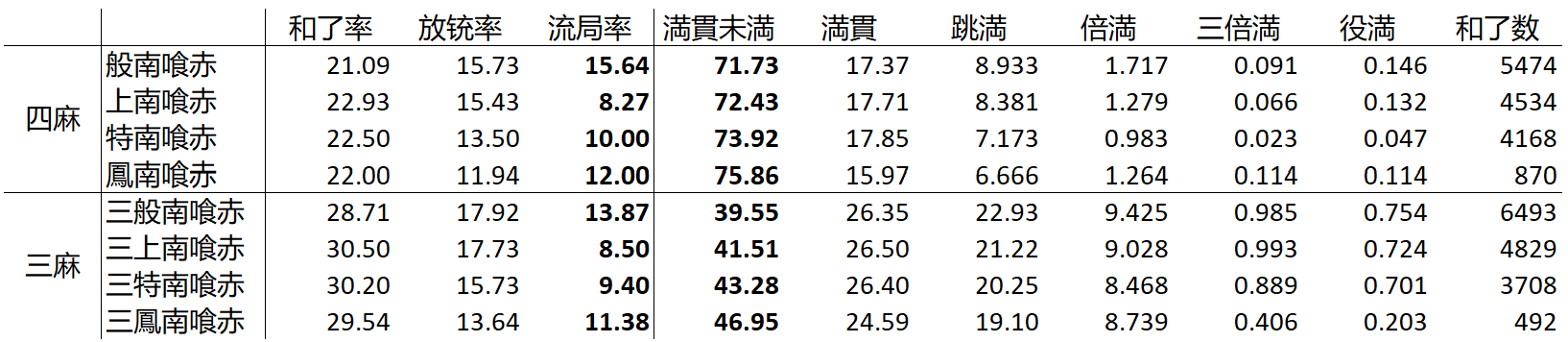
Sanma has fewer sub-mangan wins and more large hands. Kita-dora and the distribution of dora among three rather than four players help explain this; fewer tile types also make difficult combinations easier.
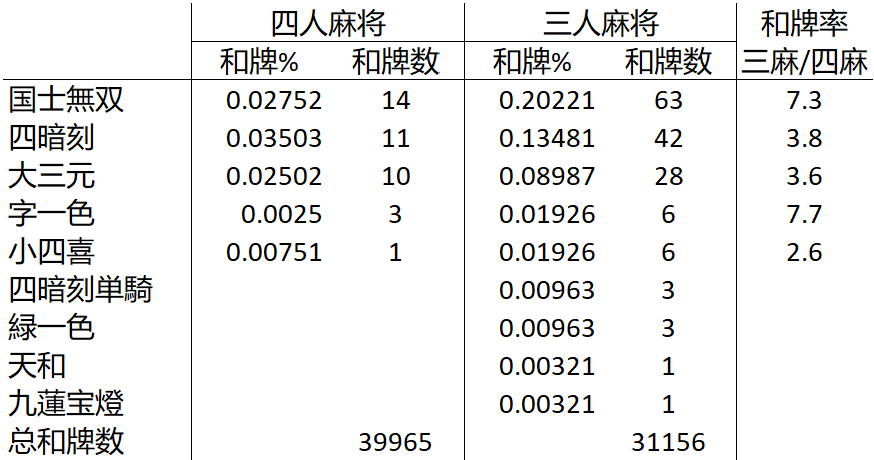
In this monthly sample, sanma produced noticeably more yakuman. A single month cannot establish the underlying frequency of rare yakuman, but yakuman occurring in both formats were often three to seven times as frequent in sanma. Sanma keeps an overall difficulty near four-player mahjong while concentrating more reward in large hands. That is both part of its appeal and a source of its distinct character.
Originally published in Chinese on Zhihu · Zhihu revision 2025-02-18