Added to this site · 2026-09-16
Rules That Change Mahjong Play, Part II: Riichi and Baoting
AI-assisted draft translation. Terminology is under review; please refer to the Chinese original if anything is unclear.
Mahjong was invented in China, but Japanese riichi mahjong is the most influential regional ruleset worldwide. Together with dora, full liability for a discard, furiten, and open-hand reductions, riichi forms a system distinct from other regional mahjong. This article considers its origins and role, alongside the related Chinese idea of *baoting*.
The origin of riichi
Japanese mahjong can broadly be divided into prewar classical mahjong and postwar modern riichi mahjong. Accounts of its history hold that riichi was not originally Japanese: the earliest form resembled today's double riichi, where a player becomes ready after their first discard. Later "mid-game riichi" allowed a declaration after the first turn, provided the hand remained closed. Amano Daizo formally introduced riichi in 1949, and the 1952 Hōchi rules systematized it.
The declaration is highly ritualized: once ready, the player declares riichi and no longer changes the hand. It was criticized as reducing skill, but was rapidly accepted.
What riichi solves
Push-Down Win with chows, pungs, and discard wins is too easy if there is no minimum condition. Competitive rules must decide when an ordinary hand may win. Chinese Official Mahjong creates many small scoring routes; Japanese mahjong uses riichi as an entry yaku. Modern Japanese mahjong therefore has two major routes: open the hand when it can retain yaku, or keep it closed and pursue riichi.
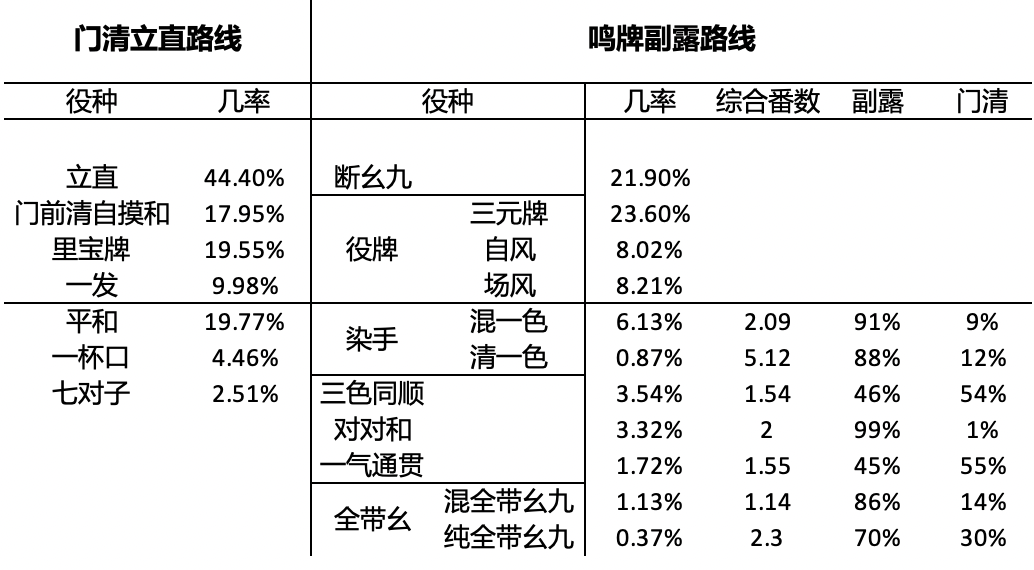
All Simples and value honors are common open routes. Flushes, All Triplets, Mixed Triple Sequence, Pure Straight, and Outside Hand make up harder major routes. Riichi lets a closed tenpai hand win even with no other yaku; ura-dora, ippatsu, closed self-draw, Pinfu, Iipeikou, and Seven Pairs add further closed-hand value. Choosing between closed and open routes thus becomes one of modern Japanese mahjong's central strategic decisions.
Baoting and related concepts
Double riichi is also called first-turn ready. A hand ready in the initial thirteen tiles is a zero-turn ready state; the dealer may then make a Blessing of Heaven, and a non-dealer's first self-draw or discard win may yield the corresponding special win. Definitions vary by ruleset.
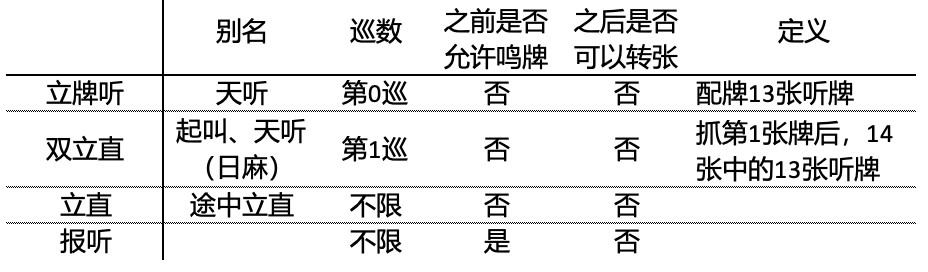
Mid-game riichi extends first-turn readiness into later turns, but Japanese mahjong requires a closed hand. In some Chinese regional rules, *baoting* similarly fixes the hand after readiness but normally does not require closure, a stick payment, or additional han. It admits an otherwise patternless hand, but has less strategic force.
Shanghai Qing-Hun-Peng permits only a few specified hands, while Qiaoma permits any four-melds-and-a-pair hand after a *baoting* declaration. The latter therefore has more winning routes. Northeastern rules and Shanxi Li-Si mahjong also use compulsory *baoting*; because it is not an optional yaku, it does not create the same open-versus-closed decision as riichi.
Originally published in Chinese on Zhihu · Zhihu revision 2025-02-04