Added to this site · 2026-09-16
Rules That Change Mahjong Play, Part I: Wildcards
AI-assisted draft translation. Terminology is under review; please refer to the Chinese original if anything is unclear.
The preceding articles discussed multiplier rules, which mainly change the reward after a win. A wildcard directly changes the way a player forms four melds and a pair. It is one of the most widespread regional mechanisms and one of those with the deepest effects on play.
Wildcards and how they are selected
A wildcard, also called a flexible tile or universal tile, may stand for any other tile when winning. It normally cannot be used to chow, pung, or kong. The northeastern *bao*, the northern *hun'er*, Wuhan's *laizi*, Nanchang's upper *jing*, Hangzhou's *piao*, Ningbo's God of Wealth, Fuzhou's gold, Guangdong's ghost, and the American joker are regional names for this idea. It appears throughout China and also in rules played in the United States, Vietnam, Singapore, and Thailand.
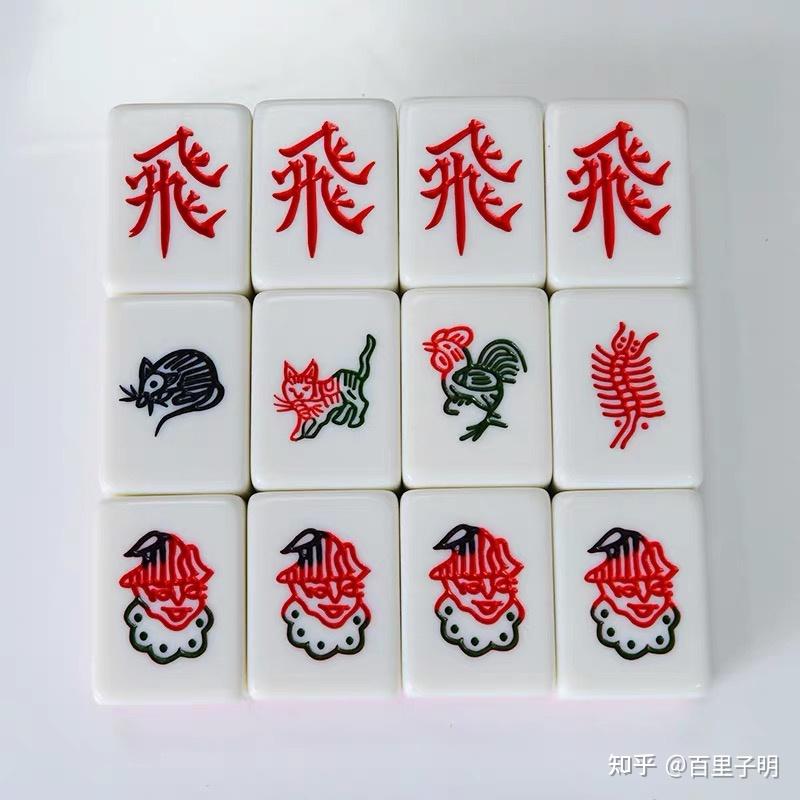
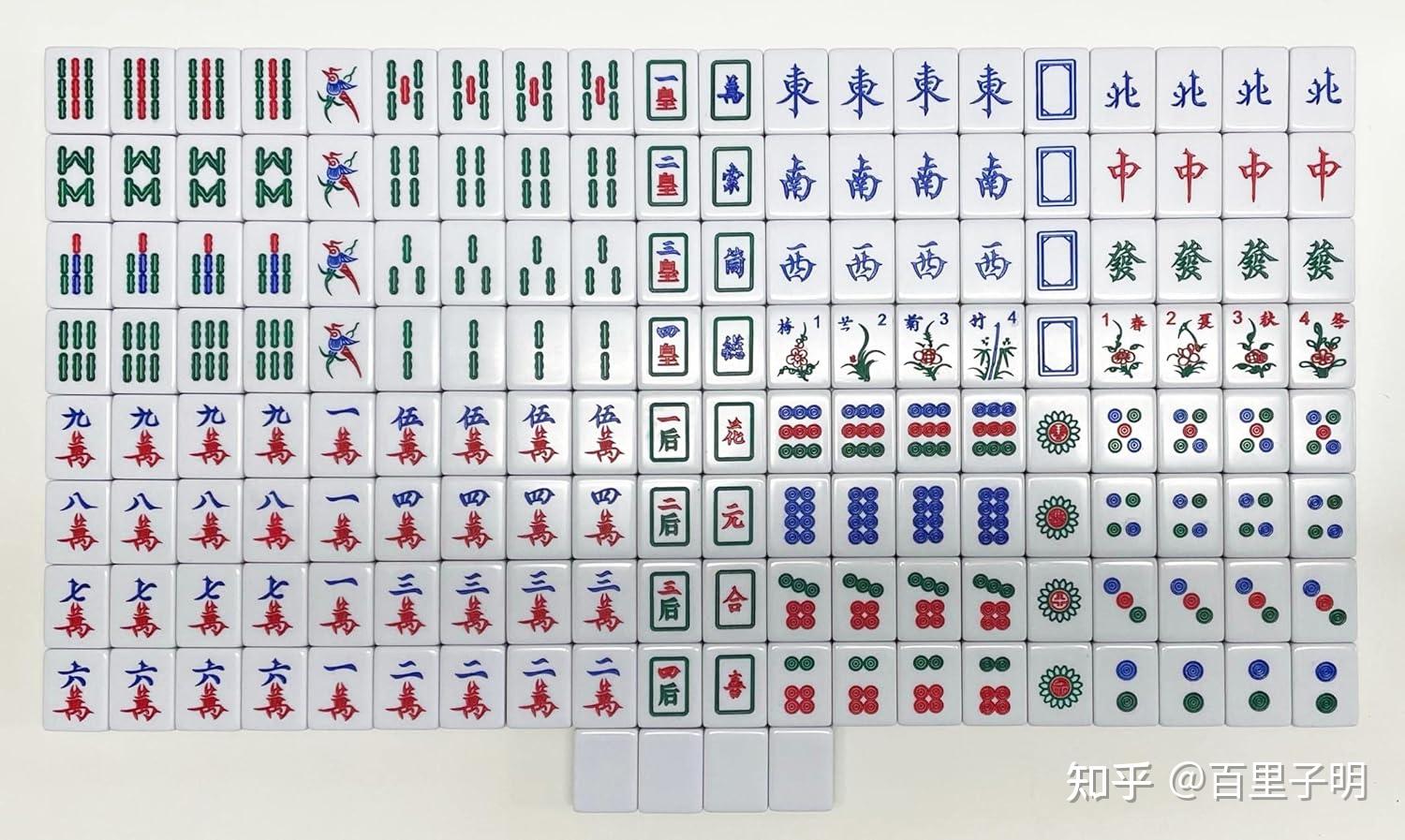
Wildcards may be fixed, represented by flowers, or selected anew each hand. A fixed rule gives every player one or two. Flower wildcards are shuffled into the wall. Variable wildcards are determined by an indicator or dice: the revealed tile itself, its next tile in rank, or both may become wildcards. Fuzhou, Ningbo, and some northeastern rules often use three; northern Push-Down Win, Henan, Wuhan, Guangdong, and Hangzhou often use four; Tianjin and Nanchang may use seven.
Effects on play
Wildcards increase choices in hand-building, speed wins, and raise the appearance rate of high-scoring patterns. For balance, most wildcard rules prohibit chows; some also prohibit discard wins and allow self-draw only. Nanchang mahjong, which has wildcards, bonus tiles, chows, and discard wins, is an exception.
Wildcards especially reduce the difficulty of patterns that need repeated tiles, such as identical sequences, All Triplets, and one-suit hands. They also create a universal wait: with four completed melds, one wildcard can pair with any drawn tile; two unformed wildcards can make a meld with any drawn tile. Tianjin's many wildcards lead it to prohibit simple chicken hands and require either a natural win or a wildcard universal wait.
A combinatorial view of difficulty
Suppose a simple four-sequences-and-a-pair hand has thirteen distinct tiles. A fixed wildcard can replace any one of those tiles. Accounting for adjacent interpretations of a sequence, the source estimates roughly twenty-one possible substitutions. In this deliberately simplified model, one wildcard reduces the difficulty of winning to about one twentieth.
Tenpai and one-away shapes permit further selection and expand the combination space again. The following illustration presents the source's comparison. It is an explanatory combinatorial estimate, not an exact probability of real play.

For a Pure Straight, one wildcard expands the combinations by roughly nine times; for three identical sequences in one suit, the source's calculation gives about eighteen times. The more a pattern is constrained by the four-copy limit on repeated tiles, the more strongly a wildcard relaxes it.
Can competitive mahjong use wildcards?
The drafters of Chinese Official Mahjong considered wildcards and did not adopt them, on the grounds that they add randomness and reduce competitiveness. Giving every player a fixed wildcard removes the luck of whether one is drawn, but it still weakens defense: discards and visible tiles constrain an opponent's effective tiles less strongly. Since patterns are affected unequally, the scoring system would also need to be recalibrated. Fixed wildcards may serve a ruleset focused on hand-building, but their attack-defense balance and values require extensive playtesting.
Originally published in Chinese on Zhihu · Zhihu revision 2025-02-11