Added to this site · 2026-09-14
What Does “Triple Payment for Self-Draw” Really Mean in Chinese Official Mahjong?
AI-assisted draft translation. Terminology is under review; please refer to the Chinese original if anything is unclear.
Many people describe Chinese Official Mahjong’s “triple payment for self-draw” as unscientific overrewarding: “Why should self-draw earn three times as much as a discard win?” This takes the expression at face value without fully understanding the rules. Let us examine it more closely. As explained in Comparing Mahjong Payment Systems, Chinese Official payments combine base payments with self-draw tripling. It is the “hand value”—the sum of the scoring-pattern values—that is tripled for self-draw. In most situations, the base payments have a greater effect than that tripling.
First, consider the two systems used for comparison: Zung Jung competitive payments and Four Seas payments. Zung Jung combines fixed income with shared payments for small hands and increased discarder responsibility for large hands. Four Seas develops this approach by combining discarder-double payments with the same small-hand/large-hand distinction. Both share small-hand payments: equally among the three losers in Zung Jung, and in a 2:1:1 ratio in Four Seas. For large hands, the discarder takes on the additional payment, approaching full-discarder payment. Zung Jung gives equal income for self-draw and discard wins. Four Seas uses discarder-double payments, giving self-draw 1.5 times the income of a discard win. To keep point values integral, Four Seas self-draw payments are twice Zung Jung’s. The table compares the two systems.
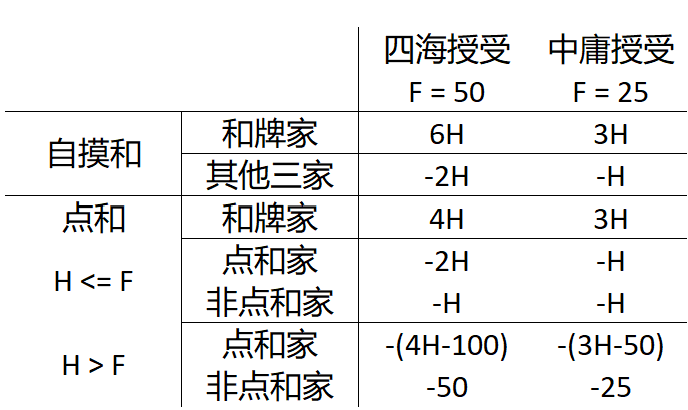
In the original table, H is the hand value and F is the shared-payment threshold. Four Seas uses F = 50; Zung Jung uses F = 25. The formulas are transcribed below for English readers.
| Outcome / player | Four Seas | Zung Jung |
|---|---|---|
| Self-draw: winner | +6H | +3H |
| Self-draw: each other player | -2H | -H |
| Discard win: winner | +4H | +3H |
| H ≤ F: discarder | -2H | -H |
| H ≤ F: each other losing player | -H | -H |
| H > F: discarder | -(4H - 100) | -(3H - 50) |
| H > F: each other losing player | -50 | -25 |
In Chinese Official Mahjong, a self-drawing winner receives the base payment of 8 points from each of three players, plus three times the hand value. A discard winner receives three base payments plus the hand value. Thus, the system is better described as a fixed base total of 8 × 3 = 24 points, plus a hand value that is tripled for self-draw.
To compare the three rulesets on the Chinese Official scale, divide Zung Jung and Four Seas hand values by 5, and additionally divide Four Seas receipts by 2.
Figure 1 compares total receipts divided by hand value—the return ratio—for self-draw and discard wins under the three rulesets.
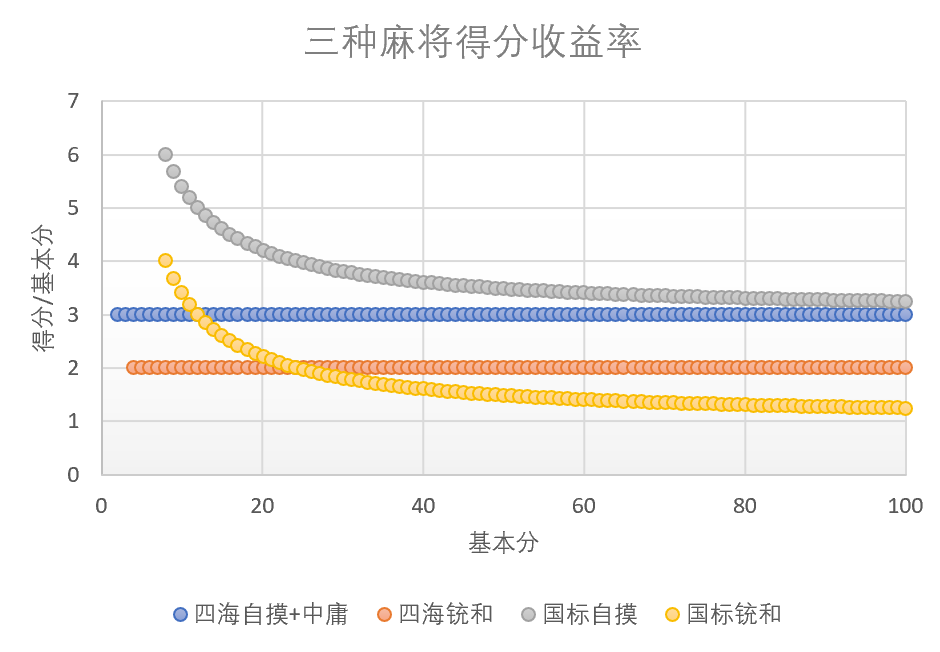
Horizontal axis: hand value. Vertical axis: receipts / hand value. Blue: Four Seas self-draw and Zung Jung; orange: Four Seas discard win; gray: Chinese Official self-draw; yellow: Chinese Official discard win.
Zung Jung and Four Seas self-draws both return three times the hand value on this scale. Four Seas actually returns six times the hand value before the additional division by 2. This ratio does not change with hand value. Zung Jung pays the same for a discard win as for self-draw; Four Seas pays two-thirds of its self-draw amount, also independently of hand value. Because Chinese Official Mahjong includes base payments, its return ratio is highest at the minimum winning threshold: for either self-draw or a discard win, it is twice that of the other two rulesets. As hand value increases, however, its return ratio falls rapidly. For large hands, the self-draw ratio approaches 3, similar to the other systems, while the discard-win ratio approaches 1, below Zung Jung’s 3 and Four Seas’ 2. This change in return ratio indicates that rushing to win small hands is the best strategy in Chinese Official Mahjong: returns fall as hand-building difficulty increases, making large hands unrewarding for the effort. In other words, doubling the difficulty of a scoring pattern yields less than double the income. Even a 40-point self-draw has a lower return ratio than an 8- or 9-point discard win. Chinese Official Mahjong is therefore a race to win with a high minimum threshold; it does not encourage large hands and is not hand-building mahjong.
Figure 2 compares self-draw receipts with discard-win receipts at the same hand value.
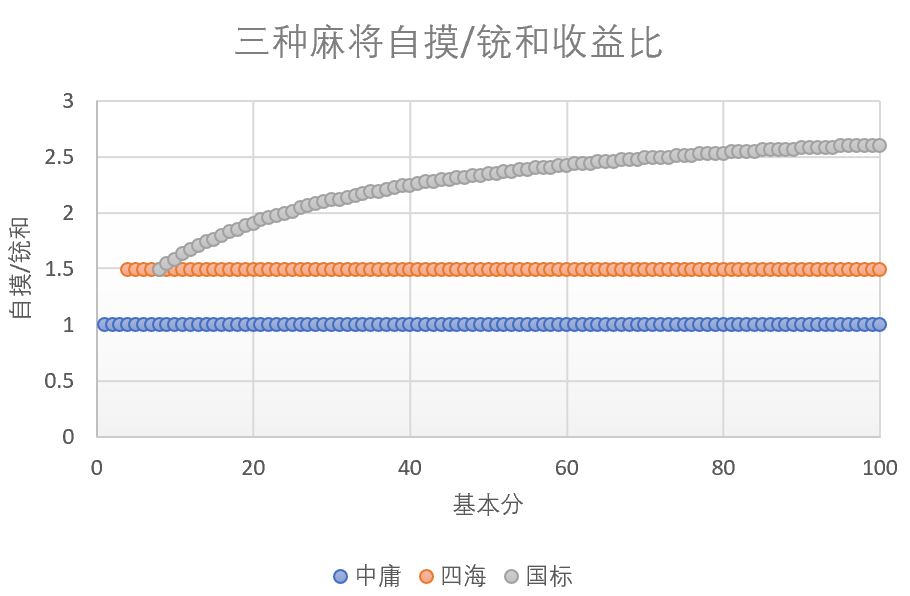
Horizontal axis: hand value. Vertical axis: self-draw receipts / discard-win receipts. Blue: Zung Jung; orange: Four Seas; gray: Chinese Official.
Zung Jung and Four Seas have ratios of 1 and 1.5 respectively, as their definitions imply. At Chinese Official Mahjong’s 8-point minimum, its ratio is exactly 1.5, the same as Four Seas’ discarder-double system. The ratio rises with hand value. Statistics from an online Chinese Official platform show that 62% of winning hands score 8–12 points, with a ratio of 1.67 at 12 points. Another 30% score 13–24 points, reaching a ratio of 2 at 24. Thus, 92% of these Chinese Official winning hands have self-draw/discard-win ratios between 1.5 and 2, far from a literal tripling. Self-draw functions much as it does under discarder-double payments, becoming more prominent only for large hands. As Figure 1 shows, receipts relative to hand value decrease for both win methods: self-draw approaches three times the hand value and discard wins approach once the hand value. Consequently, Figure 2 shows an increasing relative advantage for self-draw as hand value rises. The higher the value—for example, patterns worth more than 20 points, such as Seven Pairs or Full Flush—the greater the relative return from self-draw, and the stronger the incentive to gamble on drawing the winning tile. Rather than saying that Chinese Official Mahjong overrewards self-draw, it is more accurate to say that it underpays large hands won on discard.
Figure 3: Winning-hand statistics from an online Chinese Official platform.
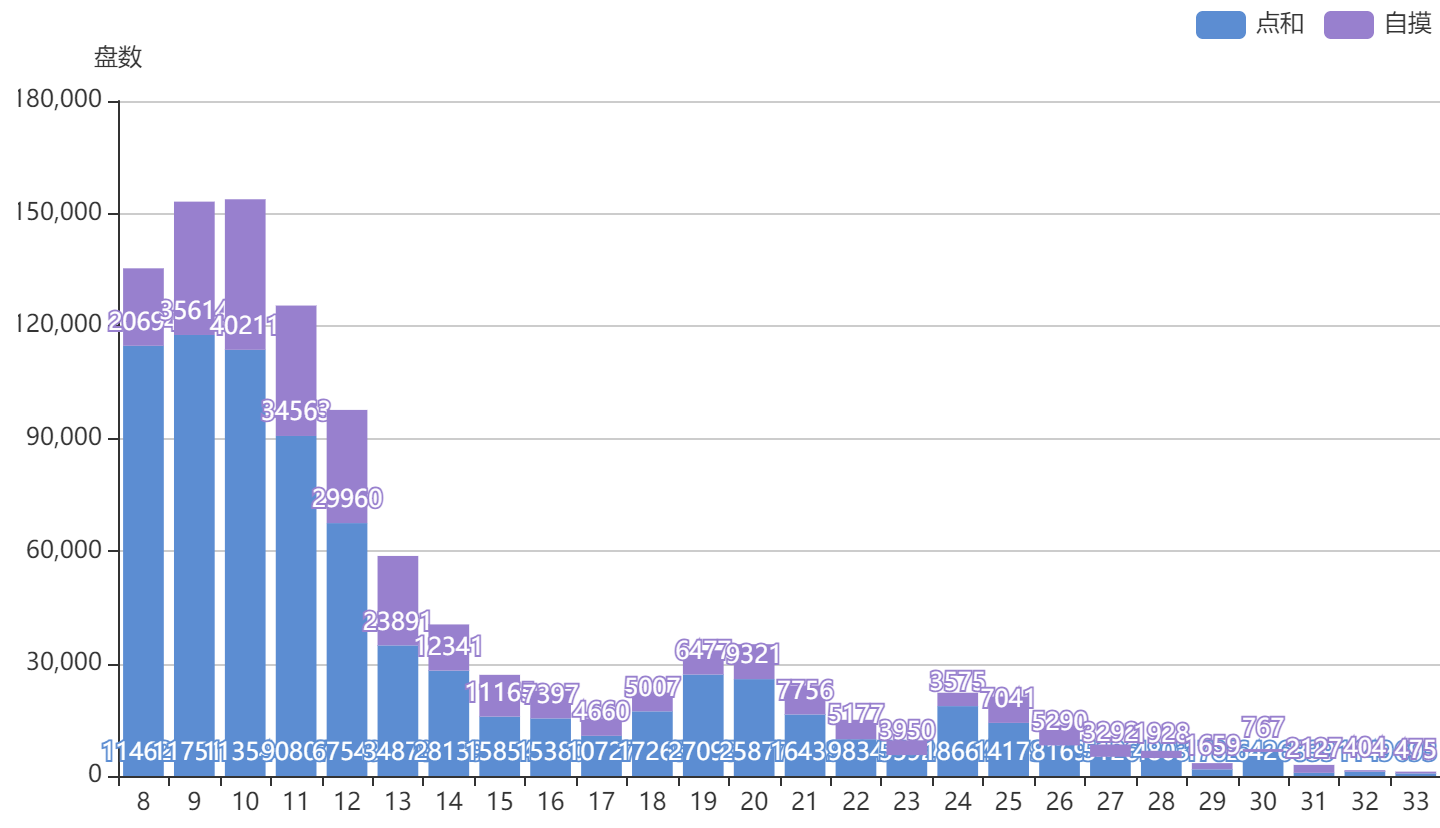
Horizontal axis: hand value. Vertical axis: number of wins. Blue: discard wins; purple: self-draws. The original chart and its labels are retained.
Figure 4 shows the discarder’s payment as a proportion of the total paid for a discard win: the discarder’s relative liability.
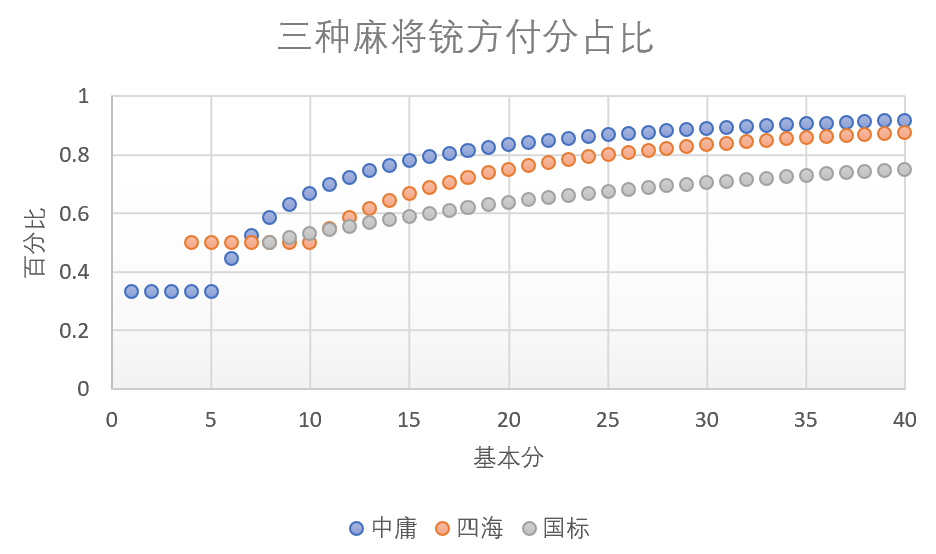
Horizontal axis: hand value. Vertical axis: discarder’s share of total payment. Blue: Zung Jung; orange: Four Seas; gray: Chinese Official.
At low hand values, Zung Jung splits payment equally. Above its shared-payment threshold of 5 × 5 = 25 in its original units, the discarder’s share rises rapidly. Four Seas is similar: below its threshold of 10 × 5 = 50, the discarder pays half, and above it the share increases. Chinese Official Mahjong is close to Four Seas at its 8-point minimum, and its discarder share increases slowly with hand value, remaining below Zung Jung and Four Seas. This illustrates that Chinese Official Mahjong imposes relatively little discarder liability: base payments make the other two players bear more of the loss. This is another reason to characterize it as an attacking form of mahjong. Zung Jung gives the discarder a small share at low hand values and a large share at high values; Four Seas falls between the two.
These comparisons suggest that Chinese Official Mahjong does not overreward self-draw as much as the phrase implies. Its high minimum winning threshold and substantial base payments matter more than self-draw tripling. Combining base payments with tripling makes low-value hands behave much like discarder-double payments. Because every win receives the fixed base total, winning itself can be viewed as an 8-point self-draw pattern. Chinese Official Mahjong therefore strongly encourages racing to win, rather than specifically encouraging self-draw. At or just above the 8-point threshold, both win methods have very high returns, and passing a discard win to wait for self-draw is a mistake. At higher values, both return ratios fall. Self-draw begins to show a relative advantage, but still does not yield three times as much. Chinese Official Mahjong also has the lowest discarder liability among the three systems, further encouraging attack.
In conclusion, Chinese Official Mahjong’s payment system makes it a race to win with a high minimum threshold, and base payments are the largest incentive to race. The much-criticized tripling is overstated: most self-draw/discard-win ratios are actually between 1.5 and 2, close to discarder-double payments.
Originally published in Chinese on Zhihu · Zhihu revision 2024-12-31