Added to this site · 2026-09-14
A Reasonable Payment System for Hand-Building Mahjong
AI-assisted draft translation. Terminology is under review; please refer to the Chinese original if anything is unclear.
This article follows two related discussions:
Comparing Mahjong Payment Systems
What Does “Triple Payment for Self-Draw” Really Mean in Chinese Official Mahjong?
Those articles compared common mahjong payment systems and examined Chinese Official Mahjong’s self-draw tripling in particular. Here, we consider what payment system is reasonable for hand-building mahjong.
Hand-building mahjong should encourage players to construct aesthetically pleasing, difficult, high-value hands, rather than simply rushing to win small hands. As the discussion of Chinese Official Mahjong showed, its payment system clearly works against this goal. Japanese full-discarder payment is also unsuitable because it retains outdated dealer privileges. With fixed income and shared small-hand payments combined with greater discarder liability for large hands, Zung Jung’s competitive system has surpassed other fixed-income payment arrangements to become the most widely recognized competitive mahjong payment system. But is it really ideal?
A game’s scoring system acts as a guide: players make and optimize decisions in pursuit of the highest score. A scientifically sound mahjong scoring—or payment—system should encourage active hand-building, strategic counterattack, reasonable defense, and informed folding. It should not produce the widespread passive folding encouraged by Japanese full-discarder payment, or the relentless race to win encouraged by Chinese Official Mahjong’s large base payments. The payment system defines rewards and penalties: it should reward aesthetically pleasing and difficult hands, allocate liability for dealing in reasonably, and guide players toward constructive decisions about attack and defense.
Specifically, an ideal payment system must reconcile three relationships: the reward for self-draw versus a discard win; the liability of the discarder versus the other losing players; and the liability for dealing into small versus large hands.
First: the reward for self-draw versus a discard win
Fixed-income systems insist that the two rewards must be equal. As “A Historical Perspective on Zung Jung Mahjong” puts it:
“There is no reason for the same hand to acquire three times the ‘aesthetic value’ simply because it is self-drawn.”
But Zung Jung shifts the concept here. Self-draw does not increase a hand’s aesthetic value, but it does increase the difficulty of winning it. In hand-building mahjong, aesthetic value determines which patterns deserve recognition, while difficulty determines their point values. Self-draw occurs, on average, one-third as often as a discard win, making it three times as difficult. A difficult chance-based pattern such as self-draw can reasonably receive a score reflecting that difficulty.
Looking more closely, self-draw means more than a simple statistical comparison with discard wins. By definition, it means drawing the final winning tile yourself. This resembles the definition of a concealed hand: obtaining the preceding thirteen tiles by drawing, without calling chows, pungs, or kongs. Together they form the combined pattern Fully Concealed Hand, also called “not asking for help.” Yet drawing the final tile is not on the same level of difficulty as keeping the preceding thirteen tiles concealed. Anyone familiar with tile efficiency knows that hand-building proceeds from N tiles away from ready, through two away and one away, to a ready hand and finally a win. As the hand approaches completion, fewer effective tiles—tiles that reduce this distance—remain at each step. For the first thirteen tiles, a concealed hand has a wide range of useful draws and can change direction. At the ready stage, even an excellent two-sided wait wins on only two tile types. In rulesets such as Chinese Official Mahjong, where satisfying particular patterns matters, the wait often narrows to a single tile type. Self-draw then depends on drawing one of its remaining copies from the wall. Several copies may already have been discarded, or may be held in another player’s concealed pung or pair. With two or more exposed melds, opponents can often infer the intended pattern, reducing the chance of a winning discard and making self-draw still more valuable. Whether the hand wins may depend entirely on the luck of drawing that tile.
The final self-drawn tile therefore has great value, and a reward of 1.5 to 2 times the discard-win amount is reasonable. This differs from Zung Jung’s probability-only argument that, among chance-based patterns, one occurring a quarter of the time deserves neither triple payment nor even one and a half times payment. Although Chinese Official Mahjong nominally triples self-draw, its base payments mean that 92% of the winning hands discussed have actual ratios between 1.5 and 2.
Extra points for self-draw are common across mahjong rules. Classical mahjong gives 2 minipoints for self-draw. Guangdong Old Style raises this to 1 fan, with 3 fan for a fully concealed self-draw. Japanese riichi gives 1 han for a concealed self-draw, doubling the score. Chinese Official Mahjong awards 1 point for the Self-Drawn pattern in addition to its payment tripling. K-shen Mahjong gives 2 points, while regional mahjong variants may award still more fan. Extra value for self-draw is clearly widely accepted. Systems such as Zung Jung, which give it no additional value at all, are a small minority.
Second: the discarder’s liability when a hand wins on discard
Should the discarder bear more responsibility than the other losing players? If so, what proportion? The answer to the first question is clear. Only classical mahjong lacked a separate notion of dealing in; subsequent rules distinguish the discarder from other players. The discarder’s share rose from 50% in the early discarder-double system to 100% under full-discarder payment. These rules all recognize responsibility for dealing in. The reason is simple: if all losses were shared equally, a player building Little Three Dragons could push freely against an opponent showing three exposed melds toward Full Flush, because the other players would share the loss. Counterattacking would be highly rewarding. Some rules impose special liability for hands such as Full Flush or Big Three Dragons, but why not for other difficult, valuable hands such as Pure Shifted Chows or Four Pure Shifted Pungs? Dealing into an obvious large hand must carry responsibility. Zung Jung’s equal-share arrangement, in which all three players pay equally regardless of who discards the winning tile, suits games among family and friends but not serious competition.
The second question is whether the discarder should bear the entire loss. In the original discarder-double system, the discarder pays one-half and the other two players one-quarter each. Although borrowed directly from dealer-double payments, this implicitly recognizes some responsibility for players who did not deal in. Japanese riichi requires full-discarder payment and gives the winner the same amount for self-draw and discard wins. K-shen Mahjong later adopted this arrangement: the discarder bears the entire loss and the other two pay nothing. Zung Jung splits payments equally below its 25-point threshold; above that, the other two pay 25 each and the discarder covers the rest. Chinese Official Mahjong nominally triples self-draw, but its base payments mean that the other two always pay 8 points, somewhat like Zung Jung’s 25-point cap. Thus, the discarder’s share is 50% under discarder-double payments; 100% in Japanese and K-shen mahjong; more than 33% but less than 100% in Zung Jung; and more than 50% but less than 100% in Chinese Official Mahjong.
To examine this, we compare five systems: Chinese Official, combining base payments and self-draw tripling; K-shen, using fixed income and full-discarder payment; Zung Jung, combining fixed income with shared small-hand payments and capped payments from the other players for large hands; Four Seas, combining that same arrangement with discarder-double payments; and Hong Kong half-discarder payment, representing the shared-payment form of discarder-double.
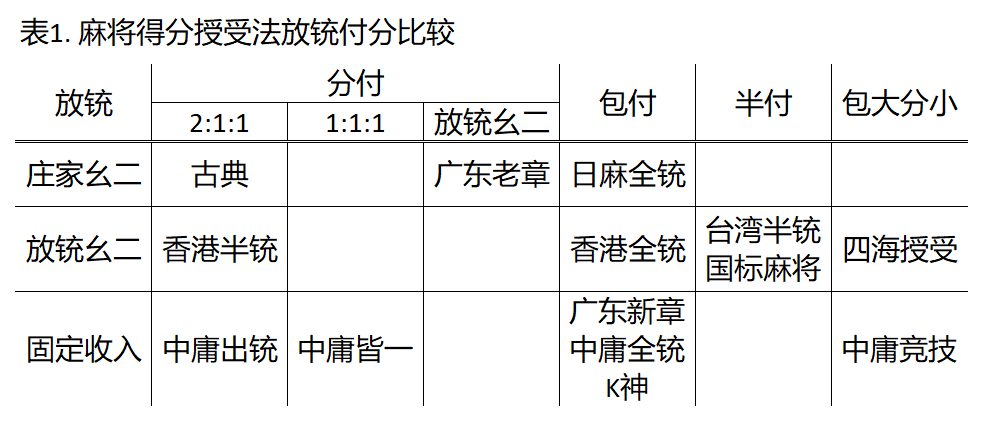
The original table groups systems by dealer-double, discarder-double, and fixed-income frameworks. Its columns distinguish shared payment, full discarder payment, payment of the discarder’s own share only, and the combined small-hand/large-hand approach. The translated table appears in “Comparing Mahjong Payment Systems,” linked above.
For direct comparison on the Chinese Official scale, Zung Jung and Four Seas hand values are divided by 5, and Four Seas receipts are further divided by 2. The following figure shows each system’s discarder and other-player payments relative to hand value.
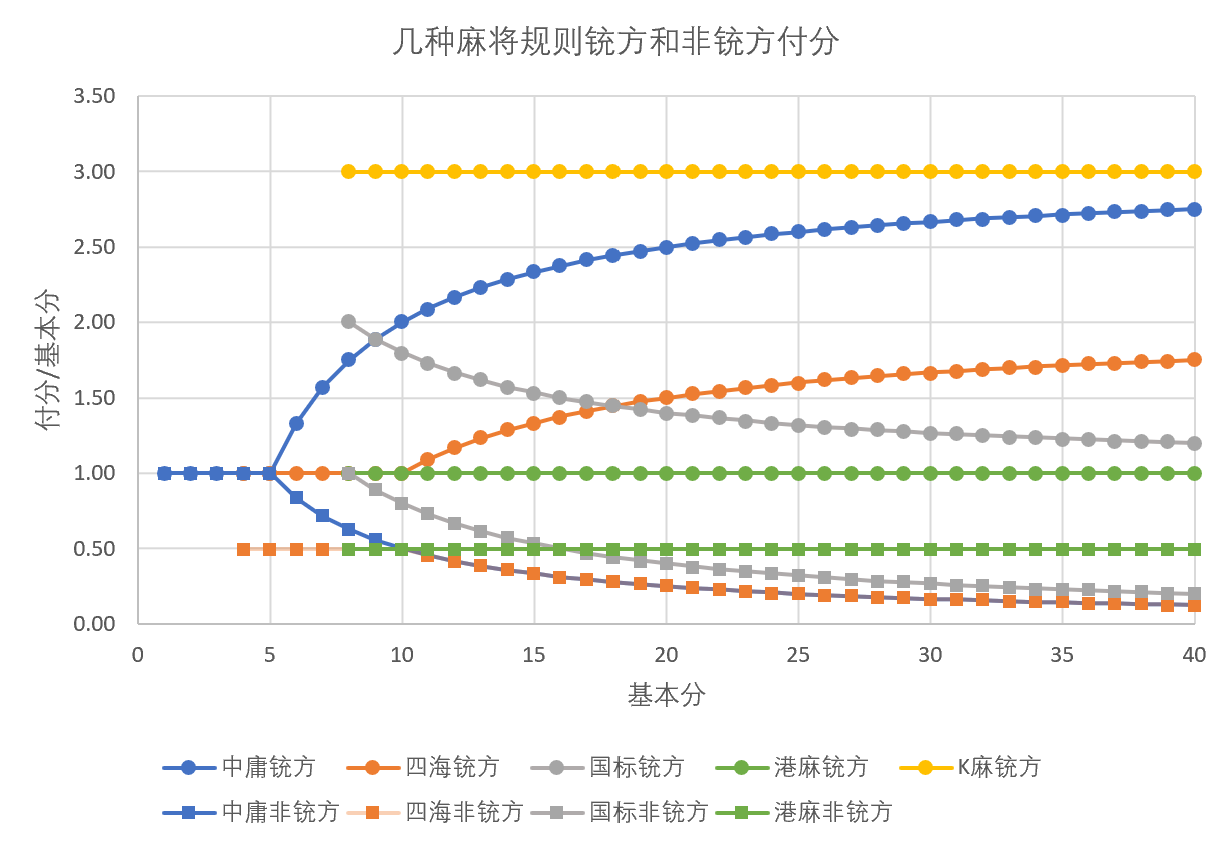
Horizontal axis: hand value. Vertical axis: payment / hand value. Circles mark discarder payments; squares mark the payment of each other losing player. Blue: Zung Jung; orange: Four Seas; gray: Chinese Official; green: Hong Kong; yellow: K-shen.
Full-discarder systems, represented by K-shen and also including Japanese riichi, make the discarder cover the whole loss while giving the winner the same receipts for self-draw and discard wins. They impose the greatest penalty for dealing in, shown by the highest horizontal line. After a player declares riichi with a concealed hand, opponents cannot tell which tiles complete it or how much it is worth—how many dora it contains. Japanese mahjong therefore developed what are the strictest and most complex furiten restrictions among mahjong rules: for example, restrictions described here as not being able to win on or wait for a tile previously discarded, and restrictions extending to other winning tiles in a multiple wait. These rules run against mahjong’s tile logic and freedom of play. They attempt to rescue the score imbalance created by dora and full-discarder payment, but also produce a conservative style with an extreme emphasis on defense.
All four players often race toward concealed ready hands, and it is common for one riichi declaration to cause the other three to fold. The riichi player waits for a lucky self-draw or winning discard, while the others mechanically draw and discard safe tiles, hoping that someone else deals in or the hand ends in an exhaustive draw. Without dora, Japanese mahjong would offer little enjoyment, and its skill demands would be close to those of simple first-to-win mahjong. These problems are not caused solely by full-discarder payment, but are closely connected with it. The potential loss makes opponents reluctant to counterattack. Meanwhile, unless the riichi player self-draws, those who do not deal in lose nothing, making it easy to abandon their hands.
Experience shows that full-discarder payment penalizes dealing in too heavily, making avoidance more important than winning and producing passive competition and dull play. It is an unreasonable rule.
Chinese Official and Zung Jung do not use full-discarder payment, so the other losing players also bear some loss: the discarder’s share stays below 100% in the next figure. Chinese Official requires an 8-point base payment; Zung Jung shares payments equally below 25 and caps each other player’s payment at 25. Although the final tile is the most important, a winning hand needs fourteen tiles and does not depend solely on the last discard. During construction, the winner may call chows, pungs, or kongs from other players; all three opponents have opportunities to supply tiles. To align responsibility with participation, players who did not discard the winning tile should also pay a share.
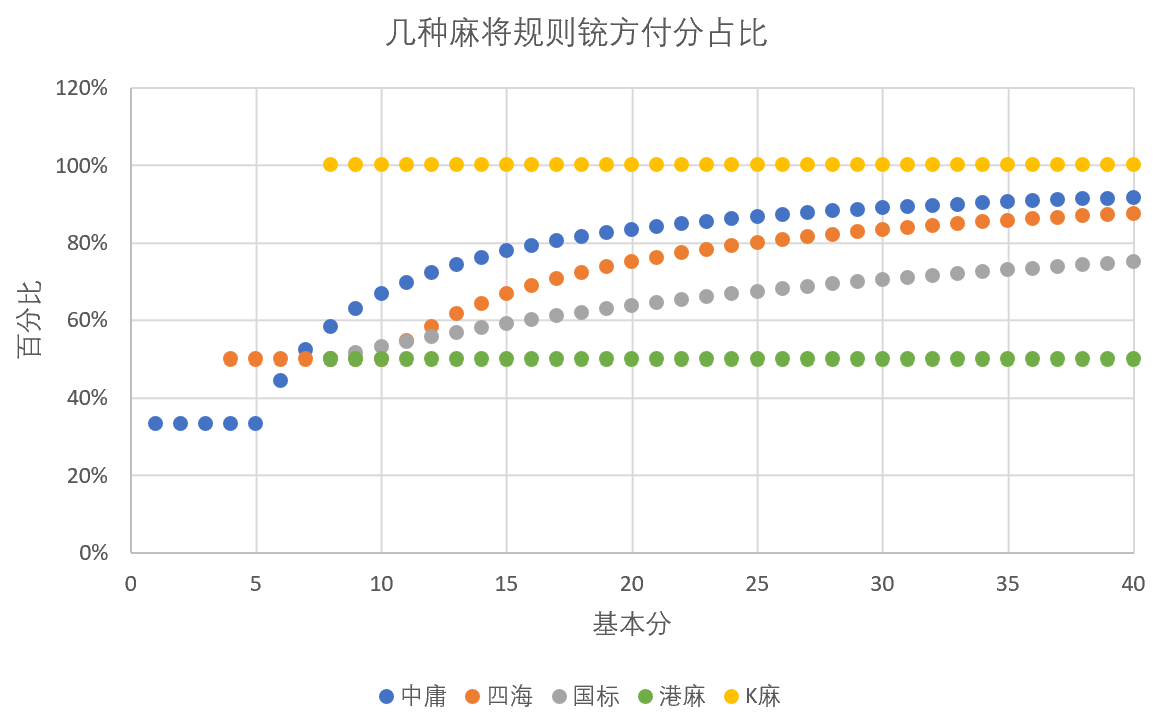
Horizontal axis: hand value. Vertical axis: discarder’s percentage of total payment. Blue: Zung Jung; orange: Four Seas; gray: Chinese Official; green: Hong Kong; yellow: K-shen.
Third: liability for dealing into small and large hands
“A Historical Perspective on Zung Jung Mahjong” also analyzes how full-discarder payment encourages excessive defense, makes mahjong dull, and reduces its competitive quality. Zung Jung identifies the main complaint about the original dealer-double or equal-share arrangements: when someone deals into a large hand, the other players are dragged into the loss. Small-hand losses attract far fewer complaints. Its solution is to share small-hand payments while placing the additional burden of large hands on the discarder. Large hands generally leave clues in exposed melds or discards. A player who misses those clues or takes the risk of counterattacking should cover the liability for dealing into such a hand. Small hands have fewer constraints and reveal less information, making their waits difficult to identify; the discarder should not bear the entire loss. Small hands also cost less, so the other two players suffer little even when they share the payment.
The figure above shows the discarder’s share at different hand values. In Zung Jung, Four Seas, and Chinese Official Mahjong, that share rises with hand value: the discarder bears greater responsibility for a large hand, in line with mahjong’s logic. Pure full-discarder and discarder-double systems instead maintain fixed proportions, without distinguishing liability for small and large hands.
Zung Jung’s combined approach first articulated this distinction and the corresponding responsibility, making an important improvement on full-discarder payment. For small hands, the system approaches shared payment, encouraging players to build large hands without excessive fear of dealing into a small one. For large hands, it approaches full-discarder payment, requiring players to weigh the risks and rewards and defend sensibly. This improves mahjong’s competitive quality.
The same improvement can be applied to discarder-double payments, producing the Four Seas system. In the two figures, pure full-discarder and discarder-double systems have horizontal lines: payments relative to hand value and the distribution of liability do not vary with hand value. The problem Zung Jung identifies—dragging other players into a large loss—also exists under discarder-double payments. For a 100-point hand, for example, the discarder loses 200 and each other losing player still loses 100. The two approaches can therefore be combined by setting a shared-payment threshold: below it, use discarder-double sharing; above it, have the discarder cover the excess while capping the others’ payments. This is the recommended Four Seas payment system.
The analysis suggests that a reasonable mahjong payment system should give self-draw 1.5 to 2 times the discard-win reward, avoid making the discarder bear the entire loss, share small-hand payments among all three losers, and place the additional burden of large hands on the discarder.
Apart from its fixed-income requirement that self-draw and discard wins pay equally, Zung Jung’s competitive system meets these criteria. Modifying it therefore naturally produces Four Seas’ combination of discarder-double payments with shared small-hand payments and capped other-player payments for large hands. It combines the strengths of several systems into a comparatively moderate approach. As the figures show, the Four Seas curves occupy the middle position among the five systems—another kind of “middle way,” the meaning of Zung Jung. Pure full-discarder and discarder-double payments are the extremes. Chinese Official and Zung Jung combine mechanisms and fall between them. Four Seas considers the various factors together and seeks balance across them, making it a reasonably designed mahjong payment system.
Originally published in Chinese on Zhihu · Zhihu revision 2024-12-31