Added to this site · 2026-09-15
Comparing Four Seas Mahjong with Several Competitive Rulesets
AI-assisted draft translation. Terminology is under review; please refer to the Chinese original if anything is unclear.
The previous article, A Comparative Evaluation of the Three Major Competitive Mahjong Rulesets: Chinese Official, Riichi, and Zung Jung, compared their strengths and weaknesses in ease of learning, hand-building, skill, and enjoyment. This article extends the comparison to several other competitive rulesets: Sichuan continuation mahjong, K-shen Mahjong as a revision of Chinese Official Mahjong, and Four Seas Mahjong as a development of Zung Jung. Each dimension is rated from 1 to 10, from lowest to highest.
Sichuan Mahjong is one of three rulesets recognized by the Mahjong International League, alongside Chinese Official Mahjong and Riichi, but not Zung Jung. Sichuan's Blood Battle to the End undoubtedly has the broadest player base in China. Popularity, however, does not establish that a ruleset is the most systematic or reasonable. Regional Chinese mahjong often emphasizes gambling more than competition. Although the league's three-fan cap reduces the gambling element, Sichuan's competitive qualities should be judged against the same dimensions used for the other major competitive rulesets.
K-shen Mahjong was developed from Chinese Official Mahjong by K-shen, a high-level player of both Chinese Official and Riichi Mahjong. It substantially simplifies the pattern list and reassigns more reasonable values, reducing 81 patterns to 61. It replaces Chinese Official Mahjong's eight-point base payment and triple self-draw reward with a full-discarder payment system resembling Riichi's, removes the base payment, and retains the eight-point minimum for winning. By removing many small patterns and increasing the rewards for concealment and self-draw, it borrows Riichi's emphasis on concealed-hand tile efficiency.
I designed Four Seas Mahjong on the foundation of Zung Jung's hand-building philosophy, making hand-building its main source of enjoyment while considering accessibility and competition. Four Seas explicitly uses the beauty of a tile pattern as the criterion for inclusion and its difficulty as the basis for scoring. It selects suitable patterns from mahjong rules across periods and regions, and adds original patterns based on the same philosophy. It has three levels defined by pattern counts and winning requirements: at present, Basic contains 18 patterns, Intermediate 49, and Advanced 100, forming a gradual progression from simple to complex. Since I designed Four Seas, some subjectivity in this comparison is unavoidable. Corrections and criticism are welcome.
1. Ease of learning
Sichuan Mahjong removes honors, leaving 108 tiles in three suits, and requires players to clear one suit before winning. It therefore has few patterns and centers on kongs and roots—four identical tiles, or Tile Hog. Its principal tile patterns are Full Flush, All Pungs, and Seven Pairs. Overall, its rules are easy to learn, although special provisions such as Blood Battle to the End, settlement in stages, checking readiness, and checking for players still holding all three suits add some complexity. Despite the Mahjong International League's recognition of Sichuan Mahjong, I could not find official Chinese rules on its website. The English pattern table is reproduced below.
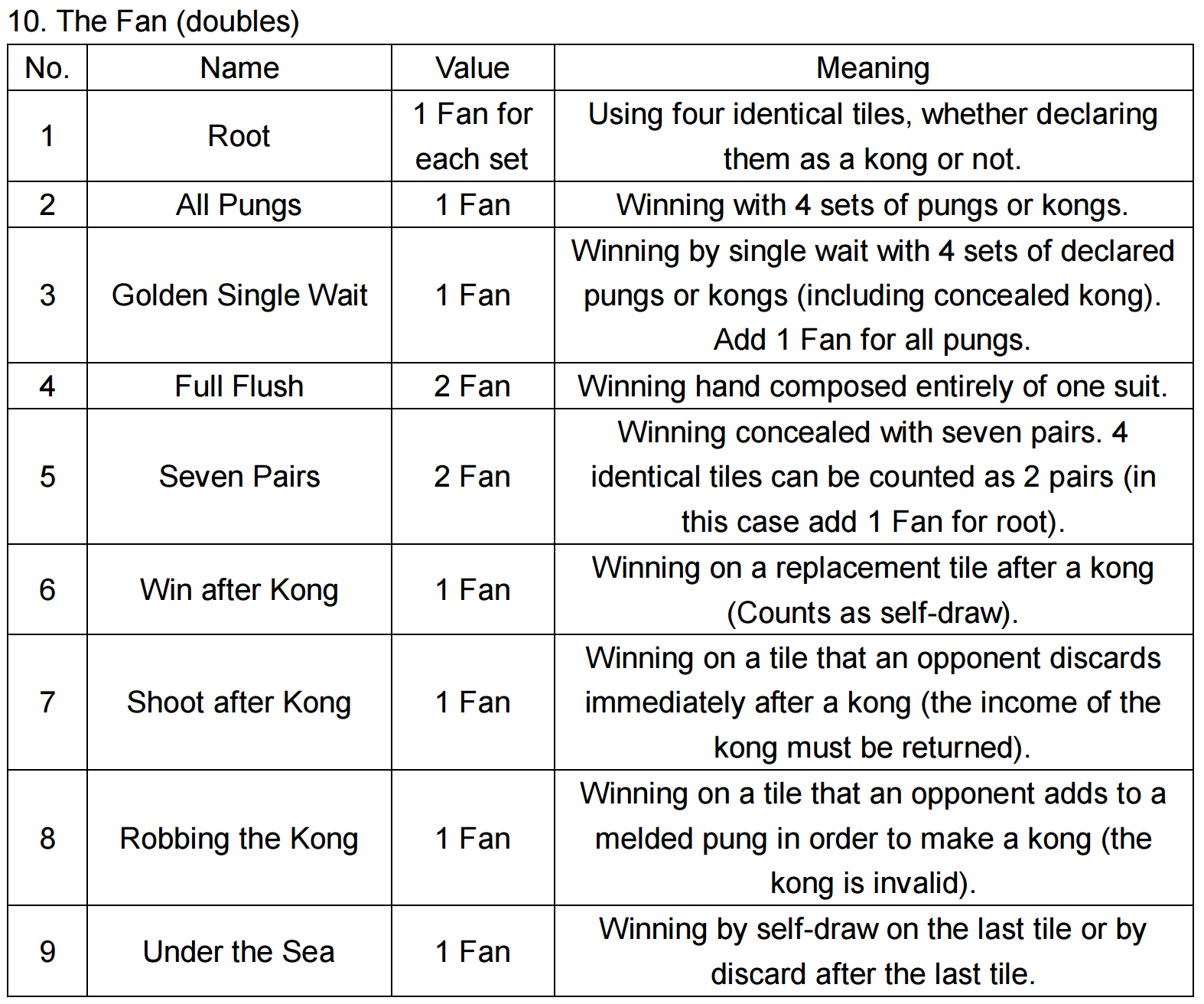
1. Root (including kongs); 2. All Pungs; 3. Golden Single Wait (Melded Hand); 4. Full Flush; 5. Seven Pairs; 6. Win after Kong; 7. Shoot after Kong; 8. Robbing the Kong; 9. Under the Sea.
Overall, Sichuan is the easiest to learn among the rulesets discussed here. This also helps explain its popularity: the simpler a game, the easier it is for the general public to learn.
The main obstacle to the wider adoption of Chinese Official Mahjong is the complexity of its rules. Its many patterns and high minimum score deter most players. Ordinary people do not have the time and energy to memorize 81 patterns and the still more numerous combinations needed to qualify for a win. Some knowledgeable players have therefore tried revising it. K-shen Mahjong is among the earliest and most influential of these efforts.
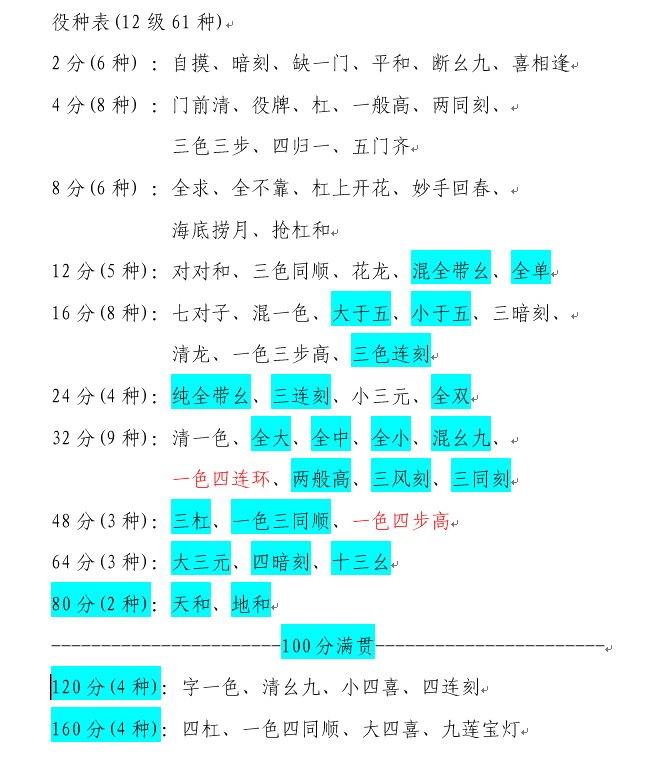
Reducing 81 patterns to 61 is a simplification, but a quantitative rather than qualitative one. Newcomers must still understand and memorize many patterns before starting. The minimum remains eight points, and learning how to combine patterns to reach it remains a major hurdle.
Four Seas develops Zung Jung, whose moderate total of 44 patterns, absence of a minimum score, and simple rules make it accessible. Even so, memorizing 44 patterns can be difficult for beginners. Under a five-point minimum that excludes Chicken Hand, the only small patterns are Concealed Hand, All Sequences, and All Simples, often leaving newcomers unsure how to win. From the outset, Four Seas identified ease of learning and skill or depth as conflicting elements that cannot both be fully satisfied at once. It therefore offers three progressively harder levels: Basic (Casual, or beginner level) prioritizes accessibility, while Standard (Advanced) prioritizes skill and competition.
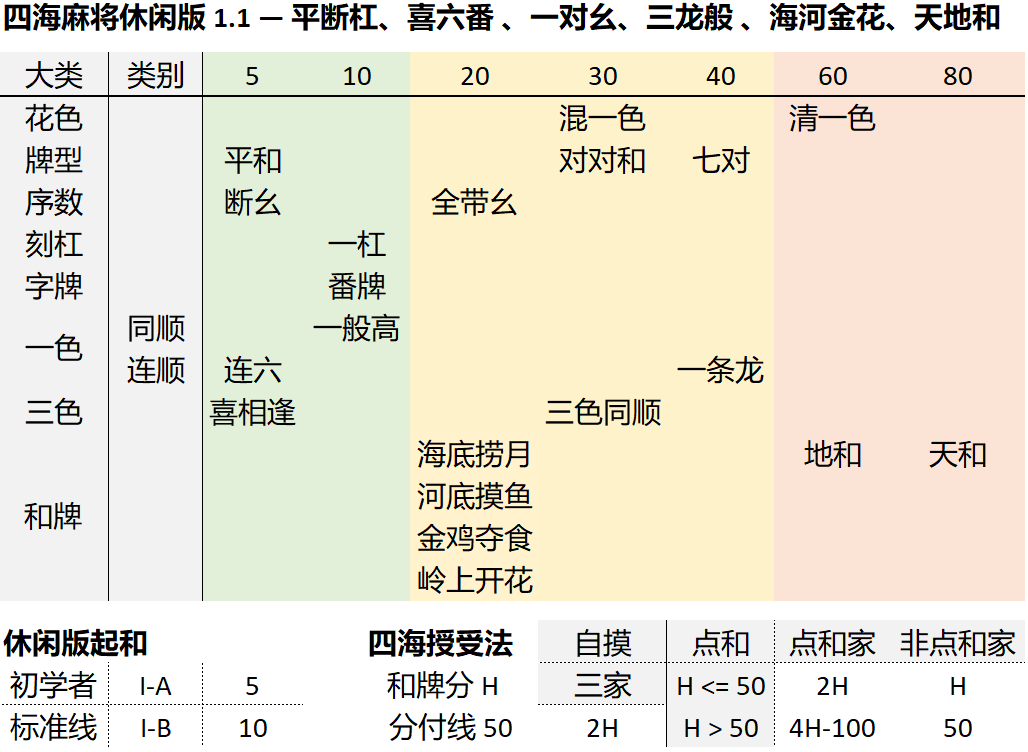
This illustration uses the watermark-free Casual version 1.1 original from Word, retaining its historical names and scores.
Basic contains only 14 tile patterns across nine series, with the mnemonic “平断杠、喜六番、一对幺、三龙般” to help players remember them. Adding six chance-based patterns for variety still gives it the smallest pattern list among existing competitive rulesets. It includes Mixed Double Chow and Short Straight, two of the easiest two-set combinations, helping beginners achieve the “freedom to win.”
Ease-of-learning scores: Sichuan 8, K-shen Mahjong 2, Four Seas 8.
2. Hand-building
Sichuan has only three major tile patterns—Full Flush, All Pungs, and Seven Pairs—and centers on kongs, leaving little scope for hand-building.
K-shen Mahjong removes patterns that K-shen considers unsuitable, but its overall pattern count remains in the same range as Chinese Official Mahjong. Removing the base payment that encourages quick small-hand wins, and weakening three-suit and five-type combinations, encourages hand-building relative to Chinese Official Mahjong. Under Riichi's influence, however, K-shen Mahjong regards Chinese Official Mahjong's lack of emphasis on tile efficiency as a weakness in skill. It therefore introduces concealed self-draw as a way to qualify through tile efficiency alone, much as Riichi does through the riichi declaration. Concealed Hand is worth four points, Self-Draw two, All Sequences two, and a concealed triplet two. A concealed self-draw therefore has either All Sequences or a concealed triplet and reaches eight points. Just as riichi becomes widespread in Japanese mahjong, introducing concealed self-draw as an eligibility route inevitably emphasizes concealed play. Concealment already supplies four points, so any other small patterns totaling four points suffice. Nearly half of K-shen Mahjong wins consequently consist of concealment plus small patterns, which does not fit the philosophy of building large hands. Overall, its hand-building is not improved over Chinese Official Mahjong and, in some respects, may be a step backward.
Four Seas Basic has expanded to 100 patterns. In substance, its patterns are tile-pattern-based: it removes purely difficulty-based rewards prone to excessive scoring, such as concealment, edge/closed/single waits, Fully Concealed Hand, and Last Tile. It also removes Mixed Shifted Chows, adjusts All Types, and eliminates the base payment that encourages quick wins. Many two-suit and triplet patterns are added to expand hand-building routes. Some series are completed from small patterns through main patterns to large patterns to support deliberate construction. Four Seas thus offers more buildable patterns than Chinese Official Mahjong and better supports hand-building.
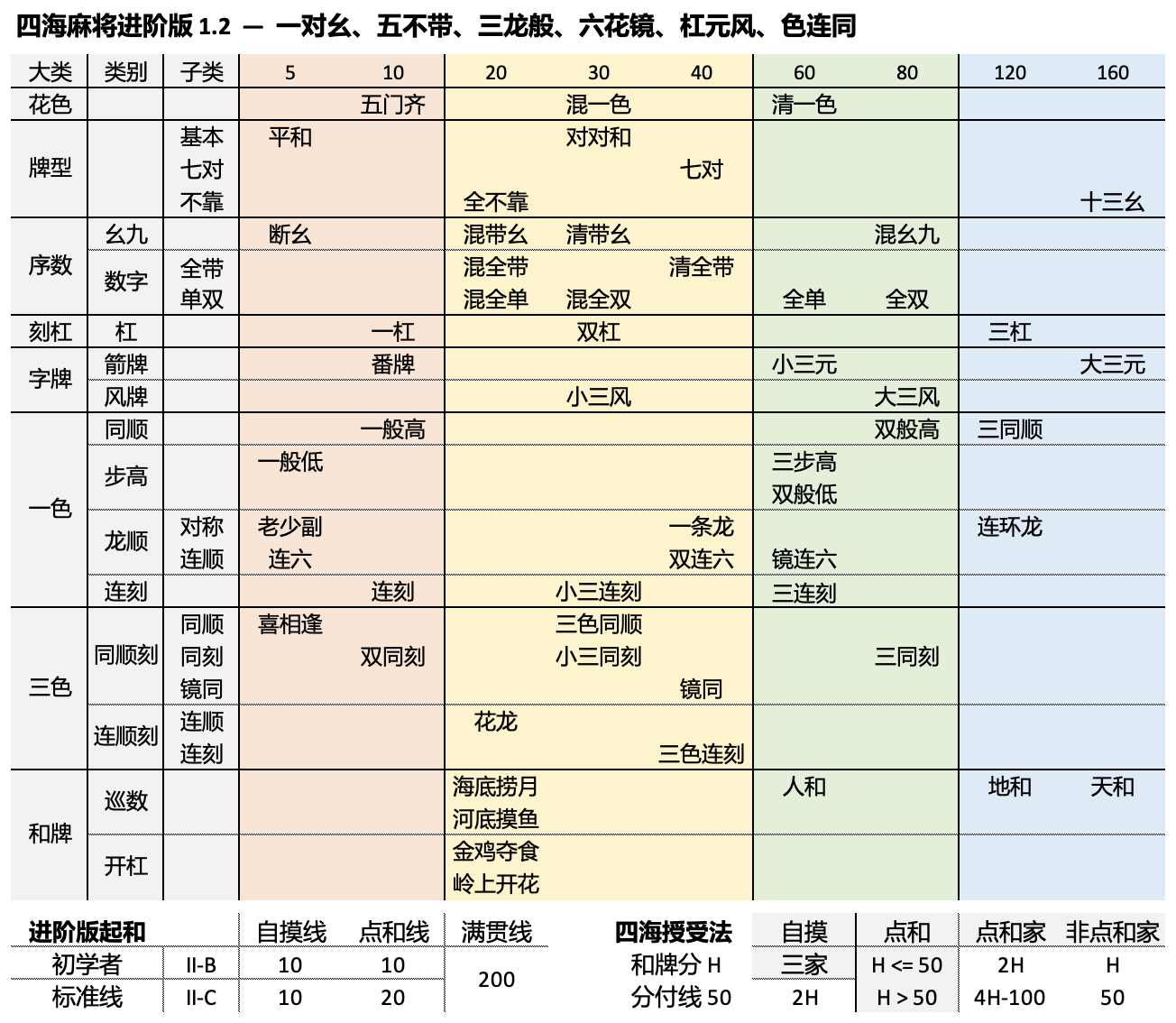
This illustration uses the watermark-free Intermediate version 1.2 original from Word, retaining its historical names and scores.
Hand-building scores: Sichuan 2, K-shen Mahjong 7, Four Seas 9.
3. Skill and depth
As discussed in A Comparative Evaluation of the Three Major Competitive Mahjong Rulesets: Chinese Official, Riichi, and Zung Jung, skill is not limited to general tile efficiency. Different rules introduce their own varied skills and additional dimensions of decision-making. In other words, tile efficiency focuses on the single objective of winning as quickly as possible; different rules add considerations such as hand-building, concealed riichi, and defense, making decisions more complex and multidimensional and thereby increasing skill and depth.
Sichuan's Blood Battle to the End is undoubtedly a distinctive innovation. It changes the usual winning structure and adds a new dimension of skill. Yet its associated rules—no honors, a required missing suit, no chows, readiness checks, and penalties for retaining all three suits—reduce the complexity of hand structures, player interaction, and defensive play. Placing kongs, with their strong chance component, at the center increases luck. Choosing the missing suit and counting tiles in the endgame introduce new skills, but these fall far short of compensating for the weakening of mahjong's basic skills.
K-shen Mahjong has two main technical components: combining patterns to reach eight points, as in Chinese Official Mahjong, and prioritizing concealment, as in Riichi. This matches K-shen's intention to give hand-building and efficiency equal weight. Together, they offer somewhat more technical variety than either source ruleset.
Four Seas has separate minimum scores for self-draw and discard wins: under Rule C, 10 and 20 points; under Rule D, 20 and 40. A hand above the discard-win threshold may win either way; a hand below it but above the self-draw threshold may win only by self-draw; a hand below the self-draw threshold cannot win. This gives players more choices and offers those with poor starting tiles a self-draw route when they cannot build enough points. It also allows defensive changes of plan: if a large hand's route is blocked, a player can switch tiles and aim for self-draw, adding another dimension of skill.
A closer analysis shows that these different designs address the same question: can an ordinary patternless hand win, and under what conditions should it be allowed to do so? Unrestricted mahjong with chows, pungs, discard wins, and no pattern requirement makes winning too easy. Although it supports pure tile-efficiency theory, it offers little variety of enjoyment. Almost every competitive ruleset therefore imposes eligibility requirements. (Indeed, the more a ruleset depends on tile-efficiency skill, the less enjoyable it becomes.)
Eligibility conditions usually take the form of historically established patterns, some based on tile structure and others on luck, with widely differing difficulty. Pattern selection is therefore crucial. Too many easy patterns fail to impose a meaningful requirement; too few difficult ones cannot accommodate the enormous variety of random 13-tile starting hands, letting initial luck undermine competition. There are two approaches: provide many small patterns that can combine to meet the minimum across different starting hands, as Chinese Official Mahjong does; or provide an eligibility condition or pattern that allows an otherwise ordinary hand to win, as Riichi does. The table compares these approaches.
| Ruleset | Small patterns | Eligibility route | Combining patterns to qualify |
|---|---|---|---|
| Unrestricted mahjong | Chicken Hand | ||
| Riichi | All Simples, scoring honors | Riichi declaration | |
| Zung Jung | All Sequences, All Simples | Concealed Hand | |
| Chinese Official | 8 points | ||
| K-shen Mahjong | Concealed self-draw | 8 points | |
| Four Seas | Self-draw halves the minimum | 20 points |
Riichi requires a yaku but has relatively few patterns, omitting simple classical small patterns such as edge, closed, and single waits. Its easiest qualifying patterns are scoring honors and All Simples, while All Sequences requires concealment. To accommodate random starting hands, it introduces the riichi declaration: once a concealed hand is ready, any hand structure can obtain a yaku by declaring riichi. This gives ordinary hands an eligibility condition. The influence is far-reaching. Zung Jung follows a similar approach, using Concealed Hand as an eligibility pattern, while All Sequences and All Simples can also qualify independently. Both its small-pattern and eligibility routes have lower barriers than Riichi, making it much easier to qualify for a win.
Chinese Official Mahjong takes the other approach. Neither a patternless hand nor a single small pattern suffices; more than 30 patterns worth less than eight points can be combined to reach the minimum. This supports hand-building but makes entry difficult. Their design and point values strongly shape strategy and tactics, and unreasonable values can create excessive rewards and loopholes, such as the prevalence of three-suit and five-type combinations.
K-shen Mahjong retains Chinese Official Mahjong's eight-point minimum while removing many small patterns used to reach it. To compensate, it borrows from Riichi and introduces concealed self-draw as an eligibility route when no hand-building route is apparent. This combination balances hand-building against tile-efficiency skill.
Four Seas does not let self-draw qualify just any hand. Instead, it halves the minimum from 20 to 10 points, or from 40 to 20. Some pattern value is still required; patternless wins are not allowed. While preserving hand-building, it uses one chance-based event—self-draw, described here as a one-in-four possibility—to compensate for another source of luck: random starting tiles.
Skill scores: Sichuan 3, K-shen Mahjong 8, Four Seas 8.
4. Enjoyment and spectator appeal
The previous article argued that both hand-building and the skill involved in competitive interaction improve enjoyment for players and spectators. Gambling is also an important source of mahjong's entertainment value, and the entire source of pleasure in gambling-focused mahjong. Flaws in the rules detract from enjoyment and spectator appeal.
Sichuan offers relatively little hand-building or skill, and much of its nationwide popularity comes from Blood Battle to the End. Traditional mahjong has one winner and three losers; this becomes, nominally, three winners and one loser. Losing three deals out of four on average becomes winning three out of four, satisfying the desire to complete winning hands. Removing honors reduces useless tiles; requiring a missing suit simplifies decisions and makes large hands such as Full Flush easy; centering on the simple, luck-driven kong allows rewards to stack to large values where local rules impose no cap, making gains and losses more exciting. These design choices meet various psychological needs and give Sichuan its distinctive appeal. Yet the mandatory missing suit, readiness checks, and three-suit penalties severely constrain strategy. Choosing the wrong suit to clear or being forced to deal into another player's hand also generates frustration.
K-shen Mahjong resembles Chinese Official Mahjong in hand-building and skill. It exchanges the bias toward three-suit and five-type patterns for one toward concealed self-draw, with nearly half of wins concealed. Its tradeoff between hand-building and tile efficiency leaves its enjoyment broadly similar to Chinese Official Mahjong.
Four Seas prioritizes hand-building. Its Standard version also includes Rule D, with higher minimums of 20 points for self-draw and 50 for discard wins, intended for experienced players who know the rules and want to pursue large hands.
Enjoyment and spectator-appeal scores: Sichuan 5, K-shen Mahjong 6, Four Seas 8.
The following table summarizes the four dimensions and total scores for the rulesets, including unrestricted mahjong. Each dimension is rated from 1 to 10.
| Dimension | Unrestricted | Chinese Official | Riichi | Zung Jung | Sichuan | K-shen Mahjong | Four Seas |
|---|---|---|---|---|---|---|---|
| Ease of learning | 10 | 1 | 4 | 6 | 8 | 2 | 8 |
| Hand-building | 1 | 7 | 3 | 4 | 2 | 7 | 9 |
| Skill/depth | 1 | 7 | 8 | 5 | 3 | 8 | 8 |
| Enjoyment/spectator appeal | 1 | 6 | 6 | 4 | 5 | 6 | 8 |
| Total | 13 | 21 | 21 | 19 | 18 | 23 | 33 |
Sichuan is simple and accessible, and Blood Battle to the End appeals to human psychology. Its derivative Blood Flowing Like a River is still more exciting, making it strongly attractive to a broad audience. As a competitive ruleset, however, its few patterns cannot express mahjong's variety through hand-building. Removing honors, requiring a missing suit, and prohibiting chows substantially restrict freedom of play and interaction, reducing the role of skill. It is therefore not particularly suitable for competitive mahjong.
K-shen Mahjong systematically reassesses Chinese Official Mahjong's patterns, corrects excessive rewards, removes the base payment that encourages quick wins, and adds concealed self-draw as an eligibility route. These improve both its coherence and technical play. Yet it does little to address the greatest obstacle to Chinese Official Mahjong's adoption: ease of learning. Anyone willing and able to learn K-shen Mahjong could also learn Chinese Official Mahjong. This prevents its design advantages from displacing a ruleset that has already become a national standard and been in use for 20 years.
Four Seas designs different levels for newcomers and experienced hand-builders. The beginner or Casual level is kept simple enough to remember. Interested players can then move to Intermediate, learn more routes, and raise the minimum score before progressing to the complete Standard or Advanced version. This device gives Four Seas the highest total in the table, whereas the other rulesets' ease of learning generally trades off against their other qualities.
Again, these judgments inevitably contain subjectivity, and Four Seas is far from perfect. My hope is that this exploration, building on earlier work, offers useful ideas for mahjong's design and development. More enjoyable, accessible, systematic, and competitive rules will surely emerge in the future.
Originally published in Chinese on Zhihu · Zhihu revision 2026-05-31