Added to this site · 2026-09-15
What Makes an Ideal Mahjong Ruleset?
AI-assisted draft translation. Terminology is under review; please refer to the Chinese original if anything is unclear.
I came across a question on Zhihu: “What do you think the best mahjong rules would look like? If a ‘perfect’ ruleset existed, what qualities should it have?” People's tastes and preferences differ. Some enjoy building large hands, some enjoy the excitement of bonus tiles, some are happy only when they win, and others feel a sense of achievement from defending against a large hand. No perfect ruleset can therefore satisfy everyone.
Existing mahjong rules all have problems of one kind or another and do not fully meet enthusiasts' needs, so we should try to design the most systematic and reasonable rules possible. Of course, this idea of what is systematic and reasonable also reflects personal preferences. The previous two articles compared competitive rulesets through ease of learning, hand-building, skill, and enjoyment. We can discuss an ideal ruleset by extending those dimensions.
1. Ease of learning
Above all, the rules should be simple to learn. They should not immediately drive people away with dozens of patterns and a high minimum score. We should borrow from online game design by building the player's learning path into the rules, dividing them into beginner, intermediate, and advanced levels, and gradually introducing more patterns and harder winning requirements. Anyone familiar with mahjong's basic mechanics should be able to pick up the beginner version quickly. It should contain fewer than 20 patterns, with a single scoring pattern sufficient to win. Regional rules differ enormously across China; the beginner version should be simple enough for people from different regions to start playing together quickly.
2. Hand-building
Scoring patterns lie at the heart of mahjong's enjoyment, and hand-building should be the direction of its future development. Beauty should determine which patterns are included, and difficulty should determine their scores. In principle, the more patterns that meet these criteria, the better. Pattern design must be systematic and reasonable: avoid excessive duplication, provide series from low to high to support deliberate construction, and impose a scoring limit to reduce luck. The rules should encourage large hands without excessively restricting play or forcing players to build them regardless of their starting tiles. As far as possible, every starting hand should offer something to build.
3. Skill
In perfect-information games such as Go and Chinese chess, all pieces are visible to both players, and the outcome depends entirely on skill. Mahjong and card games, in which players cannot see one another's hands, are imperfect-information games with a substantial element of luck. In bridge and Dou Dizhu, the cards held by each side are fixed at the outset. In mahjong and Texas Hold'em, hands develop as play proceeds, and each decision affects the player's own hand and those of opponents. Such games therefore inherently contain more luck. Mahjong rules cannot eliminate that inherent randomness, but good rules should not add more.
Mahjong's most basic skill is tile efficiency in unrestricted play, grounded in mathematics and statistics. Beyond efficiency, the rules should express multiple dimensions of skill—building and combining patterns, changing hand structures, and judging attack versus defense—to deepen and broaden the game's technical content.
4. Coherence of the rules
The basic mechanisms of chow, pung, and kong should all be retained. Rules that permit pungs but not chows, or self-draw wins but not discard wins, compromise the completeness of the game. Unreasonable restrictions such as furiten, kuikae, and readiness checks limit players' freedom and mahjong's strategic variety and should be excluded. Mahjong is a four-player contest of attack and defense. Preventing opponents from completing their hands while developing one's own is a fundamental strategy, so the payment system should reflect discarder liability. Pattern values should be reasonable, avoiding excessive rewards that make particular patterns dominate winning hands.
5. Enjoyment
Mahjong's positive recreational appeal should be considered apart from gambling. Even without money at stake, it should be enjoyable to play and engaging to watch. Hand-building, skill, and coherent rules all contribute to that enjoyment. We should improve each of these aspects, designing rules that offer more hand-building, more skillful interaction and competition, and greater coherence. Mahjong, a game with more than a century of history, can serve as entertainment for family gatherings and social occasions, just as card games and today's popular board games do.
6. Competitive potential
Mahjong includes many mathematically grounded skills, but it is also a game with considerable luck. A large luck component does not, however, make a game unsuitable for competition. We can think of competitive performance as a normal distribution, with skill determining the mean and luck the standard deviation. In Go and Chinese chess, luck is almost zero, producing a tall, narrow bell curve, and the outcome between players depends almost entirely on skill. In mahjong, luck—the standard deviation—is very large, even larger than the mean, producing a low, broad curve. Even players with different skill levels have strongly overlapping distributions, so luck may dominate a single contest. Statistically, repeated measurements can reduce variance. Competitive Chinese Official Mahjong and Riichi therefore increase the number of deals to reduce the influence of luck.
From the perspective of tournament design, mahjong can thus support competition. Indeed, because luck means that skill does not completely determine the result, the contest can be more engaging to watch. A Go match between players of substantially different ranks is a one-sided defeat. In football and other sports, where luck, condition, morale, and performance on the day play significant roles, results are less predictable and contests more exciting. Mahjong rules should strengthen skill as much as possible without adding to existing randomness, thereby improving competitive potential.
Overall, an ideal ruleset should first be easy to learn, then do as well as possible in hand-building, skill, and coherence. Such a game will also be highly enjoyable and suitable for competition. Hand-building and skill necessarily bring complexity and depth, however, and thus conflict with ease of learning.
Comparing Four Seas Mahjong with Several Competitive Rulesets evaluated the different systems. The table below reproduces those scores and adds separate scores for Four Seas levels I, II, and III.
| Dimension | Unrestricted | Chinese Official | Riichi | Zung Jung | Sichuan | K-shen Mahjong | Four Seas | I | II | III |
|---|---|---|---|---|---|---|---|---|---|---|
| Ease of learning | 10 | 1 | 4 | 6 | 8 | 2 | 8 | 8 | 5 | 2 |
| Hand-building | 1 | 7 | 3 | 4 | 2 | 7 | 9 | 3 | 6 | 9 |
| Skill/depth | 1 | 7 | 8 | 5 | 3 | 8 | 8 | 5 | 7 | 8 |
| Enjoyment/spectator appeal | 1 | 6 | 6 | 4 | 5 | 6 | 8 | 5 | 7 | 8 |
| Total | 13 | 21 | 21 | 19 | 18 | 23 | 33 | 21 | 25 | 27 |
Using these scores, the chart below shows the relationship between ease of learning and depth, defined as the average of hand-building, skill, and enjoyment. Greater ease of learning corresponds to less depth, and vice versa.
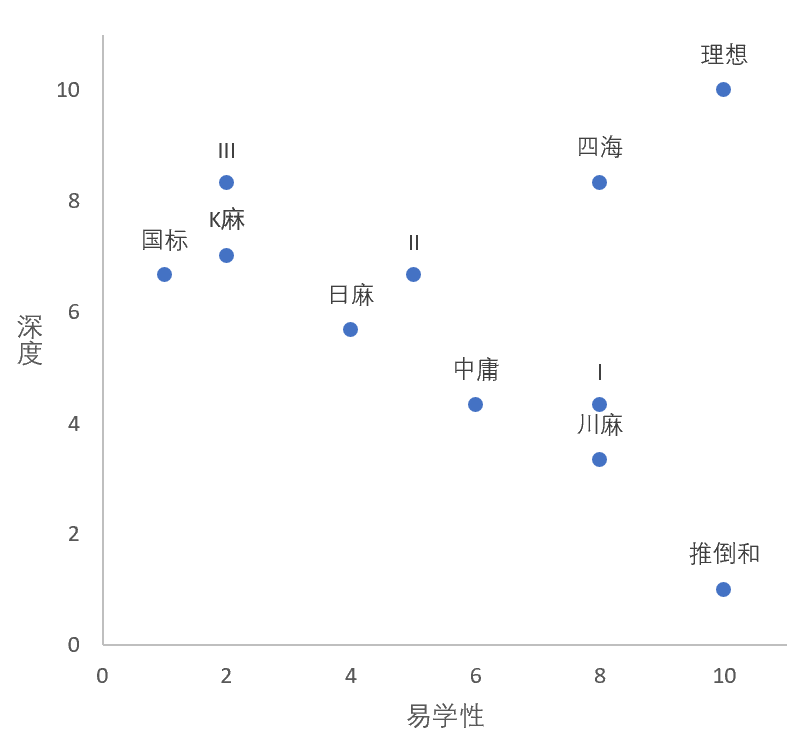
Chart labels: 推倒和 = Unrestricted; 国标 = Chinese Official; 日麻 = Riichi; 中庸 = Zung Jung; 川麻 = Sichuan; K麻 = K-shen Mahjong; 四海 = Four Seas; 理想 = Ideal. I, II, and III are the three Four Seas levels.
Four Seas addresses this tension by designing three difficulty levels: Basic (Casual) prioritizes ease of learning, while Standard (Advanced) strengthens hand-building. Even so, it remains far from an ideal ruleset. In accessibility, Basic's 14 tile patterns and four chance-based patterns already approach the limit of simplification. In depth, Standard still has considerable room to improve hand-building and technical depth.
Originally published in Chinese on Zhihu · Zhihu revision 2026-05-31