Added to this site · 2026-09-16
Preliminary Four Seas Mahjong Statistics, Part I: Hand-Building in Practice
AI-assisted draft translation. Terminology is under review; please refer to the Chinese original if anything is unclear.
Designing new mahjong rules can draw on the strengths and experience of existing rulesets, while mathematical and statistical methods help analyze pattern difficulty and scoring. Actual playtesting and the collection of game records are nevertheless indispensable for identifying weaknesses and refining the rules.
Over the past few months, I recorded games of Four Seas Mahjong played with friends in our spare time. We played approximately once a week, usually a half-game or full-game session, accumulating more than 200 hands. We mainly used the 56-pattern Intermediate Edition rather than the Advanced Edition for two reasons. First, our group was moving from Zung Jung to Four Seas, while beginners were progressing from the Recreational Edition; memorizing the Advanced Edition's 81 patterns would burden newcomers. Second, Intermediate already includes every hand-building route. Advanced adds higher forms of the corresponding patterns, which are harder and rarely completed. Intermediate therefore preserves Four Seas' strategic and competitive qualities while allowing players to advance as they become familiar with the rules.
List of winning patterns
The patterns in all winning hands are listed in Preliminary Four Seas Statistics: Pattern List. The format is illustrated below: the first entry is the hand score, followed by the patterns present in that hand.
180, Pure One-Suit, Two Identical Sequences Twice, Half Straight Twice
160, Thirteen Orphans
160, Thirteen Orphans
150, All Triplets, All Even, Little Three Similar Triplets, Two Similar Triplets
130, Pure One-Suit, Three Shifted Sequences, Two Terminal Sequences, All Sequences
125, All Linked, Two Identical Sequences Twice, All Simples
120, All Triplets, All Even, Two Similar Triplets
115, All Linked, Three Shifted Sequences, Two Similar Sequences, All Sequences, All Simples
115, Pure One-Suit, Pure Straight, Two Identical Sequences, All Sequences
110, All Triplets, Three-Suit Consecutive Triplets, Little Three Similar Triplets, Consecutive Triplets
100, Mixed One-Suit, All Triplets, Little Three Consecutive Triplets, One Quad
Winning-score distribution and minimum winning scores
There were 234 winning hands. The chart shows a roughly bell-shaped distribution with a slight positive skew. The mean was 51.13 points. There were 115 hands scoring 50 or more and 119 scoring 45 or less, almost equal numbers, placing the median between 45 and 50. With the relatively small sample, both 45 and 50 had appeared as the median at different stages of collection. The mode, the most frequent score, was 40 points. This distribution changed little as records accumulated: its general shape, mean, and median were already evident after approximately 100 hands. It therefore seems reasonable to infer that, despite the limited sample, these records broadly reflect Four Seas' overall winning-score distribution.
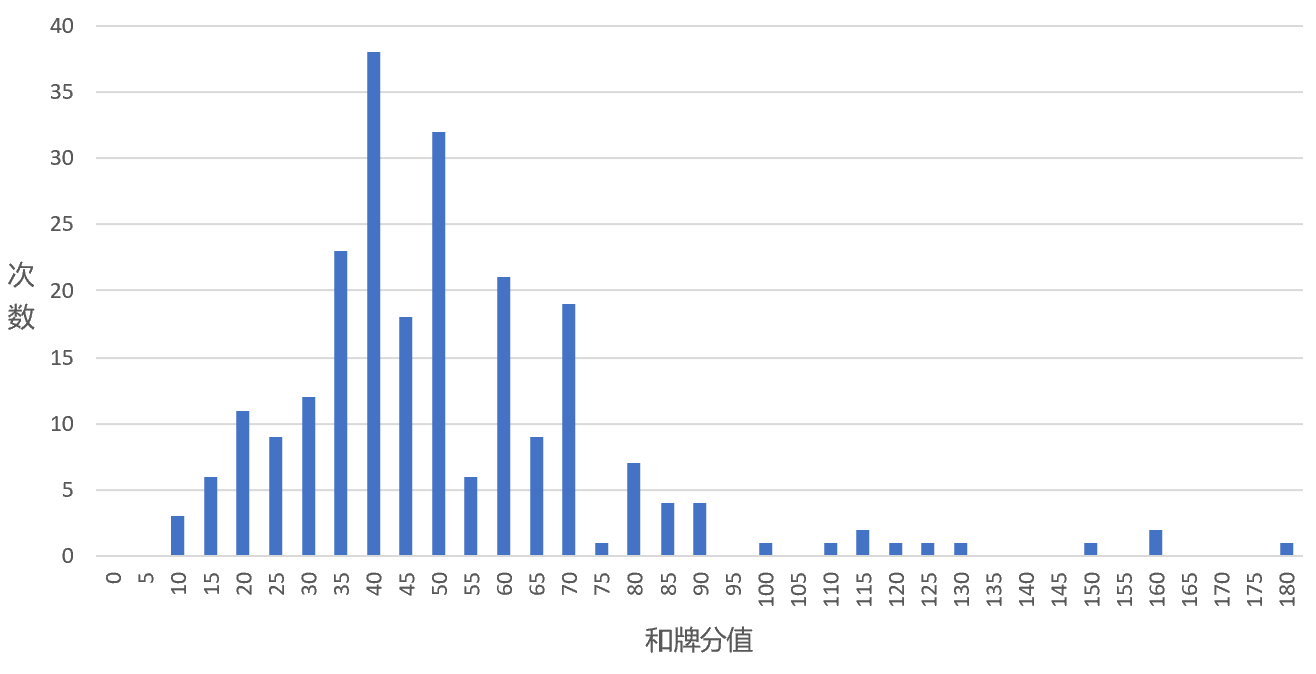
Four Seas has two minimum winning scores: 10 for self-draw and 20 for a discard win. Taking 20 as the threshold, the mean score of 51.13 is approximately 2–2.5 times the minimum; taking the self-draw threshold, it reaches four to five times the minimum.
Compare this with Zung Jung and Chinese Official Mahjong:
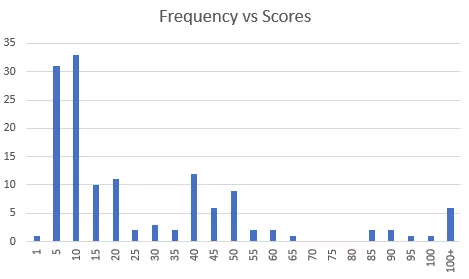
Zung Jung score distribution, from BarclayII.
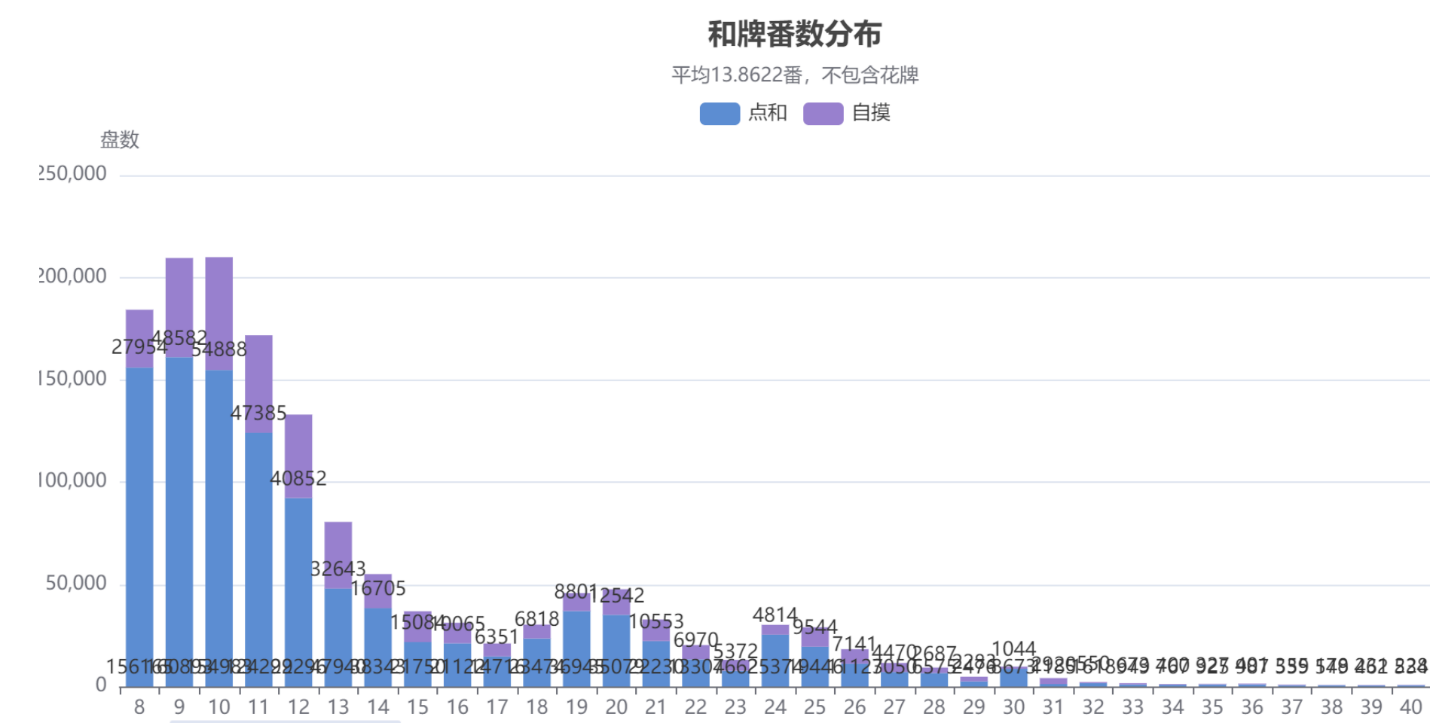
Chinese Official Mahjong score distribution, from an online platform.
Zung Jung's minimum is five points, or one in the alternative version, while Chinese Official Mahjong requires eight. Their scores concentrate at or just above the minimum, with the peak close to that threshold. This is characteristic of racing-to-win rules: players compete to complete hands that just qualify rather than pursuing more valuable patterns. Their distributions are consequently highly asymmetric, with the minimum near the peak and high-scoring wins forming a long right tail, as though half a bell-shaped distribution had been cut away.
I did not find an equivalent distribution of pattern han for Japanese mahjong. Such a chart would need to exclude dora and ura-dora, since those are purely multiplying factors unrelated to the beauty or difficulty of hand construction. I would nevertheless predict a distribution similar to Zung Jung: predominantly one- and two-han wins, with relatively few high-han hands. Because riichi requires a yaku, racing to a one-han win is the optimal strategy. The experience of a two-han minimum—one han being easy, but two being difficult—also suggests that players will not sacrifice speed to build a substantially harder hand for one additional han. In this sense, Japanese mahjong is a ruleset for racing to one han.
Four Seas also sets a minimum, but its relationship with pattern categories and values, discussed later, encourages hand-building while players race to win. Although the thresholds are 10 and 20, the mean exceeds 50. Its outcomes thus encourage hand-building.
Scores ending in five come entirely from the six five-point patterns: All Sequences, All Simples, Two Shifted Sequences, Two Terminal Sequences, Half Straight, and Two Similar Sequences. Higher-valued patterns contribute multiples of ten, so fewer hands end in five than in zero. Grouping adjacent scores into ten-point intervals makes the distribution clearer. The resulting chart is a typical bell-shaped distribution with a slight positive skew.
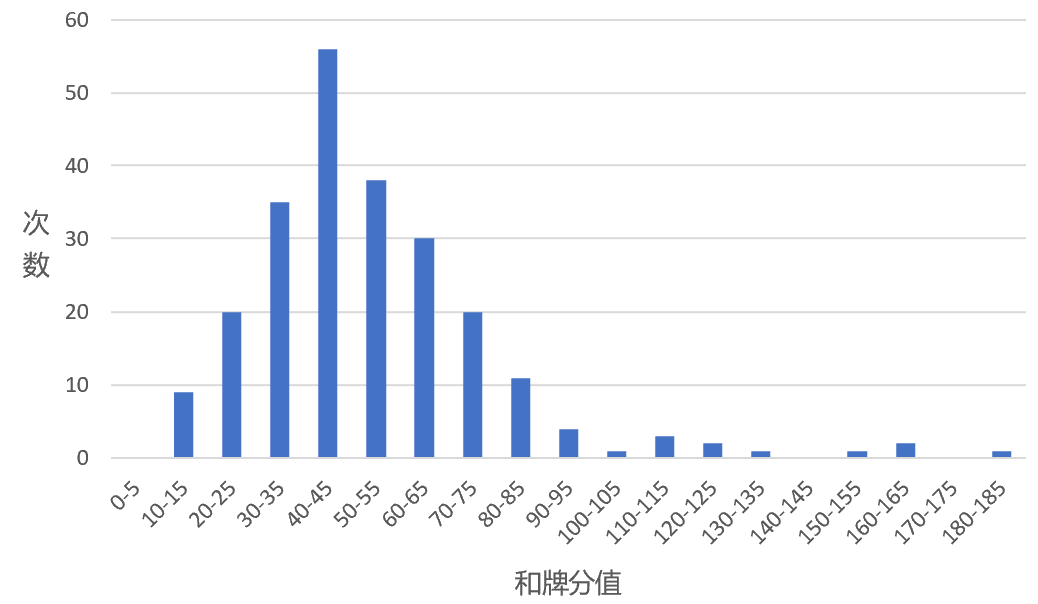
Skewness measures asymmetry. Positive skewness means the peak lies toward the left and the longer tail extends right. Its absolute magnitude indicates the degree of asymmetry; zero indicates symmetry around the mean. The table compares distribution parameters for scores up to 100, or 25 in Chinese Official Mahjong.
| Ruleset | Mode | Median | Mean | Skewness |
|---|---|---|---|---|
| Four Seas | 40 | 45 | 51.1 | 0.37 |
| Chinese Official | 10 | 11 | 13.9 | 1.20 |
| Zung Jung | 10 | 15 | 29.0 | 1.45 |
All three distributions are positively skewed because high-valued patterns exist. Their asymmetry follows Zung Jung > Chinese Official >> Four Seas. Four Seas is closest to a normal distribution. Its peak at 40–45 is four times the lowest 10–15 band, reflecting its encouragement of hand-building.
Payments, win rate, and self-draw share
For roughly the first 150 hands, we used Zung Jung's competitive payment system before switching to Four Seas payments. Four Seas developed from Zung Jung, and its original design did not rule out using that payment system. Preliminary analysis nevertheless showed that it was increasingly ill-suited to Four Seas.
Most Zung Jung wins score five or ten points. Its 25-point payment-sharing threshold distinguishes the discarder's responsibility for small and large hands. In Four Seas, however, the average winning score is about 50 and hands below 25 are rare. The two non-discarding opponents consequently pay 25 in most cases, making the sharing threshold almost a fixed base payment and depriving it of its intended role.
Second, as discussed in Attack–Defense Decisions and Payment Systems, Part II, at an average winning score of 50, Zung Jung payments approach full discarder liability. The severe penalty encourages conservative play and produces an exhaustive-draw rate above 20%. The table compares the first 159 hands with the later 126 under different payment systems.
| Payment system | Hands | Exhaustive draws | Winning hands | Draw rate |
|---|---|---|---|---|
| Zung Jung competitive | 159 | 32 | 127 | 20.13% |
| Four Seas | 126 | 19 | 107 | 15.08% |
| Total | 285 | 51 | 234 | 17.89% |
In the later period, switching to Four Seas payments with a sharing threshold of 50 reduced draws to some extent. At this stage, Four Seas retained a fourteen-tile dead wall to preserve uncertainty and competition, so its draw rate was unlikely to fall to Chinese Official Mahjong's 4%. Nor is a lower draw rate always better for balanced attack and defense. Drawn results are common in games such as Chinese chess and chess. In Four Seas, an exhaustive draw often reflects the contest between attackers and defenders rather than all four players being unable to complete a hand, and is itself part of competitive play.
Of the 234 winning hands, 72 were self-drawn, a 30.8% share. Generally, the self-draw share reflects the balance between attack and defense: a higher share, and correspondingly fewer discard wins, suggests greater emphasis on avoiding deal-ins. Chinese Official Mahjong's share is 26.0%, compared with 33.6% for Japanese mahjong, suggesting that the former favors attack and the latter defense. Four Seas lies between them.
Attack–Defense Decisions and Payment Systems, Part II discussed how payments affect these decisions. Chinese Official Mahjong uses an eight-point base and a triple self-draw reward; Four Seas uses a double discarder share with capped payments by uninvolved players for large hands; Japanese mahjong combines a double dealer factor with full discarder liability. The corresponding attack–defense multiplier, x, rises across these systems, indicating an increasing defensive tendency. The observed Four Seas self-draw share, alongside the Japanese and Chinese Official figures, supports the influence of these payment structures on attack and defense.
These preliminary game statistics illustrate Four Seas' hand-building characteristics.
Originally published in Chinese on Zhihu · Zhihu revision 2024-12-31