Added to this site · 2026-09-16
Preliminary Four Seas Mahjong Statistics, Part II: Ten Main, Eight High-Scoring, and Eight Supporting Routes
AI-assisted draft translation. Terminology is under review; please refer to the Chinese original if anything is unclear.
See Preliminary Four Seas Mahjong Statistics, Part I: Hand-Building in Practice.
Statistical analysis of winning patterns
We now examine the types and counts of patterns in the 234 winning hands, beginning with main patterns: those worth more than 20 points and able to meet the winning requirement on their own. The table presents the Intermediate Edition's main-pattern statistics.
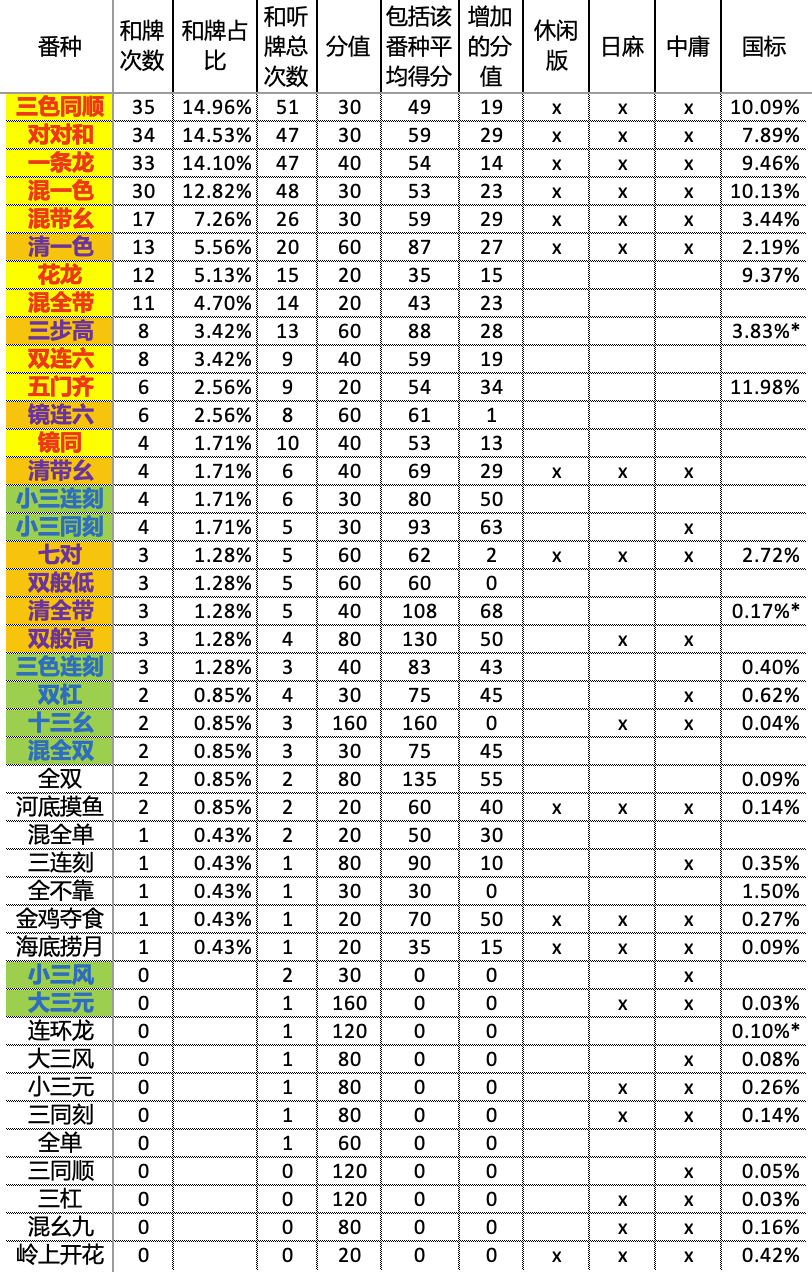
Table 1. Winning-pattern statistics. Asterisks in the Chinese Official column indicate that Pure Shifted Chows includes both one- and two-rank steps; the counterpart to All Linked is only All Fives; and the counterpart to Golden Bridge is Four Pure Shifted Chows, again including one- and two-rank steps. Original Chinese table labels are retained.
The patterns are sorted by occurrence count in column 2. A winning hand can combine several main patterns, so their shares of all winning hands in column 3 sum to more than 100%, reaching 111%. The most frequent include Three Similar Sequences, All Triplets, and Pure Straight, each near 15%, followed by Mixed One-Suit at about 12% and Mixed Outside Hand at 7%. By comparison, Chinese Official Mahjong's most common main pattern is Mixed Shifted Chows, above 20%, followed by All Types at 12%. Four Seas' leading patterns have more similar frequencies, all below 15%, are among the most traditional patterns, and do not favor three-suit combinations as strongly as Chinese Official Mahjong does.
Column 4 counts wins plus recorded ready hands. In some games we also recorded the ready hands of players who did not win. Adding these to wins produces this column. It usually tracks winning counts but can offer extra information. Mirrored Sequences, for example, was ready many times but rarely won, perhaps reflecting chance in a small sample; its actual frequency may be higher. Ready-hand records also inform us about high-valued patterns that never won: Little Three Winds, Little Three Dragons, Golden Bridge, and Three Similar Triplets all reached readiness. The fewer wins observed, however, the weaker the statistical evidence. Thousands or tens of thousands of hands would be needed to characterize these difficult patterns.
Column 5 gives the Four Seas pattern value. Column 6 is the average complete-hand score when that pattern occurs, reflecting its actual winning return. Three Similar Sequences itself scores 30, for example, but can combine with All Sequences, All Simples, Half Straight, All Types, Mixed Outside Hand, or Mixed Linked. The extra points appear in column 7. Whole-hand patterns such as All Triplets, Mixed One-Suit, and Mixed Outside Hand have more opportunities to combine, usually adding over 20 points. Sequence combinations such as Pure Straight, Three Similar Sequences, and Assorted Straight add less. Triplet combinations often accompany All Triplets, so their additional value includes its 30 points.
The next four columns show whether each Intermediate pattern appears in Four Seas Recreational, Japanese riichi, and Zung Jung, followed by its Chinese Official frequency, averaged from Quezha and MahjongSoft.
Analysis by hand-building family
Sorting individual patterns by frequency is useful, but for hand-building mahjong, the better unit of analysis is the family founded on a shared structural rationale. Many difficult patterns rarely appear. Three Similar Triplets never won in our sample, for example, but its lower forms, Little Three Similar Triplets and Two Similar Triplets, did. Examining the whole family better reveals its building potential and place in the system.
A main hand-building route is a pattern or family occurring in a substantial share of wins, offering both a worthwhile chance of completion and a substantial scoring return. Zung Jung identifies five routes: one suit, triplets, terminals, Pure Straight, and Mixed Triple Chow. K-Mahjong identifies six for Chinese Official Mahjong, adding upper, middle, and lower ranks. Here we use a 5% share of wins by a family's main patterns as the criterion for a main route. Thus, main patterns are above 20 points, while main routes exceed 5% frequency.
Like the payment-system change, some pattern values were adjusted after preliminary results became available halfway through collection. The individual changes are discussed below.
The table groups Four Seas patterns above the minimum, worth 20–80, into whole-hand patterns, where each meld or pair meets a condition, and combination patterns. Combinations divide into sequences, using two to four sequences, and triplets, using one to four triplets. Whole-hand and sequence-combination families are the principal routes.
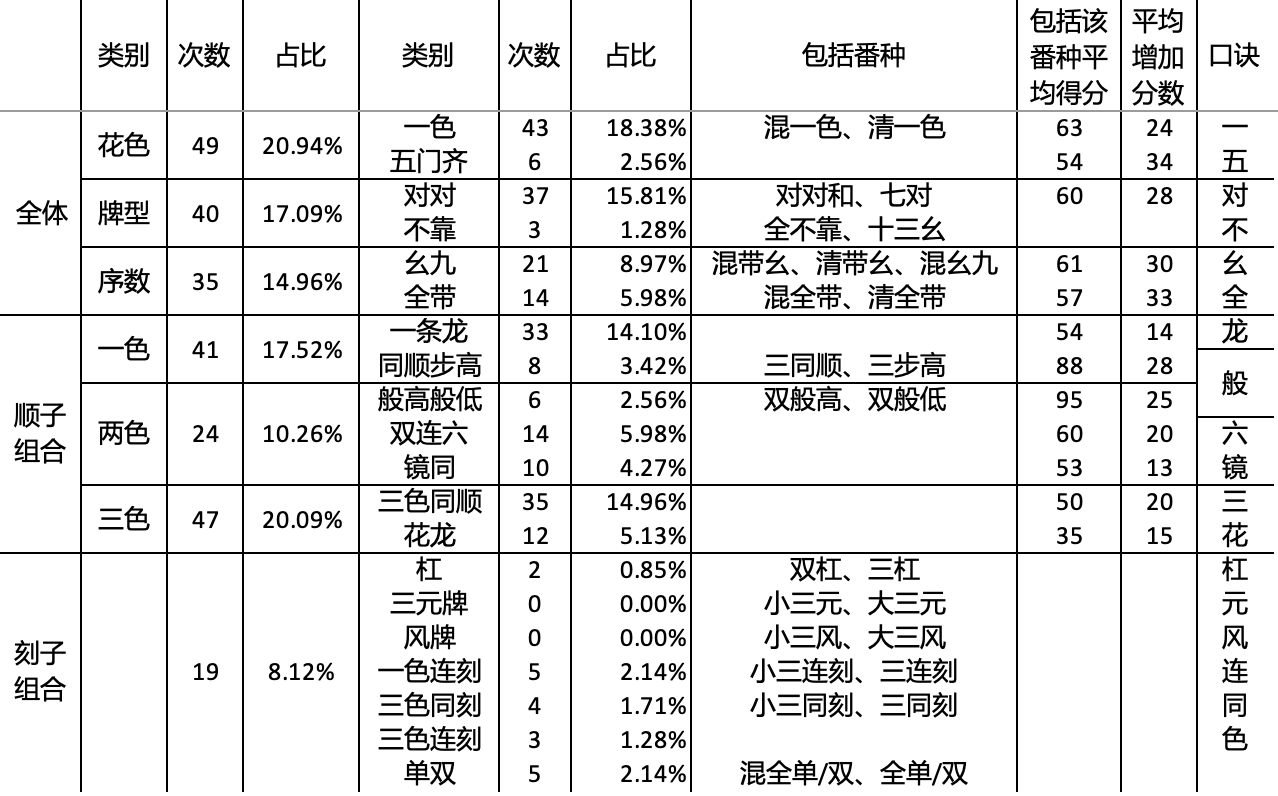
Table 2. Statistics by family. Columns group counts and proportions by category and subcategory, then list the patterns, average complete-hand score, and average additional points. Original Chinese table labels are retained.
Whole-hand patterns
Whole-hand families are distinguished by three elements: suit, hand structure, and rank.
Suit
Suit-based routes include the Pure and Mixed One-Suit family and the all-inclusive All Types route.
Pure and Mixed One-Suit are traditional patterns of outstanding beauty. Their combined share of just under one fifth, 18.38%, is appropriate: Mixed One-Suit accounts for 12.82% and Pure One-Suit for 5.56%.
All Types, Chinese Official Mahjong's second most common main pattern, has some beauty and difficulty, but did not win once in the first part of our sample. It was initially worth 10, requiring a dragon or seat-wind triplet to reach 20. Influenced by K-Mahjong, this aimed to correct its excessive Chinese Official frequency, but proved an overcorrection. Below the winning minimum, it was too restricted: if the necessary honor triplet could not be claimed, the route failed, leaving All Types effectively ornamental.
In the later period we raised All Types from 10 to 20, allowing it to qualify alone and offer another route for weaker starting hands. Its value remains below Mixed One-Suit and Mixed Outside Hand, preserving a lower return than those more beautiful and difficult patterns. We expect its adjusted frequency to remain below Chinese Official Mahjong's 12%, but reach 5%, enough to sustain an independent route.
Hand structure
Structure-based families include All Triplets, Seven Pairs, and All Unrelated.
All Triplets is one of the most traditional patterns. At roughly 15%, it ranks among the most frequent main patterns. Four Seas also includes same-suit consecutive triplets, similar triplets across suits, consecutive triplets across suits, winds, dragons, and kongs, all of which often combine with it. Although All Triplets itself is worth 30, its average complete-hand score approaches 60.
Seven Pairs is the most widely accepted nonstandard hand structure, yet did not win in the first half of collection. Sample size plays a role, but its 40-point value was fundamentally too low compared with the nearly 60-point expected return of the alternative All Triplets route. Zung Jung gives Seven Pairs the same 30 as All Triplets; Four Seas raised it to 40, but that was still insufficient. Both can combine with one-suit and odd/even families, but Seven Pairs cannot combine with triplet patterns and is harder to construct. It was therefore rarely the first choice. Raising it from 40 to 60 in the later period increased its frequency. Adjusting for the later sample alone suggests a true share around 2–3%, similar to Chinese Official Mahjong.
All Unrelated offers an escape route for particularly poor hands, but should not be so valuable that it suppresses other patterns. Like All Types, it had little presence in the first half: its 20-point return was far below the mean winning score of 50. We raised All Unrelated to 30, retained Seven All Unrelated at 40, and raised Five Honors and Knitted Straight to 60.
Rank
Rank-based families include outside hands and the family in which every set contains a shared rank.
Initially, Four Seas reduced Mixed and Pure Outside Hand from Zung Jung's 40 and 50 to 20 and 30, because it added compatible patterns such as Two Similar Sequences, Two Terminal Sequences, and Mirrored Sequences. Column 7 shows more than 20 added points for both outside patterns. But reducing them by 20 left the family under-rewarded relative to other routes, so restoring them to 30 and 40 is more appropriate. We expect Mixed Outside Hand's eventual share to rise to around 10%.
The shared-rank family develops the outside-hand idea for hands concentrated away from terminals. All Linked is difficult and readily combines with Three Shifted Sequences, Two Identical Sequences Twice, and Three Similar Sequences. It won only three times, so its observed 68 additional points reflect a very small sample. Mixed Linked broadens the condition by allowing honors as substitutes, making the family a more frequent main route.
Both outside-hand and shared-rank families exceed 5%, establishing each as a main route.
Suit, structure, and rank account for approximately 21%, 17%, and 14% respectively, a relatively balanced distribution across whole-hand elements.
Combination patterns
Sequence combinations use two to four sequences across one, two, or three suits.
Pure Straight represents consecutive sequences in one suit, covering all nine ranks in three melds, and is a traditional main route. The three-meld forms of the identical- and shifted-sequence families—Three Identical Sequences and Three Shifted Sequences—are difficult, infrequent, and highly valued.
Compared with Zung Jung and international rules, Four Seas introduces two-suit combinations including Half Straight Twice, Two Shifted Sequences Twice, and Mirrored Sequences. The first two can also use one suit, but usually use two. These broaden construction opportunities for two-suit hands. Half Straight Twice and Mirrored Sequences each support a main route and combine into the higher-valued Mirrored Half Straight. Two Shifted Sequences Twice provides a lower-valued alternative to Two Identical Sequences Twice and can be developed toward or from Three Shifted Sequences.
For three-suit sequences, Four Seas retains Three Similar Sequences and Assorted Straight but omits the excessively prevalent Mixed Shifted Chows of Chinese Official Mahjong. One-, two-, and three-suit sequence combinations account for approximately 17%, 10%, and 20% of wins. This is more balanced than Chinese Official Mahjong, where three-suit combinations account for over half.
Probabilistically, triplet combinations are much harder than sequence combinations. Their seven families together account for only 8%, usually alongside All Triplets, and can be considered its accompanying or supporting patterns.
Ten main patterns, eight high-scoring patterns, and eight supporting families
Within a family, lower forms are generally easier and more frequent, while higher forms score more but occur less often. To clarify this, we compress adjacent values into five bands: small (5–10), main (20–40), large (60–80), very large (120–160), and limit (240–480).
Four Seas Advanced 2.1: historical value bands from the original article
| Class | Family | Subtype | Small 5–10 | Main 20–40 | Large 60–80 | Very large 120–160 | Limit 240–480 |
|---|---|---|---|---|---|---|---|
| Suit | All Types, Mixed One-Suit | Pure One-Suit | Melded Nine Gates | All Honors, Nine Gates | |||
| Hand structure | Standard | All Sequences | All Triplets | ||||
| Hand structure | Seven Pairs | Seven Pairs | Seven Consecutive Pairs, Seven Honor Pairs | ||||
| Hand structure | Unrelated | Honors and Knitted Tiles, Seven Honors and Knitted Tiles | Five Honors and Knitted Straight | Thirteen Orphans | |||
| Rank | Terminals | All Simples | Mixed Outside Hand, Pure Outside Hand | All Terminals and Honors | All Terminals | ||
| Rank | Shared rank | Mixed Linked, All Linked | All Symmetric | ||||
| Rank | Odd/even | Mixed Odd, Mixed Even | All Odd, All Even | All Knitted | |||
| Triplets/kongs | One Quad | Two Quads | Three Quads | Four Quads | |||
| Honors | Dragons | Value Honor | Three Dragon Pairs | Little Three Dragons | Big Three Dragons | ||
| Honors | Winds | Little Three Winds, Three Wind Pairs | Big Three Winds, Four Wind Pairs | Little Four Winds, Big Four Winds | |||
| One suit | Identical sequences | Two Identical Sequences | Two Identical Sequences Twice | Three Identical Sequences | Four Identical Sequences | ||
| One suit | Shifted sequences | Two Shifted Sequences | Two Shifted Sequences Twice, Three Shifted Sequences | Four Shifted Sequences | Golden Ladder | ||
| One suit | Straights | Symmetry | Two Terminal Sequences | Pure Straight | Golden Bridge | Pure Terminal Sequences | |
| One suit | Straights | Consecutive sequences | Half Straight | Half Straight Twice | Mirrored Half Straight | ||
| One suit | Consecutive triplets | Two Consecutive Triplets | Little Three Consecutive Triplets | Three Consecutive Triplets | Two Consecutive Triplets Twice | Four Consecutive Triplets, Silver Ladder | |
| Three suits | Matching melds | Identical sequences | Two Similar Sequences | Three Similar Sequences | |||
| Three suits | Matching melds | Similar triplets | Two Similar Triplets | Little Three Similar Triplets | Three Similar Triplets | ||
| Three suits | Matching melds | Mirror | Mirrored Sequences | Mirrored Sequences and Triplets | Mirrored Triplets | ||
| Three suits | Linked melds | Consecutive sequences | Assorted Straight | ||||
| Three suits | Linked melds | Consecutive triplets | Assorted Three Consecutive Triplets |
This arrangement makes family relationships clearer. Many families have a principal route in the 20–40 band, such as Mixed One-Suit or Little Three Similar Triplets, and a higher form above it, such as Pure One-Suit or Three Similar Triplets.
The statistics identify about ten main patterns worth 20–40, each representing an independent, aesthetically meaningful, moderately difficult route with a substantial frequency above 5%. They are All Types, Mixed One-Suit, All Triplets, Mixed Outside Hand, Mixed Linked, Pure Straight, Half Straight Twice, Three Similar Sequences, Mirrored Sequences, and Assorted Straight. These are the ten main hand-building patterns, marked red in the original chart. The Chinese mnemonic is “一对幺三龙,五带六花镜”: one suit, triplets, terminals, three similar sequences, straight; five types, shared rank, double half-straight, assorted straight, mirror. Together they account for over 80% and form the core of Four Seas hand-building.
Eight higher-valued or more difficult patterns either score 60–80 directly—Pure One-Suit, Seven Pairs, Two Identical Sequences Twice, Two Shifted Sequences Twice, Three Shifted Sequences, and Mirrored Half Straight—or yield an average complete-hand score above 60, as Pure Outside Hand and All Linked do. These eight high-scoring patterns are marked purple in the original chart. Building them offers expected scores above 60, exceeding those of the ten main patterns.
The seven triplet-related families are infrequent and mainly combine with All Triplets. Together with All Unrelated, which rescues poor starting hands, they form eight supporting families, marked blue in the original chart. Each represents multiple patterns within a family.
| Group | Patterns or families | Combined frequency |
|---|---|---|
| Ten main patterns | Mixed One-Suit; All Triplets; Mixed Outside Hand; Three Similar Sequences; Pure Straight; All Types; Mixed Linked; Half Straight Twice; Assorted Straight; Mirrored Sequences | 81.20% |
| Eight high-scoring patterns | Pure One-Suit; Seven Pairs; Pure Outside Hand; All Linked; Three Shifted Sequences; Two Identical Sequences Twice; Two Shifted Sequences Twice; Mirrored Half Straight | 18.38% |
| Eight supporting families | Kongs; winds; dragons; odd/even; All Unrelated; same-suit consecutive triplets; similar triplets across suits; consecutive triplets across suits | 9.40% |
Analyzing these preliminary winning-pattern statistics by shared structural rationale yields ten main patterns, eight high-scoring patterns, and eight supporting families, illustrating the breadth of Four Seas' hand-building routes.
Originally published in Chinese on Zhihu · Zhihu revision 2026-05-31