Added to this site · 2026-09-16
Preliminary Four Seas Mahjong Statistics, Part III: Accessible Rules That Encourage Hand-Building
AI-assisted draft translation. Terminology is under review; please refer to the Chinese original if anything is unclear.
See Preliminary Four Seas Mahjong Statistics, Part I: Hand-Building in Practice and Part II: Ten Main, Eight High-Scoring, and Eight Supporting Routes.
Earlier discussions examined two tensions in hand-building mahjong: hand-building versus racing to win, and accessibility versus depth. With preliminary statistics from more than 200 hands, we can now consider how Four Seas addresses both through its rules.
A Recreational Edition designed for beginners
To balance accessibility with depth, Four Seas offers simplified rules specifically for beginners. They provide a transition from mahjong without scoring patterns to the full rules containing all hand-building families, establishing a gradual learning path. The simplified version should contain as few patterns as possible and use a relatively low minimum winning score, reducing the learning and memory burden. Its patterns should be the most familiar, structurally well-founded, easily learned main routes and their simplest lower forms, expressing the hand-building philosophy from the start.
Recreational includes the most traditional routes
Four Seas Recreational contains just twenty patterns: six situational patterns and fourteen aesthetic patterns that players can actively construct. Intermediate, Advanced, and Expanded contain 56, 81, and 96 respectively. Recreational normally requires ten points, half the other editions' twenty. Both pattern count and winning difficulty are greatly reduced.
Recreational mainly includes five routes: one suit (Mixed and Pure One-Suit), triplet-oriented hands (All Triplets and Seven Pairs), outside hands, Pure Straight, and Three Similar Sequences. These correspond to Zung Jung's five routes. Two Identical Sequences can qualify at ten in Recreational but does not reach the minimum in Intermediate or Advanced, so it is not classified as a main pattern here. The six patterns within those five routes, counting Mixed and Pure One-Suit separately, occupy the top six positions in the preliminary frequency table. They are the most common and frequently completed routes.
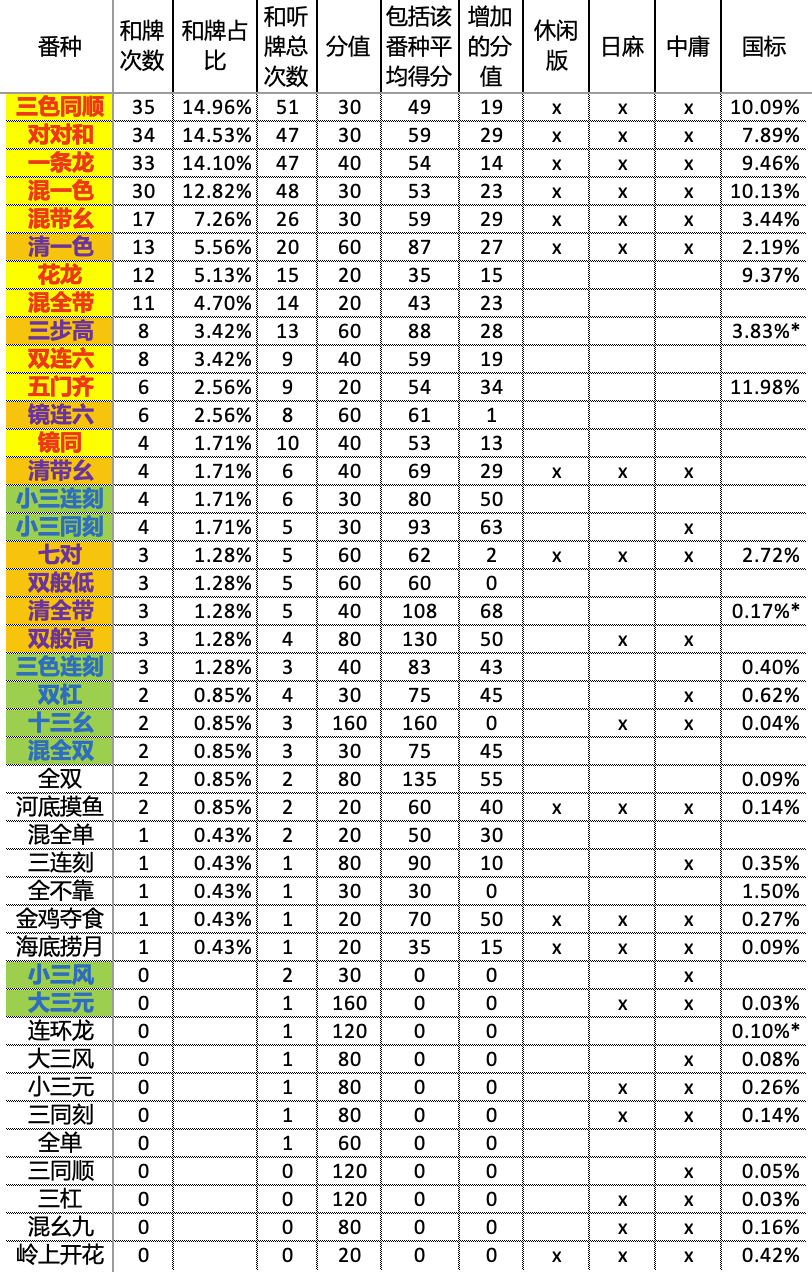
The later columns indicate inclusion in Four Seas Recreational, Japanese riichi, and Zung Jung. From these we obtain counts of main-pattern occurrences covered by each ruleset.
| Measure | Recreational | Riichi | Zung Jung | Intermediate |
|---|---|---|---|---|
| Number of patterns | 20 | 42 | 44 | 56 |
| Main-pattern occurrences | 169 | 174 | 181 | 255 |
| Recreational / this ruleset | — | 97.13% | 93.37% | 66.27% |
| Riichi / this ruleset | — | — | 96.13% | 68.24% |
| Zung Jung / this ruleset | — | — | — | 70.98% |
Although Recreational has fewer than half as many patterns as riichi or Zung Jung, its main patterns account for over 90% of the main-pattern occurrences covered by either. This suggests that as a standalone ruleset, twenty-pattern Four Seas Recreational offers almost as much hand-building coverage as riichi or Zung Jung.
Intermediate expands the routes
Recreational accounts for 66% of Intermediate's main-pattern occurrences. Part II identified ten main, eight high-scoring, and eight supporting routes. Recreational includes half the main patterns—Mixed One-Suit, All Triplets, Mixed Outside Hand, Three Similar Sequences, and Pure Straight—and three of the eight high-scoring patterns: Pure One-Suit, Seven Pairs, and Pure Outside Hand. It has none of the eight supporting families.
Intermediate adds the other five main patterns—All Types, Mixed Linked, Half Straight Twice, Assorted Straight, and Mirrored Sequences—the remaining five high-scoring patterns—All Linked, Three Shifted Sequences, Two Identical Sequences Twice, Two Shifted Sequences Twice, and Mirrored Half Straight—and all eight supporting families: kongs, winds, dragons, odd/even, All Unrelated, same-suit consecutive triplets, similar triplets across suits, and consecutive triplets across suits. Its main-pattern count is 50% higher than Recreational's. Starting from the familiar, traditional routes already selected for Recreational, Intermediate and Advanced enrich and expand the available paths.
| Group | Included in Recreational | Share | Added by Intermediate | Share |
|---|---|---|---|---|
| Main | Mixed One-Suit; All Triplets; Mixed Outside Hand; Three Similar Sequences; Pure Straight | 63.68% | All Types; Mixed Linked; Half Straight Twice; Assorted Straight; Mirrored Sequences | 17.52% |
| High-scoring | Pure One-Suit; Seven Pairs; Pure Outside Hand | 8.55% | All Linked; Three Shifted Sequences; Two Identical Sequences Twice; Two Shifted Sequences Twice; Mirrored Half Straight | 9.83% |
| Supporting | — | — | Kongs; winds; dragons; odd/even; All Unrelated; same-suit consecutive triplets; similar triplets across suits; consecutive triplets across suits | 9.40% |
| Total | 72.23% | 36.75% |
Among the ten main patterns, the five Recreational patterns account for substantially more wins, 63.68%, than the five added in Intermediate, 17.52%. Several factors explain this:
The Recreational routes are indeed traditional, common, and aesthetically compelling. They are easy to grasp and have high completion probabilities.
All five are already in Zung Jung, which our group played first. We are more familiar with them than with Intermediate's new routes and therefore tend to build them more often.
All Types and some other patterns were initially undervalued. Their frequencies increased after their values rose, suggesting that the aggregate sample underestimates them.
We deliberately held down values for Assorted Straight and Mixed Linked rather than basing them entirely on combination counts and difficulty. We did not want these routes to overshadow the more traditional and beautiful Recreational patterns. Assorted Straight, for example, is slightly harder than Three Similar Sequences by combination count, but scores 20 rather than 30.
Mirrored Half Straight, which combines Mirrored Sequences and Half Straight Twice, is counted among the eight high-scoring patterns.
The second and third factors are temporary. Over a longer period, Intermediate's five main patterns should become more frequent, approaching but not exceeding the share of Recreational's five.
Chinese Official Mahjong also has preliminary rules, reducing 81 patterns to thirty and easing memorization. From a route perspective, however, its preliminary rules already contain most of the full version's main patterns. Treating four- to twenty-four-point patterns as main patterns, 92% of their occurrences are covered by the preliminary version. The preliminary version therefore already includes most routes; moving to the full version adds only a few, such as Reversible Tiles, Chicken Hand, and Knitted Straight, without increasing the range or difficulty of hand-building ideas. This does not provide beginners with a gradual learning path and rising challenge.
| Points | Chinese Official preliminary patterns |
|---|---|
| 24 | Seven Pairs; Full Flush |
| 16 | Pure Straight; Pure Shifted Chows; All Fives |
| 12 | Lesser Honors and Knitted Tiles; Upper Four; Lower Four; Big Three Winds |
| 8 | Mixed Straight; Mixed Triple Chow; Out with Replacement Tile; Robbing the Kong |
| 6 | All Pungs; Half Flush; Mixed Shifted Chows; All Types; Two Dragon Pungs |
| 4 | Fully Concealed Hand; Last Tile |
| 2 | Dragon Pung; Concealed Hand; Tile Hog; Double Pung; Two Concealed Pungs; Concealed Kong |
| 1 | Melded Kong; One Voided Suit; No Honors; Flower Tiles |
Preliminary statistics for small patterns
The next table lists the five- and ten-point patterns across the 234 winning hands. Value Honor is the sum of dragon and seat-wind occurrences. The last two columns give Chinese Official frequency and inclusion in Recreational.
| Pattern | Points | Count | Share | Chinese Official share | Recreational |
|---|---|---|---|---|---|
| All Sequences | 5 | 85 | 36.32% | 40.40% | Yes |
| Two Similar Sequences | 5 | 69 | 29.49% | 20.00% | Yes |
| Value Honor | 10 | 53 | 22.65% | 21.10% | Yes |
| Half Straight | 5 | 27 | 11.54% | 12.20% | Yes |
| One Quad | 10 | 25 | 10.68% | 7.50% | Yes |
| Two Identical Sequences | 10 | 25 | 10.68% | 3.89% | Yes |
| All Simples | 5 | 22 | 9.40% | 10.30% | Yes |
| Two Terminal Sequences | 5 | 20 | 8.55% | 4.76% | |
| Two Shifted Sequences | 5 | 20 | 8.55% | ||
| White Dragon triplet | 10 | 14 | 5.98% | ||
| Red Dragon triplet | 10 | 14 | 5.98% | ||
| Seat-wind triplet | 10 | 13 | 5.56% | ||
| Green Dragon triplet | 10 | 12 | 5.13% | ||
| Two Similar Triplets | 10 | 12 | 5.13% | 3.70% | |
| Consecutive Triplets | 10 | 7 | 2.99% |
Recreational's seven small patterns are precisely the most frequent ones. As with its main patterns, the selected small patterns are the most common and most often completed. Two Similar Sequences and Half Straight are lower forms of Three Similar Sequences and Pure Straight. Including these easy two-sequence combinations guides beginners toward higher forms and expresses Four Seas' hand-building philosophy.
Recreational offers a small, carefully selected set of patterns; Intermediate and Advanced offer richer routes, with winning requirements also progressing in difficulty. Together they address the tension between accessibility and depth.
Hand-building and the choice of minimum winning score
Since Zung Jung introduced hand-building as a concept, the idea that it represents mahjong's future has gained recognition. Four Seas likewise aims for coherent, enjoyable hand-building rules. Yet there is no generally accepted definition or standard. Zung Jung describes itself as hand-building mahjong, but small patterns such as Concealed Hand, All Sequences, and All Simples dominate, with over half of wins scoring only five or ten. The main reason is its lack of a minimum: even a hand without an aesthetic pattern can win. A minimum winning score is necessary to encourage beautiful, difficult hands rather than simply racing with small ones, and the chosen threshold strongly affects hand-building.
Existing competitive thresholds
Existing competitive rules use two approaches:
Minimum-pattern qualification: riichi and Zung Jung, requiring a qualifying pattern.
A threshold above some main patterns: Chinese Official Mahjong's eight points.
The Zung Jung rules used in the World Series of Mahjong allow minimum patterns such as five-point Concealed Hand, All Sequences, or All Simples. Their value is much lower than 30–40-point main patterns such as Half Flush and Mixed Triple Chow, but so is their difficulty. Winning not only earns points but stops opponents from completing their own, potentially large hands. When a main pattern is distant, quickly completing a five- or ten-point hand is therefore optimal under Zung Jung.
Chinese Official Mahjong's eight-point requirement is comparatively high. More than half of the main patterns, including Half Flush, All Pungs, and Outside Hand, score only four to six and need supplements. Numerous small patterns unrelated to hand shape—Edge, Closed, or Single Wait, Self-Drawn, and Concealed Hand—alongside common structural patterns such as Pung of Terminals or Honors and Mixed Double Chow make one or two extra points attainable. Nevertheless, reaching eight is challenging for many starting hands and substantially harder than Zung Jung's minimum. Most wins therefore just reach or slightly exceed it. The fixed eight-point base payment further rewards racing, making a quick eight-point win the best strategy rather than encouraging larger hands.
Despite different thresholds, both rulesets favor completing the simplest qualifying hand as quickly as possible: racing to the minimum. Their means and peaks lie near the threshold, producing strongly asymmetric, positively skewed distributions, as shown in Part I.
What if Zung Jung or Chinese Official Mahjong adopted Four Seas' twenty-point threshold? Zung Jung has relatively few small patterns: commonly five-point Concealed Hand, All Sequences, All Simples, and One Kong, plus ten-point Identical Sequences. Reaching twenty would require Identical Sequences and two of the first three, and identical sequences are not reliably obtainable. Such a minimum would effectively prohibit small-pattern combinations and force main-pattern wins. With only five main routes, many starting hands would have little chance, leading to draws and a poorer experience.
For Chinese Official Mahjong, twenty Four Seas points corresponds to four points. Its many two- and four-point patterns mean that simply combining two of Concealed Hand, All Chows, and All Simples would qualify. Add easy one-point wait, self-draw, and terminal-triplet patterns, and the barrier falls toward Zung Jung's level. Numerous low-value combinations would enable wins lacking aesthetic merit, undermining hand-building.
The threshold is only one factor: its interaction with the pattern system is what makes a ruleset encourage hand-building.
Four Seas' threshold design
Drawing on these approaches, Four Seas places its twenty-point minimum between small and main patterns. Every main pattern qualifies alone, while combinations of small patterns remain possible. Part I found a mean winning score above fifty, equivalent on average to a main-route hand above Pure Straight. The distribution is relatively close to normal, and the mean is 2.5 times the twenty-point threshold, without raising the minimum to forty or fifty. This demonstrates that Four Seas encourages construction rather than merely racing to the threshold.
Above twenty lies a broad range of ten main, eight high-scoring, and eight supporting routes. Since any main pattern qualifies, players who see a plausible main route should pursue it quickly. Main patterns score 20–40 before combinations, with expected complete-hand scores of 35–60. High-scoring patterns are worth 40–80 and yield expected scores above sixty. Quickly completing a main-pattern hand is therefore the best strategy.
With a twenty-point threshold, players whose starting hands offer no clear main route can still combine small patterns, rather than being forced to pursue a large pattern. Four Seas' small patterns concern hand structure, unlike difficulty-based patterns such as Concealed Hand, special waits, or Last Tile. Apart from Two Identical Sequences, two-sequence combinations score only five: Two Similar Sequences, Half Straight, Two Terminal Sequences, and Two Shifted Sequences. They are not over-rewarded. A standard four-meld-and-pair hand supports only three two-sequence combinations—for example, similar + half-straight + terminal, similar + half-straight + similar, or similar + half-straight + shifted. Adding five points for All Sequences just reaches twenty. This shows why All Sequences' five points are crucial to small-pattern construction.
Viewed pairwise, a three-sequence main pattern comprises three two-sequence relationships. Three Similar Sequences comprises three similar-sequence pairs; Pure Straight comprises two half-straights and one terminal-sequence pair. Their construction difficulty is therefore similar to the three small combinations above, but their 30 and 40 points substantially exceed twenty. Each two-sequence combination also has a main-pattern higher form, offering opportunities to change course during construction. Although small patterns can reach twenty, they are not easy to combine and offer a modest return. They are a fallback for poor starting hands; main patterns remain preferable. Four Seas therefore avoids the same emphasis on racing to the minimum seen in Zung Jung and Chinese Official Mahjong.
Players must also consider that essential tiles may become unavailable, or an opponent's conspicuous large hand may demand defense. The ten-point self-draw threshold offers another decision: defending or changing course while retaining a chance to win. Early in a hand, one may decline a small self-draw to pursue more value; late in a hand, the lower threshold supports defense and flexible play.
The thresholds and pattern families together provide three principal paths: quickly complete a main pattern, combine small patterns, or self-draw for ten. They are connected routes between which players can shift. These strategies produce a relatively bell-shaped score distribution with a mean 2.5 times the minimum. Four Seas is a racing-to-win game that encourages hand-building.
Originally published in Chinese on Zhihu · Zhihu revision 2024-12-31