Added to this site · 2026-09-14
The Evolution of Mahjong Scoring Systems, Part II: Additive Scoring
AI-assisted draft translation. Terminology is under review; please refer to the Chinese original if anything is unclear.
The Evolution of Mahjong Scoring Systems, Part I: Multiplicative Scoring explained that as the number of scoring patterns increased, the weaknesses of multiplicative valuation became increasingly apparent. In particular, it overrewarded high-value pattern combinations and could not accommodate the development of rulesets with many patterns. To address the valuation of combinations, multiplication gradually gave way to addition.
The emergence of additive scoring
Additive scoring means adding the points assigned to each pattern instead of multiplying them. Under Old Style rules, for example, Mixed One-Suit and All Triplets are each worth 3 fan, equivalent to 8 points. Multiplication gives their combination 8 × 8 = 64 points; addition gives 8 + 8 = 16. Additive scoring thus assigns a lower score to the combination, correcting the overvaluation produced by multiplication. Yet the combined score remains higher than the value of either individual pattern, recognizing the contribution of each.
According to Fanye's A Brief Discussion of Guangdong Mahjong: Its Development from Classical Mahjong and Its Role as a Foundation for Competitive Mahjong (Chinese), additive scoring first appeared in the “Wu Qi Bu You” version of Guangdong New Style mahjong. It was later adopted by Chinese Official Mahjong, Zung Jung, and regional variants including Taiwanese mahjong and Hong Kong–style Taiwanese mahjong. These rulesets generally have many scoring patterns. Addition also accommodates adding or removing patterns without allowing one or two patterns to distort the entire scoring system.
Additive scoring scales
Modern additive systems, represented by Chinese Official Mahjong and Zung Jung, evolved gradually from multiplicative systems. In the table below, each system has three columns: the fan count or tier, its corresponding points, and the ratio of that score to the score in the preceding row.
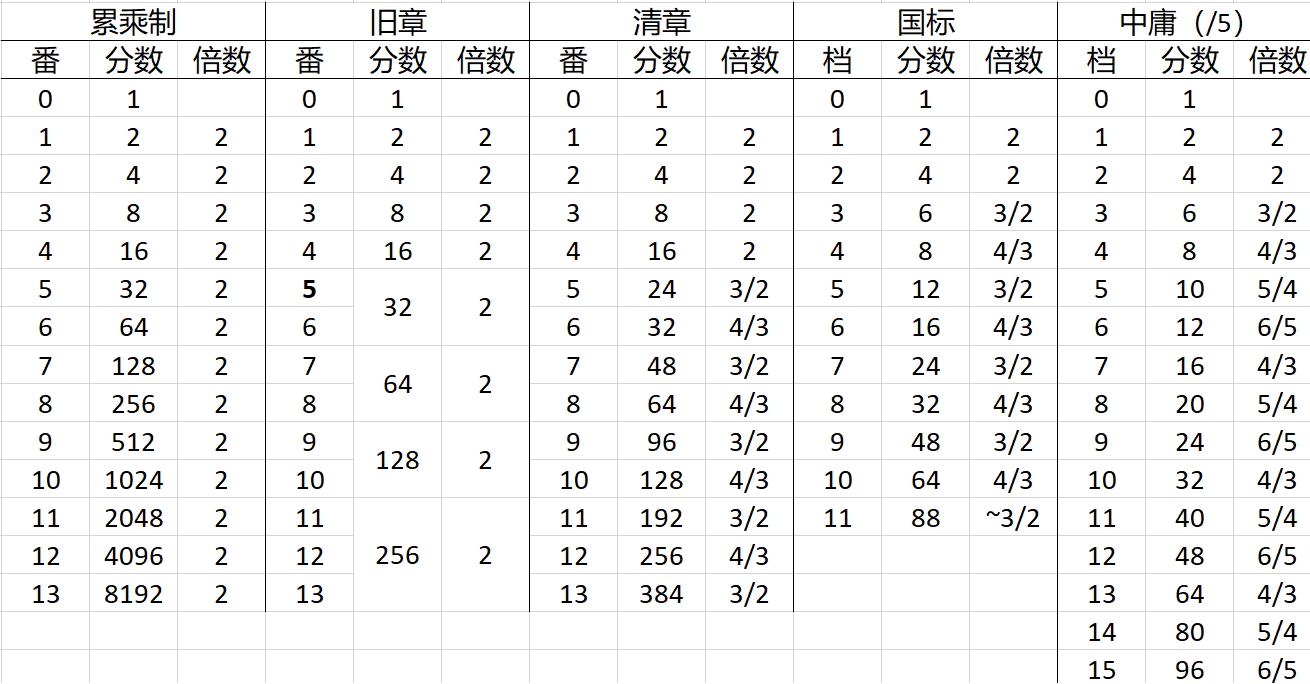
Figure labels: 累乘制 = multiplicative system; 旧章 = Old Style; 清章 = Hong Kong Qingzhang; 国标 = Chinese Official Mahjong; 中庸(/5)= Zung Jung with scores divided by 5. 番 = fan; 档 = scoring tier; 分数 = points; 倍数 = ratio to the preceding level. The original Chinese figure is retained.
In the original multiplicative system, every additional fan doubles the score.
Guangdong Old Style introduced tiered limits: above the 4-fan limit, the score doubles only once every two fan. This raises a question: why should 6 fan receive the same score as 5 fan despite the extra fan?
Hong Kong Qingzhang resolved this by splitting each doubling into two steps: multiply by 3/2 for the first additional fan and by 4/3 for the second. The sequence after 16 points is therefore 24, 32, 48, 64, and so on. Scores are no longer exclusively powers of 2. The factor 3/2 = 1.5 is the same idea as haneman in Japanese mahjong.
The numbers 24, 32, 48, and 64 may look familiar. Indeed, the Chinese Official scoring scale came from this progression, except that the 3/2 step begins at 3 fan, or 6 points. Since Chinese Official Mahjong uses addition, speaking of fan counts in the multiplicative sense is no longer meaningful; we can instead call them scoring tiers. Interestingly, Mixed One-Suit is worth 6 points, tier 3, while Pure One-Suit is worth 24 points, tier 7. Many players consider this fourfold difference excessive. Yet Old Style already assigned Mixed One-Suit 3 fan and Pure One-Suit 7 fan; Chinese Official Mahjong carried those levels over directly. The original difference was even larger: eightfold.
After dividing its scores by 5, Zung Jung has values similar to Chinese Official Mahjong. The difference is that it further divides the 3/2 increase into factors of 5/4 and 6/5, adding four tiers overall. This permits finer assignments but makes the scoring system more complicated, without an absolute need to do so.
How should points be assigned to patterns?
Once an additive scale has been established, the next step is to decide which tier each pattern belongs to and how many points it receives. Traditional pattern values were largely based on experience rather than mathematical calculation, as illustrated by the unreasonable four-fan gap between Mixed One-Suit at 3 fan and Pure One-Suit at 7 fan in Old Style rules.
A pattern's points should correlate positively with its difficulty: harder hands should score more. However, the relationship cannot be linear, because the difficulties of different patterns vary by several orders of magnitude and the scores cannot vary to the same extent. When regional rules were surveyed during the development of Chinese Official Mahjong, the conclusion was to keep individual pattern values below 100 points, reflecting differences in difficulty while preventing one lucky large hand from deciding the outcome of an entire full match.
Several factors affect difficulty. The most important is the number of tile combinations satisfying the pattern. Here I am first considering structural patterns, rather than patterns based on the course of play, such as Concealed Hand or Fully Melded Hand. Other factors include whether chows and pungs are allowed and how easily opponents can defend against the hand. There are 4.25 × 10^18 combinations of 14 mahjong tiles, of which 1.28 × 10^13 are winning combinations: the count for unrestricted winning hands. The individual pattern with the fewest combinations is Four Identical Sequences in one suit, with only 3,906. The difference in combination counts between the easiest and hardest patterns is thus on the order of 10^9.
In actual play, chows, pungs, and kongs are allowed, so patterns can be easier than a calculation based only on combination counts suggests. Seven Pairs, for example, has nearly three orders of magnitude more combinations than All Triplets, but All Triplets can be built by calling pungs and is therefore easier than Seven Pairs. Adjusting the figures accordingly gives a difficulty range on the order of 10^7 between the easiest and hardest patterns. The assignment problem is therefore how to represent differences spanning 10^7 within a scoring range of 1–100 points.
The solution comes from the original multiplicative scale. Since 2^7 = 128 is close to 100, the problem becomes one of using scores from 1 to 2^7 to represent difficulties from 1 to 10^7. For any pattern, find an exponent x such that its difficulty is 10^x, and assign it a score of 2^x. The formula is log₂ F = log₁₀ N, where F is the score and N is the difficulty. The relationship is shown below.
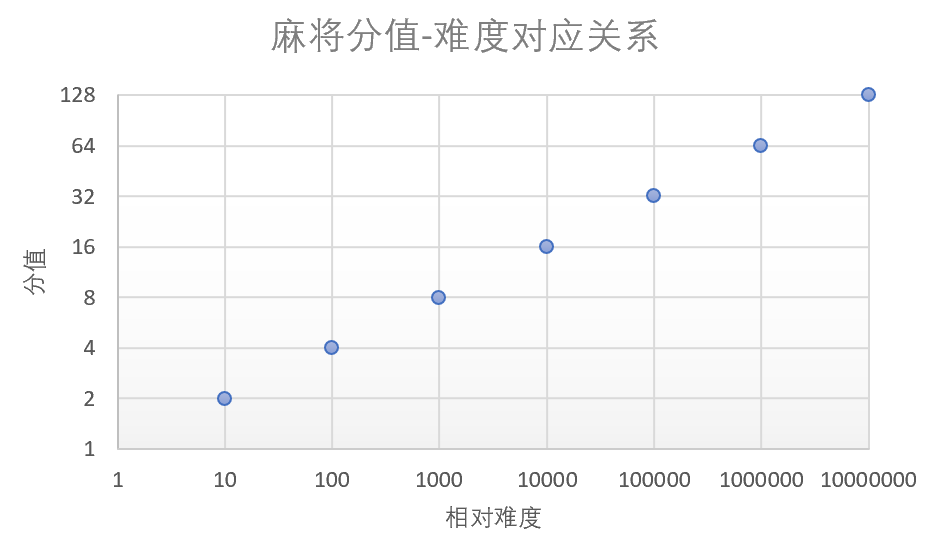
The horizontal axis is relative difficulty (相对难度), and the vertical axis is points (分值). The plotted pairs are 10 → 2, 100 → 4, 1,000 → 8, 10,000 → 16, 100,000 → 32, 1,000,000 → 64, and 10,000,000 → 128. The original Chinese figure is retained.
Viewed another way, difficulty and points increase together, but not linearly: doubling difficulty does not double the score. Instead, a tenfold increase in a pattern's difficulty doubles its score. This applies throughout the scale: a 4-point pattern is ten times as difficult as a 2-point pattern, just as a 32-point pattern is ten times as difficult as a 16-point pattern. Of course, the factor of ten is approximate. There are many patterns but only a limited number of tiers, so each pattern must be assigned the available score closest to the value calculated from its difficulty.
Although Chinese Official Mahjong has many problems in its pattern values, K-shen Mahjong, a modification of it, follows the principle above. Its values also agree closely with those in Zung Jung. For example, Mixed One-Suit occurs about five times as often as Pure One-Suit, which can be interpreted approximately as Pure One-Suit being five times as difficult. The closest assignment makes Pure One-Suit worth twice as much: both rulesets give it 16 points and Mixed One-Suit 8 points.
How additive scoring handles pattern combinations
With a framework for assigning pattern values, we can compare multiplication and addition when patterns combine. There are two criteria. First, the combined score must exceed each individual pattern's score; both systems satisfy this. Second, the combined score must not exceed what the combination's difficulty warrants. Overvaluation creates excessive rewards and scoring distortions. Taken together, the central problem in hand valuation is to avoid overrewarding high-value pattern combinations. A combined score may therefore be slightly below the value implied by its difficulty, but this is acceptable as long as it still exceeds the individual values. After all, precisely calculating every possible combination is not feasible.
To simplify the framework, suppose mahjong has only 10,000 combinations, corresponding to a maximum of 4 fan or 16 points. Pattern A, Mixed One-Suit, has 100 combinations, as does pattern B, All Triplets. Both are worth 2 fan or 4 points.
Under multiplication, Mixed One-Suit with All Triplets scores 4 × 4 = 16, or 2^(2+2) = 16. This implies that only one combination satisfies both patterns. In reality, however, Mixed One-Suit and All Triplets are correlated: ten of the 10,000 combinations satisfy both. Multiplication therefore overestimates the combination's difficulty.
Under addition, the combination scores 4 + 4 = 8, corresponding exactly to 3 fan and ten combinations. This is only a simplified example, but it illustrates how addition better accommodates correlations between patterns.
Addition has limits too. If A and B have equal scores, adding them doubles the score, corresponding to a tenfold increase in difficulty in the combination-count model. Thus, when two equally valued patterns combine, additive scoring does not overstate the difficulty if the overlap accounts for no more than one tenth of either pattern. If the overlap exceeds one tenth, even addition can overreward the combination. For example, Four Seas Mahjong's Mirrored Sequences (镜同: two pairs of matching sequences across two suits) and Half Straight Twice (双连六: two half straights) both consist of four sequences in two suits and are each worth 40 points. They combine very easily: roughly one quarter to one fifth of Half Straight Twice hands also satisfy Mirrored Sequences, and vice versa. Awarding 80 points for the combination is therefore excessive. This distortion encourages players to exploit an overvalued combination. The solution is to define a separate combined pattern, Mirrored Half Straight (镜连六), at an appropriate value of 60 points. This example again shows that combinations may be undervalued, but should not be overvalued.
This article covers several distinct but related subjects, including the historical development of addition and the assignment of pattern values. Those concepts are needed before multiplication and addition can be compared within this framework. To summarize, because mahjong patterns are strongly correlated, multiplication overrewards high-value combinations and is suitable only for systems with few patterns, or for gambling-oriented mahjong that deliberately seeks excitement. Addition better avoids such overrewarding, has been adopted by mainstream modern rulesets with many patterns, and is more scientifically grounded and reasonable.
Originally published in Chinese on Zhihu · Zhihu revision 2025-01-12