Added to this site · 2026-09-14
The Evolution of Mahjong Scoring Systems, Part I: Multiplicative Scoring
AI-assisted draft translation. Terminology is under review; please refer to the Chinese original if anything is unclear.
A mahjong scoring system specifies how values are assigned to individual scoring patterns and how those values are combined when a winning hand contains several patterns. Put simply, it answers the question: how many points is this hand worth? In this article, I call this the hand valuation system.
Once the total hand value has been determined, the points gained or lost by each player, including any additional rewards or liabilities for self-draws and discard wins, belong to the payment system. Hand valuation and payment are two separate steps in settling a mahjong hand. The former determines the size, or point value, of the hand from its patterns. The latter uses that value and the circumstances of the win to determine each player's gain or loss. For payment systems, see A Comparison and Summary of Mahjong Payment Systems.
(The Chinese work Zhongyong Maque Shiguan, 中庸麻雀史观, devotes a chapter to hand valuation: Chapter 21, “Arithmetic.” Some of its ideas are discussed here, alongside other approaches to the topic.)
In classical mahjong, scoring used the total minipoints together with fan-based multipliers. Total minipoints were the sum of individual awards, mainly for different types of triplets and kongs and for the manner of winning. Fan counted the number of doublings: one fan meant a multiplier of 2, two fan a multiplier of 4, three fan a multiplier of 8, and n fan a multiplier of 2^n. Minipoints were central to classical mahjong. Initially, there were only a few scoring patterns: Value Honor (a dragon triplet or seat-wind triplet) at 1 fan, Mixed One-Suit at 1 fan, and Pure One-Suit at 3 fan. Thus Value Honor or Mixed One-Suit multiplied the minipoints by 2, while Pure One-Suit multiplied them by 8. Multiple patterns were combined multiplicatively: Value Honor with Mixed One-Suit gave 2 × 2 = 4, or 2^(1+1) = 4. In other words, the fan values were added before taking the power of 2. The classical formula was therefore: (sum of minipoints) × 2^(sum of fan).
In the later classical period, minipoints were removed, or effectively fixed at a specified base value. Scoring became base value × 2^(sum of fan). Hand valuation now depended entirely on scoring patterns, and many new ones were introduced: Edge/Closed/Pair Wait at 1 fan, All Sequences at 1 fan, Self-Draw at 1 fan, and Concealed Hand at 1 fan. Mixed One-Suit and All Triplets rose to 2 fan, and Pure One-Suit to 5 fan. Later, the “three-three” system raised Mixed One-Suit and All Triplets to 3 fan and Pure One-Suit to 7 fan. This can be called a multiplicative fan system.
Multiplicative scoring is simple to understand and calculate, making it well suited to rulesets with relatively few scoring patterns. Many regional Chinese variants use it today. One example is the widely played Sichuan Blood Battle to the End. The version adopted by the International Mahjong League has only nine patterns: Root (gen), Last Tile, Win On Kong, Robbing a Kong, a discard win following a kong, All Triplets, and Golden Hook Wait are each worth 1 fan; Pure One-Suit and Seven Pairs are each worth 2 fan. Informal variants add only a few more, such as All Simples, Outside Hand, and Dragon Seven Pairs. Multiplicative scoring suits such a small pattern set.
Inherent weaknesses of multiplicative scoring
Once scoring patterns replaced minipoints as the measure of a winning hand's value, the fan assigned to each pattern and the accompanying multiplicative method should have reflected the hand's aesthetic qualities and difficulty. In practice, however, multiplication has several inherent weaknesses.
First, each level differs by a factor of 2, producing scores of 1, 2, 4, 8, 16, and so on. Old Style and New Style rules introduced hundreds of patterns whose difficulties cannot all differ by factors of 2. Assigning values on a multiplicative scale is therefore necessarily coarse.
Second, scores grow exponentially in powers of 2 and can quickly become enormous. The highest patterns in Old Style rules, such as Big Four Winds and Blessing of Heaven, were assigned 13 fan, equivalent to 2^13 = 8,192. This was not based on a mathematical calculation; rather, a multiplier approaching 10,000 was already near the practical limit for a gambling-oriented scoring system.
Third, and most importantly, exponential scoring can substantially overvalue hands that combine several patterns, creating scoring distortions and excessive rewards. Because the smallest unit is 1 fan, even simple patterns such as Edge/Closed/Pair Wait and All Sequences receive a doubling. They can combine with Concealed Hand, Self-Draw, Mixed One-Suit, All Triplets, and patterns introduced in New Style rules. The resulting fan total can easily become very high, far exceeding what the hand's difficulty warrants. I call this overrewarding high-value pattern combinations under multiplicative scoring: the combined patterns receive too many points.
(The Zhongyong discussion attributes this problem to the variable point value of each additional fan, which depends on how many fan the hand already has. This describes the same issue: when many patterns combine, multiplicative scoring can fluctuate excessively, leading to scoring distortions and overrewarding.)
Overrewarding high-value pattern combinations
Multiplying individual pattern values to obtain a hand's total rests on a basic assumption: that the patterns are independent and uncorrelated. That assumption is wrong. The basic winning hand consists of four melds and a pair. Different patterns restrict the tiles in two melds, three melds, or even the entire hand, so the patterns are correlated. To express this mathematically, let A and B be two patterns and use probability as an approximation of difficulty. P(A) is the probability of pattern A, and P(A|B) is its probability given pattern B. If A and B are independent, P(A) should equal P(A|B).
For example, let A be All Triplets and B be Mixed One-Suit. A Mixed One-Suit hand contains only one numbered suit and the seven types of honors. Honors can form triplets and pairs, but not sequences, so All Triplets is much more likely within Mixed One-Suit than among hands using the full tile set. The reverse also holds: Mixed One-Suit is more likely within All Triplets. Thus A and B are not independent, and P(A) < P(A|B). If their individual fan values or scores reflect the difficulty of achieving each pattern alone, multiplying those scores greatly overstates the difficulty of achieving both together. This is overrewarding a pattern combination.
As rules introduce more patterns, especially small 1-fan patterns such as All Sequences, Edge/Closed/Pair Wait, and Self-Draw, high-fan combinations become very easy to produce. This both overrewards them and creates a complex range of combinations, with widely differing difficulties among hands carrying the same fan total. The reasonableness of the scoring system is greatly reduced.
Improvements to multiplicative scoring
To address exponential growth, classical mahjong introduced a limit system: a maximum score that no combination could exceed, initially 200 points. Certain patterns, such as Big Four Winds and All Honors, were also designated as limit hands directly. This single-limit system suited a simple set of patterns.
As rules evolved, minipoints were removed and more patterns were added. A single limit could no longer adequately handle the resulting combinations. If the limit were set too low, for example at 6 fan in the “three-three” system, a combination such as Pure One-Suit with All Triplets, totaling 10 fan, would not be rewarded appropriately: it would score no more than Pure One-Suit alone. If the limit were too high, or absent, exponential growth would give combined hands excessive scores. Old Style and Japanese mahjong therefore developed tiered limit systems, including the system known as “lek” (勒). Above a specified limit threshold of 4 or 5 fan, the score would double only after another two or more fan, rather than after every additional fan.
The following table compares unlimited multiplication with the tiered limits of Old Style and Japanese mahjong. The Old Style figures extend an example in Chapter 7 of Zhongyong Maque Shiguan. For Japanese mahjong, the figures are the points paid by each non-dealer when the dealer wins by self-draw.
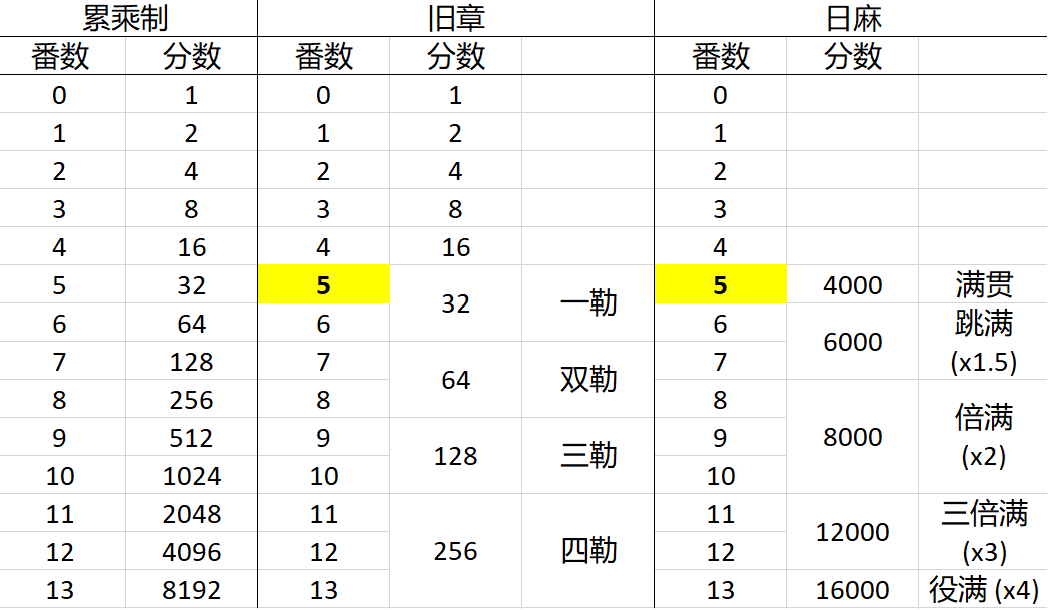
Figure labels: 累乘制 = multiplicative system; 旧章 = Old Style; 日麻 = Japanese mahjong; 番数 = fan count (han in Japanese mahjong); 分数 = points. Japanese limits shown are mangan, haneman (1.5×), baiman (2×), sanbaiman (3×), and yakuman (4×). The original Chinese figure is retained.
With tiered limits, score growth slows noticeably above the 5-fan limit. At the Old Style maximum of 13 fan, the score is only four times the 5-fan value. Old Style and Japanese scoring share the same underlying principle but differ in details, such as the Japanese haneman tier at 1.5 times the basic limit.
The essence of tiered limits is that each fan doubles the score below the limit threshold, whereas several additional fan are needed to double it above that threshold. In practice, the fan values of the hand's patterns are first added, and the corresponding score is then looked up in a table rather than calculated directly as a power of 2. This is a variant of multiplicative scoring.
Although tiered limits partly restrain exponential growth, they are not a perfect solution. The most obvious issue is that several different fan totals above the limit receive the same score: why should a 6-fan hand score the same as a 5-fan hand despite having one extra fan? More fundamentally, the problem of valuing combined patterns fairly—the third weakness discussed above—remains unresolved. Tiered limits do not eliminate overrewarding; they merely slow the rate of exponential growth.
Originally published in Chinese on Zhihu · Zhihu revision 2025-01-12