Added to this site · 2026-09-14
Push/Fold Decisions and Mahjong Payment Systems, Part II
AI-assisted draft translation. Terminology is under review; please refer to the Chinese original if anything is unclear.
This article continues Push/Fold Decisions and Mahjong Payment Systems, Part I.
In most mahjong games, push/fold decisions arise in the middle or late stages, when players are approaching readiness and can roughly estimate opponents' hand values and dangerous tiles. Although none of these three factors is certain, players must assess their own hands and waits and decide whether to push or fold. The criterion is overall expected payoff: which choice, attacking or defending, offers the higher expected return?
The calculation is: expected winnings − expected losses from dealing in,
or: points won × probability of winning − points lost on dealing in × probability of dealing in.
If pushing has a higher expected payoff than folding, push; if folding has a higher expected payoff, fold. Folding removes the possibility of winning, so its expected payoff is negative; choosing it means that pushing has an even more negative expected payoff. For example, suppose the opposite player has three exposed dot melds and is probably ready for a Full Flush, while the other two players have folded. Our decision should differ depending on whether we have two exposed melds and are ready for a Pure Straight in characters, or are still three tiles away from ready. Because the gains and losses associated with wins and deal-ins depend directly on the payment system, with different outcomes for self-draw and discard wins, push/fold criteria must be determined for each payment system.
Gains and losses under different payment systems
Table 1 shows each player's gains and losses on self-draw and discard wins under different systems. It includes four fixed-income systems; four cases in Zung Jung relative to its 25-point shared-payment threshold; three cases in Four Seas relative to its 50-point threshold; triple and sixfold self-draw systems widely used in China; and four hand values under Chinese Official rules. Apart from Chinese Official, all payments are normalized so that the self-drawing winner receives 12 points in total, allowing comparison across systems. Chinese Official combines a base payment with triple self-draw payment, so its entries use actual scores.
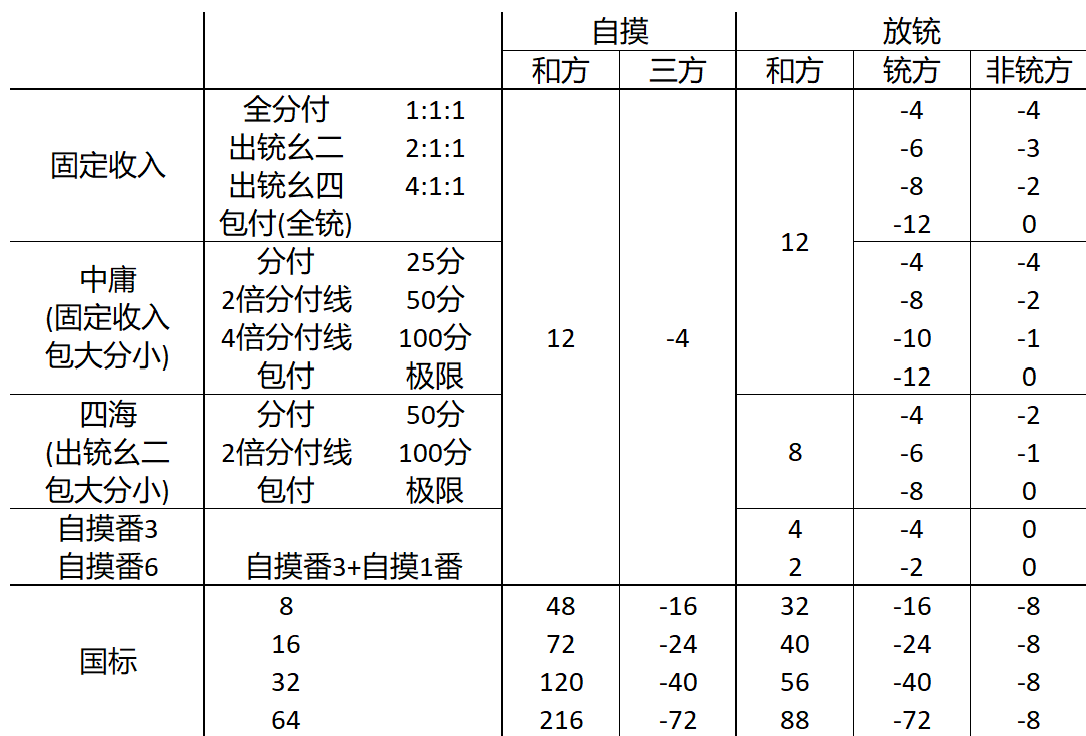
Table 1. From left to right, the outcome columns show the self-drawing winner, each other player on self-draw, the discard winner, the discarder, and each other losing player on a discard win. Fixed-income rows use equal sharing, 2:1:1 sharing, 4:1:1 sharing, and full discarder payment. Zung Jung rows show 25 points, 50 points, 100 points, and the limiting case; Four Seas rows show 50 points, 100 points, and the limiting case. Chinese Official rows use hand values of 8, 16, 32, and 64.
At Zung Jung's 25-point shared-payment threshold, its payments match equal sharing with fixed income. At the other extreme, its full-payment behavior approaches the fixed-income, full discarder-payment system as a limit.
Calculating push/fold decisions
The next step is to calculate the decision criterion: assuming the opponent is ready, what is our expected overall payoff when we are ready, one tile away from ready, and so on? The right side of Table 2 has six columns: four for pushing and two for folding. Pushing includes losses when the opponent self-draws or we deal in, and gains when we self-draw or the opponent deals in. Folding has only two possible outcomes: the opponent self-draws, or the hand ends in an exhaustive draw. This analysis reasonably simplifies the table situation by assuming that one opponent is clearly ready and the other two have folded. If we push, the four outcomes above are possible; if we fold, only an opponent self-draw or an exhaustive draw remains. It also assumes that folding does not change the opponent's self-draw probability. These are simplifications: several players can attack simultaneously, and folding can increase an opponent's win rate. Nevertheless, this simplified analysis provides a starting point that can be refined later.
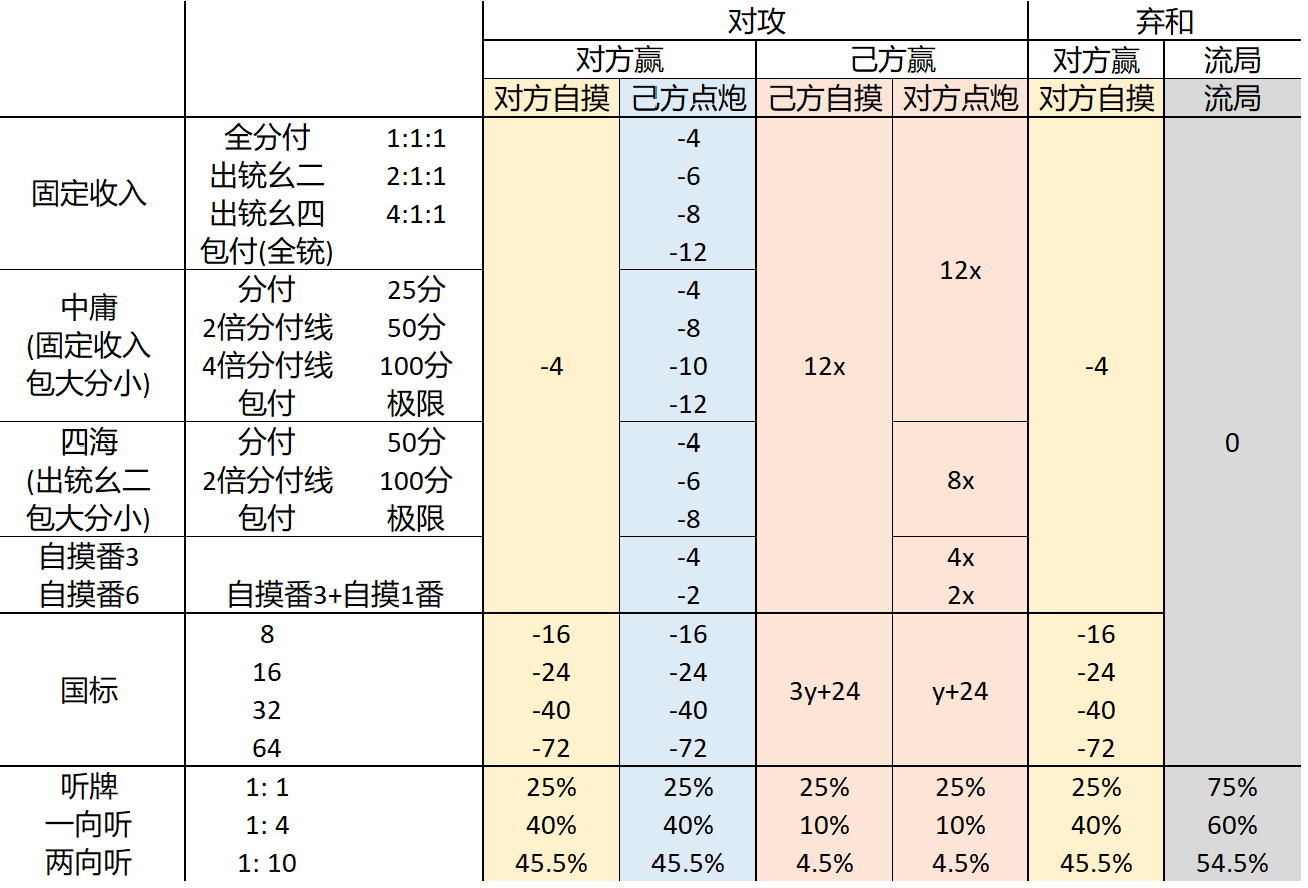
Table 2. The six outcome columns are: opponent self-draw while we push; our deal-in; our self-draw; opponent deal-in; opponent self-draw while we fold; exhaustive draw. The bottom probability rows assume our win probability relative to the opponent's is 1:1 when ready, 1:4 when one tile away, and 1:10 when two tiles away. The corresponding four pushing probabilities are 25% each; 40%, 40%, 10%, 10%; and 45.5%, 45.5%, 4.5%, 4.5%. The two folding probabilities are 25%/75%, 40%/60%, and 45.5%/54.5%. The displayed percentages are rounded where necessary.
Except for Chinese Official, the winning-payoff entries contain a variable x, the ratio of our hand value to the opponent's hand value. If the opponent's ready hand is worth one unit and ours is worth x, we should push when the expected payoff from pushing exceeds that from folding, and fold otherwise. For Chinese Official, y denotes our actual hand value, with an analogous decision criterion.
Some additional assumptions are made. When both players are ready, we assume equal win probabilities. This is the 1:1 ratio shown in the second column of the fourth row from the bottom. When we push and the other two players fold completely, the opponent's self-draw, our deal-in, our self-draw, and the opponent's deal-in each have probability 25%. When we fold completely, the opponent's self-draw probability is assumed unchanged, and an exhaustive draw pays zero.
These assumptions and payments allow us to solve for x or y. For example, under fixed income with full discarder payment, the fourth system listed, when we are ready:
(−4 − 12 + 12x + 12x) × 25% − (−4 × 25%) > 0
This gives x > 0.5. Thus, when both players are ready, we should push if our hand is worth more than half the opponent's. The value x = 0.5 is the push/fold threshold ratio, while Chinese Official's corresponding y is the push/fold threshold score.
In this calculation, the opponent's self-draw terms are identical for pushing and folding and cancel out—the two yellow columns. The final column, an exhaustive draw, always pays zero. The comparison therefore reduces to our deal-in loss, in column 2, against our self-draw gain and the opponent's deal-in payment, in columns 3 and 4.
The table also considers being one or two tiles away from ready. When we are one tile away, the opponent's win probability is assumed to be four times ours; when we are two tiles away, ten times ours. These factors of four and ten are estimates, not precise measurements. They simply represent the greater difficulty of winning from those states.
Push/fold threshold ratios and scores
Table 3 lists the threshold ratios x for being ready, one tile away, and two tiles away under each payment system, or the threshold scores y under Chinese Official.
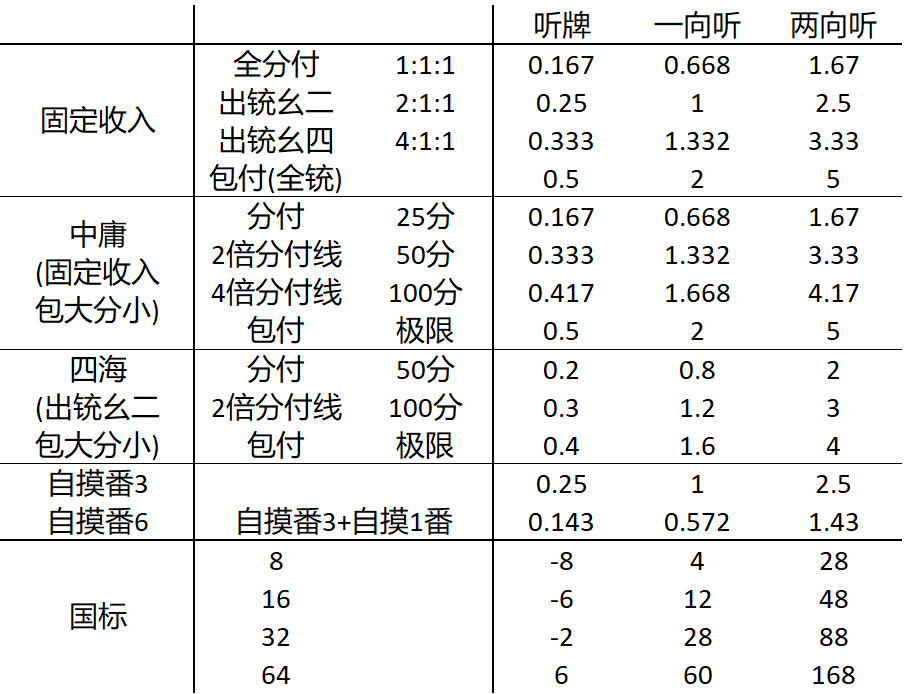
Table 3. The final three columns give the thresholds for a ready hand, one tile away from ready, and two tiles away. Most entries are hand-value ratios x; the four Chinese Official rows give actual hand scores y, for opponent hand values of 8, 16, 32, and 64 respectively.
The overall pattern is that the thresholds for ready, one-away, and two-away hands are in the ratio 1:4:10, exactly matching the assumed relative difficulty of winning. Also, when ready under Chinese Official rules, whatever the opponent's hand value, our threshold score y is below the minimum qualifying score of 8, and can even be negative. Thus, when both players are ready, a Chinese Official player need not consider what the opponent is making or how valuable their own hand is: any qualifying hand should push. This illustrates its extreme offensive tendency: once ready, pushing all-out is the best strategy.
Reordering Table 3 by x produces a list of systems ranked from the smallest to the largest threshold ratio. A smaller x means that a lower hand value suffices to justify pushing, so the system encourages more offense. Conversely, a larger x requires a more valuable hand to attack and encourages more defense.
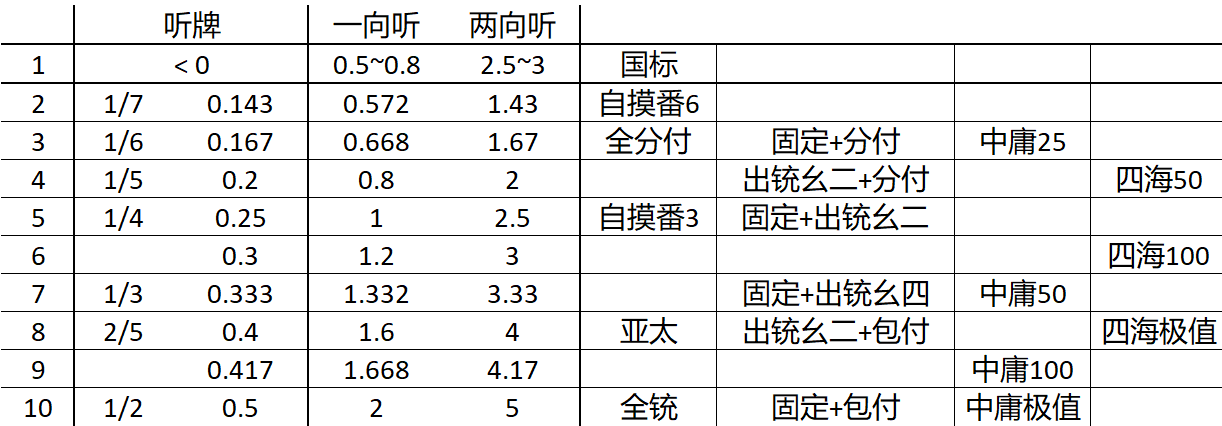
Table 4. The final three columns again show ready, one-away, and two-away thresholds. The rows are discussed below. Shared-payment thresholds and examples refer to the versions analyzed in this article.
- The first row is Chinese Official, with y converted to x. Its ready-hand x is shown as below zero, implying unconditional attack and making it the most offensive system.
- The final row is full discarder payment with fixed income, including Zung Jung's limiting case. A ready hand must be worth half the opponent's to justify pushing. Riichi and K-style mahjong, which use full discarder payment, encourage the most defense. The remaining systems fall between these extremes.
- Row 2, sixfold self-draw, has x = 1/7 and is common in regional Chinese mahjong. Since self-draw pays six times a discard win, the loss from dealing in is small. The system strongly encourages attacking while seeking self-draw.
- Row 3, equal shared payment with fixed income, has x = 1/6. It imposes no discarder liability and makes no distinction between self-draw and discard wins: the three losers always share the payment equally. It becomes a pure race to complete a hand. Interestingly, equal sharing and sixfold self-draw represent opposite extremes of payment design—see Rewarding Self-Draw Does Not Mean Overrewarding It—yet converge on similar push/fold incentives, both ranking among the most offensive systems.
- Row 4, discarder-double shared payment, has x = 1/5, also the threshold ratio at Four Seas' 50-point shared-payment threshold. Systems such as Zung Jung and Four Seas share payment for small hands and place more liability on the discarder for large hands. Their threshold ratios vary with hand value: small hands encourage offense, large hands emphasize defense. At Zung Jung's 25-point threshold, x matches equal sharing, encouraging more small-hand offense than Four Seas.
- Row 5, triple self-draw, has x = 1/4. Interestingly, triple self-draw alone has a much higher threshold ratio than Chinese Official. Chinese Official's base-payment-plus-triple-self-draw structure is a discarder-double system with a fixed basic win payment. Both triple self-draw and discarder-double payment have substantially higher x values than Chinese Official. This shows that Chinese Official's strong offensive tendency comes from its fixed 8-point base payment, rather than the much-criticized triple self-draw. Combined with the 8-point minimum, the fixed base payment makes racing for a small 8-point win the best strategy.
- Rows 6–10 include the x values for different hand sizes in Zung Jung and Four Seas. Zung Jung spans a wider range, from 1/6 to 1/2; Four Seas is more concentrated, from 1/5 to 2/5. Most Zung Jung hands are small 5- or 10-point hands, encouraging a strong rush to win. Against a large ready hand, Zung Jung approaches full discarder payment and penalizes dealing in more severely.
A reasonable push/fold criterion
The preceding section focused on threshold ratios when both players are ready. For full discarder payment, K-style mahjong argues:
Even with full discarder payment, a ready hand worth half the opponent's is enough to push.
This is the x = 1/2 case in row 10 of Table 4. Full discarder payment already encourages the most defense, yet K-style's designer seems to regard even that threshold as insufficient for competitive push/fold decisions and would prefer it higher. But this threshold applies when both players are ready. Mahjong is a four-player race; players inevitably become ready at different times. Reaching readiness at exactly the same time as an opponent is relatively uncommon. More often, when someone else becomes ready, we are one tile away, two tiles away, or further behind. Decisions in those situations are what players face more frequently.
According to Table 4, under full discarder payment, when the opponent is ready and we are one tile away, our prospective hand must be worth twice theirs to push. If they are ready for a main pattern such as Mixed Triple Chow or Pure Straight, we need to be one tile away from a hand worth twice as much, such as Full Flush or Half Flush combined with All Pungs. If our one-away hand contains only a comparable main pattern, we must fold. In practice, this means folding in most situations where the opponent is ready and we are not. Such a strong defensive tendency approaches riichi mahjong. (In riichi, dora and hidden dora make the value of a declared ready hand hard to predict, so folding is the best choice when one's own hand is not ready.)
Thus, even without riichi, dora, or furiten, full discarder payment imposes excessive liability and makes the rules too defensive. Conversely, Chinese Official, sixfold self-draw, and equal sharing, with their low thresholds, encourage too much offense. Neither extreme favors balanced play. Balanced rules should encourage active hand building and offense under ordinary circumstances, alongside sensible folding in response to the table situation. They test hand-building technique, offensive and defensive strategy, table reading, and push/fold judgment together. Rules overly committed to offense or defense cannot offer the same rich interaction, excitement, and spectator appeal.
Payment systems therefore directly influence the offensive or defensive character of a ruleset. If x represents that tendency, there is probably no single optimal value, but a reasonably balanced range. After excluding the extremes, a suitable ready-hand range is roughly 1/5 to 2/5. This includes the discarder-double, full-payment arrangement used in Asia-Pacific competition—three players pay on self-draw, while the discarder pays a doubled amount—and, surprisingly, triple self-draw. Zung Jung innovatively distinguishes liability for small and large discard wins, but its two extremes lean too heavily toward offense and defense respectively. Four Seas builds on Zung Jung's payment system, with threshold ratios between 0.2 and 0.4, providing a relatively reasonable structure that encourages balanced offense and defense.
Originally published in Chinese on Zhihu · Zhihu revision 2024-12-31