Added to this site · 2026-09-14
Rewarding Self-Draw Does Not Mean Overrewarding It
AI-assisted draft translation. Terminology is under review; please refer to the Chinese original if anything is unclear.
At some point, discussions of self-draw in mahjong rules began treating any reward for it as “overrewarding,” as though the two were identical. This idea circulates only within a small community discussing competitive mahjong and has had little effect on the much larger population playing regional Chinese variants. Nevertheless, this article examines the issue to clarify its origins and separate sound arguments from mistaken ones.
The criticism began with Zung Jung
The expression “overrewarding self-draw” probably originated in Alan Kwan’s “A Historical Perspective on Zung Jung Mahjong” (2009). Other criticisms of excessive rewards—for concealed Pinfu hands, dora, and ippatsu, for example—also appear there. The author defines overrewarding as:
Excessive increases in value: awarding a pattern more points than its difficulty warrants, adding excessive luck bonuses, or placing excessive emphasis on a particular element, such as self-draw or concealment.
The book discusses self-draw in a dedicated chapter and also in its discussion of payment systems. After Zung Jung criticized excessive self-draw rewards, particularly Chinese Official Mahjong’s tripling, the competitive-rules community began to recognize and broadly accept the idea that tripling overrewarded self-draw. It became one of the most criticized flaws in Chinese Official Mahjong.
Yet Chinese Official Mahjong was introduced in 1998, long before the book. By then it had been played for more than a decade, and players in China and elsewhere had proposed changes to the number of patterns, their values, scoring principles, and other aspects. I had not heard objections to base payments plus self-draw tripling. This is naturally related to the longstanding regional practice that all three opponents pay for self-draw, while only the discarder pays for a discard win. Many regional rules add another fan for self-draw on top of this, producing sixfold payment. From this perspective, Chinese Official Mahjong had already made considerable progress by removing the separate doubling awards for dealership and self-draw.
Zung Jung’s criticism is incomplete
Zung Jung has grounds for criticizing the threefold or even sixfold self-draw payments common in regional mahjong, including Hong Kong and Taiwanese rules:
Tripling self-draw also violates the principles of hand-building mahjong: the same hand does not acquire three times the aesthetic value simply by being self-drawn.
One argument says that self-draw has a theoretical probability of one-quarter, so triple payment is reasonable. But if that reasoning holds, should Last Tile Draw and Out with Replacement Tile receive a hundredfold payment, and Blessing of Heaven three hundred thousandfold?
The phrase “three times the aesthetic value” confuses difficulty with aesthetics. The completed pattern is unchanged by how the winning tile was obtained, so its aesthetics remain the same. In terms of difficulty, however, self-draw accounts for close to one-quarter of all wins and can indeed be described as four times as difficult. The appeal to aesthetics therefore shifts the concept being discussed.
The book then continues:
A chance-based pattern with a one-in-four probability does not deserve triple payment, or even one and a half times payment. Zung Jung therefore establishes fixed income as an immutable principle, not merely an ordinary rule.
The implication is clear: self-draw is worth neither three times nor 1.5 times as much, so Zung Jung removes its reward entirely. But there is another logical problem. Even if a one-in-four pattern does not deserve triple payment, why is it not worth 1.5 times? No calculation or other evidence is offered. Even if its value is below 1.5, must it be zero? Could it be 1.25 or 1.2? Does self-draw have no value at all? Why must the reward be eliminated?
The fundamental questions are whether self-draw should be assigned value, whether it should receive a reward, and whether every reward necessarily constitutes overrewarding. Zung Jung does not answer them, making its criticism incomplete. Nor does it criticize classical mahjong’s 2 fu for self-draw; it identifies the increase from 2 fu to 1 fan as the source of excessive rewards, implicitly leaving room for some value. Zung Jung’s insistence on equal self-draw and discard-win receipts draws on Japanese full-discarder payment. Yet even Japanese mahjong rewards self-draw: beyond the inherited 2 fu, a concealed self-draw gains 1 han, whereas a concealed discard win gains only 10 fu. Japanese mahjong therefore also has a self-draw reward.
My interpretation is that Zung Jung did not find a suitable way to value a one-in-four event within its scoring and payment framework, so simplified matters by awarding nothing. Its complete removal of self-draw rewards was an overcorrection to the widespread threefold or sixfold payments in regional mahjong.
Ironically, despite Zung Jung’s insistence that fixed income is immutable, the Asia Pacific Mahjong competition—described here as almost the only competition or organization using Zung Jung rules—uses discarder-double payments with full coverage by the discarder. Each of three players pays one unit for self-draw, while the discarder pays two for a discard win. Self-draw therefore yields 1.5 times as much.
From dealer-double to discarder-double payments
Since Zung Jung does not answer the fundamental question of whether and how much to reward self-draw, let us look to the origins and evolution of mahjong rules.
Classical mahjong’s calculation of minipoints for all four hands is complicated. Set that aside and assume a common winning-hand value. Under dealer-double payments, a winning dealer receives twice that value from each opponent. When a non-dealer wins, the dealer pays twice the value and the other two pay once. Another way to understand this is that everyone first pays the winner one share. If the dealer wins, the dealer receives one additional share from each; if a non-dealer wins, the dealer pays the winner one extra share. This divides payment into two components: the amount everyone pays the winner, which we can call the basic win payment, and the dealer’s additional gains or losses, which we can call the dealer adjustment.
Rotating the dealership makes dealer-double payments fair overall, but not within each hand. Because the dealer pays double when losing, the three non-dealers have an incentive to act against the dealer. Non-dealer A builds a large hand, non-dealer B deliberately deals in, yet the dealer pays double. This is unfair. Rotation does not solve the problem: it merely gives everyone a turn at experiencing unfairness. “A Historical Perspective on Zung Jung Mahjong” discusses this in more detail.
Dealer-double payments therefore needed reform, and dealing in was the underlying issue. Since a discarder can actively determine the outcome of a hand, that player naturally bears considerable responsibility. This produces discarder-double payment: the discarder pays two shares and the other two one share each; on self-draw, everyone pays two. Discarder-double payment replaces the dealer in the dealer-double framework with the discarder. Again, it can be divided into two components. First, everyone pays one share as the basic win payment. Second, the discarder pays the winner one extra share. If the player supplies the winning tile to themself—self-draw—the other three instead each pay that player one extra share. The dealer adjustment has become a discarder adjustment: supplying another player’s winning tile costs one share, while supplying one’s own winning tile earns one share from each opponent.
The basic win payment
In both systems, the first component represents what the winner receives from all three opponents simply for winning, before considering dealership, self-draw, or discarder liability. It represents the value of winning itself. It is the amount owed whenever another player wins. By contrast, full-discarder systems influenced by modern Japanese riichi make the discarder pay everything and leave the other two players with no loss, so this basic component is absent. The question is whether a player who neither wins nor deals in should nevertheless pay a basic win payment.
In terms of competitive outcomes, another player’s earlier win means they completed their hand faster. Losing some points reasonably reflects that result. In terms of responsibility, the winner may have self-drawn or won on someone else’s discard, but may also have called chows or pungs from either of the other losing players while building the hand. The final discarder should not bear all responsibility, nor should a self-drawing winner receive all the credit for its construction. Moreover, allowing the other players to lose nothing encourages passive play: players can readily settle for not dealing in instead of trying to win, harming the overall character of the game. A basic win payment is therefore a more scientifically sound design.
The dealer or discarder adjustment
The second component is viewed from the dealer’s or discarder’s perspective. A losing dealer pays the winner one extra share; a losing discarder likewise pays one extra share. A winning dealer receives one extra share from each opponent; a winning tile-supplier who supplies their own tile—self-draw—also receives one extra share from each. In the discarder-adjustment component, self-draw can therefore be viewed as equivalent to all three opponents dealing in. This is a formal interpretation of the transfers in the second component alone. It excludes the basic win payment and is fundamentally different from later rules that simply require three payments for self-draw and one for a discard win.
Chinese Official payments
Splitting discarder-double payments into the basic win payment and the discarder adjustment makes Chinese Official Mahjong’s system easy to understand. Base payments plus self-draw tripling are a form of discarder-double payment with a fixed basic win component. Under ordinary discarder-double payments, the basic win payment, the discarder adjustment, and the hand value are equal. In Chinese Official Mahjong, the basic win payment is fixed at 8 points, while only the discarder adjustment equals the hand value. At the 8-point minimum, its payments exactly match discarder-double payments. As hand value increases, the system approaches threefold self-draw payment. See What Does “Triple Payment for Self-Draw” Really Mean in Chinese Official Mahjong? for the detailed analysis.
Self-draw and discarder liability are two sides of the same mechanism
The analysis of discarder-double payments suggests that self-draw is equivalent to supplying oneself with the winning tile. Self-draw and discarder liability both arise from the tile-supplier’s role and are two sides of the same mechanism. A payment system that recognizes discarder liability should therefore also reward self-draw; conversely, if it rejects self-draw rewards, it should also reject discarder liability. The figure classifies payment systems along these two dimensions.
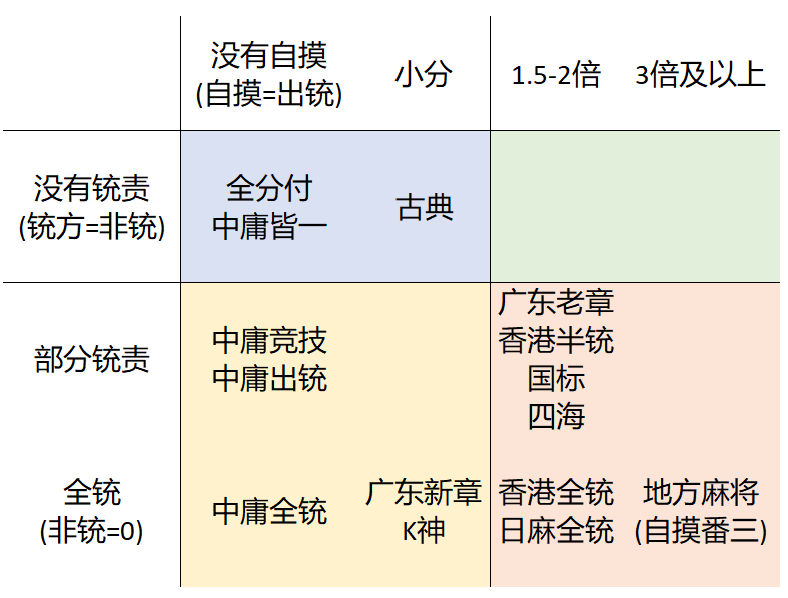
Columns show the self-draw reward: none, a small additive award, a multiplier of 1.5–2, and a multiplier of at least 3. Rows show discarder liability: none, partial, and full. Blue marks no substantial self-draw reward and no liability; red marks both; yellow marks liability without a substantial self-draw reward; green marks the opposite combination. The original Chinese labels are retained.
The self-draw dimension has four bands: no reward, meaning fixed receipts for self-draw and discard wins; a small award; 1.5–2 times; and 3 times or more. Classical mahjong’s 2 fu and the 2-point awards in Guangdong New Style and K-shen are small enough to disregard here. The liability dimension has three bands: none, partial liability, and full payment. These can also be grouped into four quadrants according to the presence or absence of a self-draw reward and liability.
Given the conclusion that self-draw and liability are two sides of the same mechanism, the blue quadrant with neither and the red quadrant with both are internally consistent. Equal sharing without either element is simple but logically coherent and suitable for family recreation. Regional tripling overrewards self-draw, while its full-discarder requirement also imposes excessive liability; its use in gambling mahjong is understandable. In the middle, systems with partial liability and a 1.5 self-draw multiplier are discarder-double payments and their modifications, with moderate rewards and liability. In fact, Zung Jung’s criticism concerns raising self-draw from 2 fu to 1 fan, or a doubling. Combining that doubling with the payment system’s 1.5 multiplier produces tripling. The larger factor is the doubling, yet Zung Jung attributes the excessive reward to the 1.5 payment multiplier.
The yellow quadrant contains systems with discarder liability but no self-draw reward. They are inconsistent on these dimensions: they value liability while rejecting self-draw, which has the same origin. It is therefore understandable that the Asia Pacific competition uses Zung Jung’s rules but changes payment to the Hong Kong full-discarder method: discarder-double receipts covered entirely by the discarder.
In conclusion, this historical comparison of classical and modern payment systems leads to the view that self-draw and discarder liability are two sides of the same mechanism, and that a sound payment system should treat them consistently. In my view, serious mahjong rules should recognize both, with neither set too high nor too low.
Originally published in Chinese on Zhihu · Zhihu revision 2026-05-19