Added to this site · 2026-09-14
Self-Draw, Hand Valuation, and Payment Systems
AI-assisted draft translation. Terminology is under review; please refer to the Chinese original if anything is unclear.
The following two articles discuss how mahjong hand valuation evolved and the reasoning behind that development:
- The Evolution of Mahjong Scoring Systems, Part I: Multiplicative Scoring
- The Evolution of Mahjong Scoring Systems, Part II: Additive Scoring
These three articles introduce different payment systems:
- Comparing Mahjong Payment Systems
- What Does “Triple Payment for Self-Draw” Really Mean in Chinese Official Mahjong?
- A Reasonable Payment System for Hand-Building Mahjong
This analysis led me to some important new insights into self-draw, a central element of mahjong. I explore them here.
Hand valuation and payment systems
First, we need to distinguish hand valuation from payment. A mahjong hand valuation system determines how points are assigned to individual scoring patterns and how their values combine when a hand contains several patterns. Put simply, it answers the question: how much is this hand worth? Each ruleset has its own longer or shorter list of scoring patterns, which embodies its hand valuation system.
Once the hand’s total value is established, the points gained or lost by each player, any additional effects of self-draw or dealing in, and the influence of dealership or other factors belong to the payment system.
Hand valuation and payment are two related steps in settling a mahjong hand. They often appear together, but they occur in sequence. First, the scoring patterns determine the winning hand’s value. Then that value and the method of winning determine each player’s gain or loss, including the winner, the discarder, and the other losing players.
Chinese Official Mahjong’s 81 patterns and five scoring principles belong to hand valuation; its 8-point base payments and self-draw tripling belong to payment. Similarly, despite the complexity of Japanese mahjong’s 39 patterns and its combination of fu and han, it first calculates basic points: the amount a non-dealer pays when another non-dealer self-draws. Each loser’s payment is then determined from those basic points, dealer status, and the win method, and rounded up to the nearest hundred. Under Japanese full-discarder payment, an individual payment may be one, two, four, or six times the basic points. The winner receives the sum of the losers’ payments.
How self-draw scoring evolved
Self-draw means that the winner draws the final tile personally. Winning on one of the other three players’ discards is a discard win. Self-draw, as a way of winning with a particular probability, has been recognized since the earliest rules. Its reward has changed as mahjong developed.
First, self-draw appears in hand valuation. Classical mahjong awarded it 2 minipoints, like edge, closed, and pair waits. Later rules commonly made it a separate pattern worth 1 fan, doubling the value. Whether added or multiplied, self-draw was treated as an ordinary pattern whose value combined with the others to determine the hand’s total.
Second, the value of self-draw is not limited to its pattern score. Payment systems can contain an implicit bonus. Under discarder-double payment, a self-draw receives twice the hand value from each of three players, totaling six times the value. A discard win receives two shares from the discarder and one from each other player, totaling four shares. Self-draw therefore pays 50% more, providing an implicit reward.
Finally, the rewards from both steps can accumulate. Under discarder-double payment, a self-draw pattern worth 1 fan gives a factor of 2, while the payment system contributes a factor of 1.5, making self-draw worth three times a discard win. This was the original source of self-draw tripling. Most regional Chinese rules now require three players to pay for self-draw but only the discarder to pay for a discard win. This is another form of tripling, produced entirely by the payment system. If hand valuation also awards self-draw 1 fan, the result is sixfold payment, encouraging players in many regional variants to gamble on self-draw.
Japanese riichi uses dealer-double, full-discarder payments, which give no additional self-draw reward at the payment stage. Hand valuation nevertheless retains 1 han for a concealed self-draw, while an open self-draw receives only 2 fu. Since nearly half of Japanese winning hands are concealed, self-draw receipts average about 1.5 times discard-win receipts.
Chinese Official Mahjong also rewards self-draw twice, although its 1-point pattern award is almost negligible. Its payment system combines 8-point base payments with self-draw tripling. The analysis in What Does “Triple Payment for Self-Draw” Really Mean in Chinese Official Mahjong? gives a self-draw return ratio of 1.5–2.0 for the hands representing 92% of the distribution, described here as scoring 8–20 points.
Self-draw in hand valuation and payment
The table shows how different rulesets reward self-draw at the two stages.
| Ruleset | Hand valuation | Payment system | Combined effect |
|---|---|---|---|
| Equal sharing; Zung Jung | — | — | 0 bonus |
| Classical | 2 fu | — | +2 |
| Guangdong New Style; K-shen | 2 points | — | +2 |
| Japanese full-discarder | 1 han for concealed self-draw | — | < ×1.5 |
| Four Seas | — | ×1.5 | ×1.5 |
| Chinese Official | 1 point | ×1.5–2 | ×1.5–2 |
| Guangdong Old Style; Hong Kong half-discarder and full-discarder | 1 fan | ×1.5 | ×3 |
| Regional triple-payment rules | — | ×3 | ×3 |
| Regional sixfold-payment rules | 1 fan | ×3 | ×6 |
Self-draw can receive an additive or multiplicative award in hand valuation. In the payment systems listed here, its effect is multiplicative. Some rules reward it at both stages, but the two calculations do not conflict: they are computed separately and combine to produce the final effect.
This raises a direct question: should self-draw be reflected in hand valuation, in payment, or in both?
Of all the patterns listed in a hand valuation system, only self-draw can also act at the payment stage. The other patterns finish their role once the hand’s value has been calculated. Dealer status also affects Japanese payments, but it is not itself a listed scoring pattern. Suppose a winning hand is worth 100 points. Whether that value came from multiplying or adding several patterns no longer matters when payments are settled. Self-draw is therefore fundamentally different from other scoring patterns—or can be understood as a distinct mahjong mechanism.
Self-draw accounts for one-quarter of wins
Alan Kwan’s “A Historical Perspective on Zung Jung Mahjong” first questioned the longstanding tradition of rewarding self-draw, calling tripling “overrewarding self-draw.” Its argument is:
In theory, self-draw accounts for one-quarter of wins. In practice, opponents hold dangerous tiles, so the proportion is often higher among skilled players. Tripling violates hand-building mahjong’s principles: the same hand does not acquire three times the aesthetic value by being self-drawn. A chance-based pattern occurring one-quarter of the time deserves neither triple payment nor even one and a half times payment.
Rather than discuss that position immediately, let us first consider self-draw’s difficulty.
One fact about self-draw is beyond doubt: it accounts for approximately one-quarter of all wins, or one-third as many wins as those on discard. This is easy to understand: with four players, each has a one-in-four chance of drawing a particular tile. Statistics from an online Chinese Official platform, showing selected patterns in the chart below, support this. Apart from patterns that necessarily involve self-draw or a discard win, the self-draw proportion is between one-quarter and one-third across patterns of different values. In four-player mahjong, this proportion does not change according to whether hand valuation is multiplicative or additive.
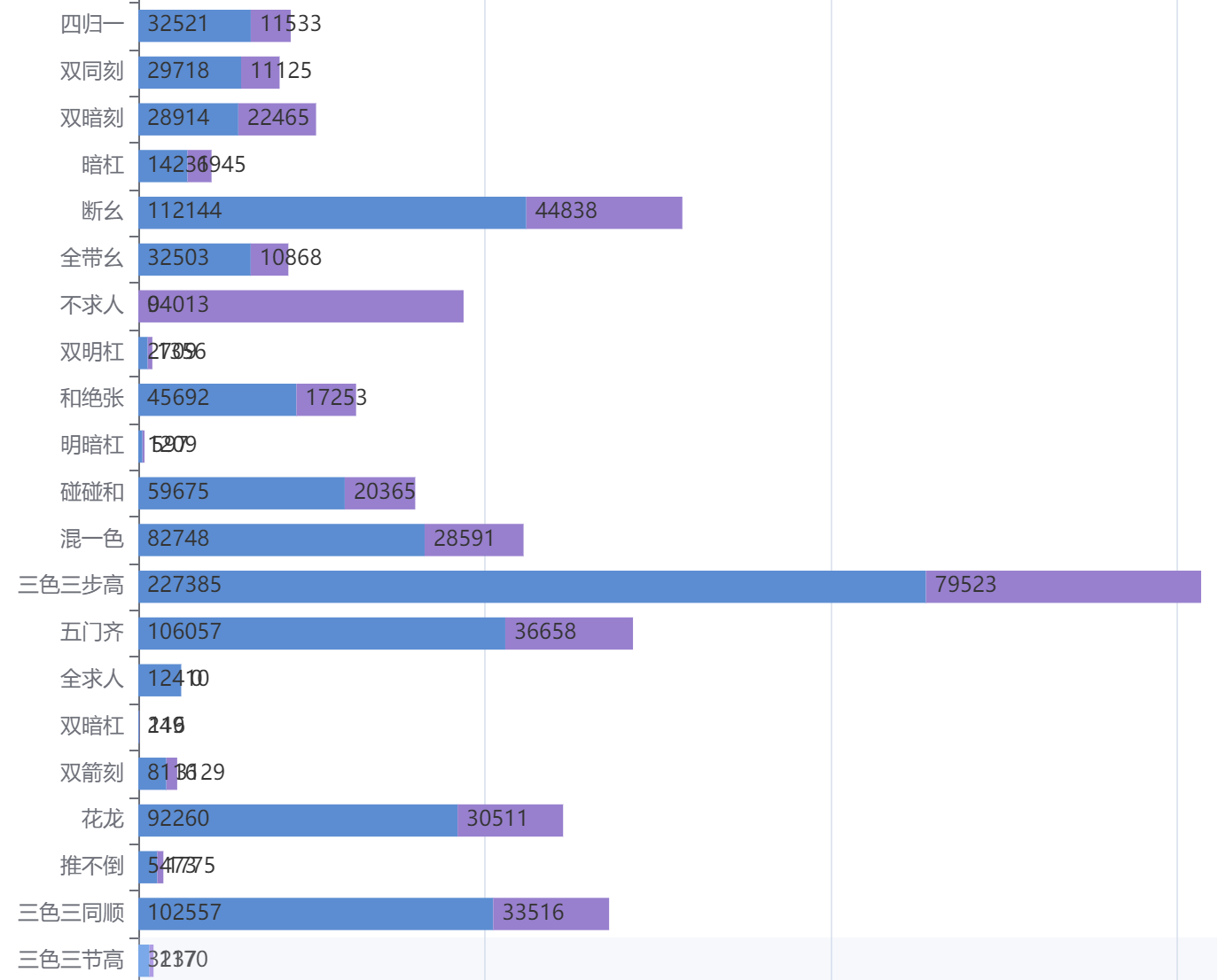
The original chart is retained. Horizontal bar lengths show win counts; blue denotes discard wins and purple denotes self-draws. Rows are selected scoring patterns, including Tile Hog, Double Pung, Two Concealed Pungs, Concealed Kong, All Simples, Outside Hand, Fully Concealed Hand, Two Melded Kongs, Last Tile, Melded Kong and Concealed Kong, All Pungs, Half Flush, Mixed Shifted Chows, All Types, Melded Hand, Two Concealed Kongs, Two Dragon Pungs, Mixed Straight, Reversible Tiles, Mixed Triple Chow, and Mixed Shifted Pungs.
Self-draw is independent of other scoring patterns
The two articles on scoring evolution explained that the most important reason for moving from multiplicative to additive scoring was to handle combinations of patterns more appropriately. Patterns are not completely independent; some are correlated. Mathematically, using probability as an approximation of difficulty, let P(A) be the probability of pattern A and P(A|B) its probability given pattern B. Independence would require P(A) = P(A|B). Mahjong patterns do not satisfy this condition, so multiplying their values overestimates the score of a combined hand.
The chart, however, shows a self-draw share of approximately one-quarter for almost every pattern. If self-draw is pattern A, then P(A) = 1/4, and P(A|B) is also approximately 1/4 for almost every pattern B. This indicates that if treated as a scoring pattern, self-draw is independent of all other patterns.
Under multiplicative scoring, self-draw can therefore be included as an ordinary scoring pattern, worth, for example, 1 fan. Its value can be multiplied with the others to reflect the difficulty of self-drawing that hand. Japanese mahjong’s 1 han for a concealed self-draw is an example.
Under additive scoring, however, no fixed score is appropriate for self-draw because of its independence. Suppose Chinese Official Mahjong assigned it 10 points. That would undervalue self-draw for a 60-point hand but overvalue it for an 8-point hand. In an additive system, self-draw’s independent contribution should therefore be represented through multiplication in the payment system, rather than as a fixed entry in the scoring-pattern table. Chinese Official Mahjong’s 1-point self-draw award is effectively negligible; its main effect lies in base payments plus self-draw tripling.
Valuing self-draw in an additive scoring system
If the payment system is to express self-draw’s value, we must determine its multiplier from its difficulty. Although hand valuation and payment are separate, they multiply together to produce the final result. The self-draw multiplier must therefore be consistent with the relationship between pattern difficulty and value in the additive system, or self-draw will be misvalued. As described in The Evolution of Mahjong Scoring Systems, Part II: Additive Scoring, a tenfold increase in difficulty doubles the score. This gives log₂ F = log₁₀ N, where F is score and N is difficulty. Rearranging gives the power-law relationship F = N^(log₁₀ 2), approximately F = N^0.301. The formula applies to relative as well as absolute difficulty and score.
Self-draw’s probability of 1/4 corresponds to fourfold difficulty. The formula gives 4^0.301 = 1.518, approximately 1.5. Thus, a self-draw multiplier of 1.5 is appropriate for the additive system described above: multiply any hand’s value by 1.5 to obtain its self-drawn value. If Pure Straight is worth 40 and Full Flush 60, a self-drawn Pure Straight scores 40 × 1.5 = 60, equal to a Full Flush won on discard. This expresses comparable difficulty and accords with our general intuition.
Self-draw and discarder-double payments
The calculated multiplier of 1.5 recalls the implicit self-draw multiplier in discarder-double payments. This appears to be a fortunate coincidence. The calculation is specific to a scoring system whose values follow a power law with exponent log₁₀ 2. That system addresses both pattern valuation and pattern combinations in mahjong with many scoring patterns. Since tenfold difficulty gives double the score, it is understandable that fourfold difficulty gives roughly 1.5 times the score. If score were proportional to difficulty, or followed another relationship, the self-draw multiplier would differ.
In A Reasonable Payment System for Hand-Building Mahjong, I argued only that the final self-drawn tile is highly valuable and that a multiplier of 1.5–2 is reasonable. That argument lacked persuasive support. The correspondence with 1.5 derived here provides support for it.
In conclusion, under additive scoring, self-draw should operate through payment rather than hand valuation and should not be a separate scoring pattern. Its return multiplier is 1.5, which can be implemented through discarder-double payments. This connects self-draw, additive scoring, and payment into a complete rules framework. A rigorous demonstration of the relationship still requires more detailed analysis.
Originally published in Chinese on Zhihu · Zhihu revision 2026-05-19