Added to this site · 2026-09-14
Payoffs for the Six Outcomes of a Mahjong Hand
AI-assisted draft translation. Terminology is under review; please refer to the Chinese original if anything is unclear.
In a contest between two players or teams that must produce a decisive result, there are only two outcomes: winning and losing. In a single-elimination event, the winner advances and the loser is eliminated; scores are not needed to record that result. In a contest that accumulates results over many rounds, the most natural assignment is one point for a win and zero for a loss, with the total determining the winner. In point-by-point contests such as tennis and volleyball, for example, a successful attacking shot earns a point, while an error gives a point to the opponent; the first side to reach the required score wins the set.
Some games, such as football and Chinese chess, allow draws, giving three possible results: win, loss, and draw. Knockout competitions cannot leave a result tied, so football uses extra time and, if necessary, a penalty shootout, while chess competitions may use faster tiebreak games. Leagues or point-based rankings instead assign different scores to each result. Early football leagues awarded two points for a win, one for a draw, and zero for a loss; the win reward later increased to three to encourage offense. Chess awards one point for a win, half a point for a draw, and zero for a loss, equivalent in relative terms to the earlier football system. Whatever the specific values, the purpose is to distinguish different outcomes with different scores, rather than assign the same score to different results.
Unlike these two-sided contests, mahjong has four players, each playing against the other three. A win ends the hand, setting aside special variants such as Sichuan's Bloody Battle to the End. Each player scores separately, and rankings determine success. Adding the distinction between self-draw and discard wins expands the possible results for an individual player to six:
- A. Winning by self-draw.
- B. Winning on another player's discard.
- C. An exhaustive draw.
- D. Another player deals into someone else's hand, while we are neither winner nor discarder.
- E. Another player wins by self-draw.
- F. We deal into another player's hand.
These consist of two winning outcomes, one draw, and three losing outcomes. Their difficulty, probability, and associated responsibility differ, so their scores should differ too. Below, I examine how different rules, particularly payment systems, affect the relationships among these payoffs. Lowercase letters a–f denote the absolute amounts gained or lost in the respective outcomes.
Reasonable payoff relationships from the logic of winning and losing
Let us begin with some straightforward relationships arising from the logic of wins and losses. Almost all mahjong rules follow them.
Deduction 1: c = 0
Mahjong generally uses zero-sum payments: the sum of all players' gains and losses in a hand is zero. This is connected to its origins as a gambling game, but the arrangement remains reasonable even without money. Some systems that claim to “only award points, never deduct them” are mathematically equivalent to zero-sum scoring.
In an exhaustive draw, each player should normally neither gain nor lose points. This excludes not-ready penalties found in some rules, because those transfers do not arise from the win/loss result itself.
Deduction 2: a >= b > 0
In the first two outcomes, the player wins, so both a and b must be positive.
Self-draw occurs about one-third as often as a discard win. Under the principle that reward should increase with difficulty, self-draw income a should therefore be at least as great as discard-win income b. Almost all mahjong rules satisfy a >= b. The notable exception is Japanese three-player mahjong, where the “self-draw shortfall” arises from carrying over the four-player scoring table without recalculating payments for the number of players. Even within Japanese mahjong, receiving less for self-draw than for a discard win is often considered unreasonable. Supporting this view, Japanese four-player mahjong awards two fu for self-draw and specifically one han for a concealed self-draw, while a concealed discard win receives only ten fu. One function of these provisions is to prevent self-draw income from falling below discard-win income.
Deduction 3: a = 3e; b = 2d + f
Mahjong is zero-sum. On a self-draw, the three losing players pay equally, so a = 3e. On a discard win, the two other losing players pay equally, so b = 2d + f.
Deduction 4: d <= f
The discarder's loss f should be at least as large as another losing player's loss d. This expresses discarder liability and connects responsibility with cost. If the discarder paid less than the other losers, it could encourage collusion between the winner and the discarder.
Deduction 5: d <= e
From deduction 2: a >= b.
Substituting deduction 3: 3e >= 2d + f.
Combining this with deduction 4: 3e >= 3d.
Therefore: e >= d.
A non-discarding loser's payment d on someone else's discard win should thus not exceed their payment e when another player self-draws.
Deduction 6: The relationship between e and f
The logic of winning and losing alone does not determine which is greater.
Together, these deductions give:
a >= b > 0 >= −d >= −e/−f
This expresses the general descending order of the six payoffs. The slash here lists the two losses −e and −f; it does not mean division or establish an order between them.
Actual payoffs under different payment systems
The preceding analysis identifies reasonable relationships from the most general logic of wins and losses. Specific mahjong rules, especially their payment systems, directly affect the actual relationships.
The following table compares the six payoffs under twelve payment systems. For a common basis, self-draw income is normalized to 6x. Chinese Official is a special case, with hand value y.
| No. | Payment system | A: self-draw, a | B: discard win, b | C: draw, c | D: other player deals in, −d | E: other player self-draws, −e | F: own deal-in, −f | Differentiation |
|---|---|---|---|---|---|---|---|---|
| 1 | Japanese three-player (dealer differences ignored) | 4x | 6x | 0 | 0 | −2x | −6x | (5) |
| 2 | Fixed income: equal sharing (Zung Jung equal-payment variant) | 6x | 6x | 0 | −2x | −2x | −2x | 3 |
| 3 | Fixed income: 2:1:1 sharing (Zung Jung discarder-weighted variant) | 6x | 6x | 0 | −1.5x | −2x | −3x | 5 |
| 4 | Fixed income: 4:1:1 sharing | 6x | 6x | 0 | −x | −2x | −4x | 5 |
| 5 | Fixed income: Zung Jung | 6x | 6x | 0 | Small hand: −2x; large hand: −25 | −2x | Small hand: −2x; large hand: −6x+50 | 5 |
| 6 | Fixed income: full discarder payment (Zung Jung variant, K-style, riichi; dealer differences ignored) | 6x | 6x | 0 | 0 | −2x | −6x | 4 |
| 7 | Triple self-draw (regional mahjong) | 6x | 2x | 0 | 0 | −2x | −2x | 4 |
| 8 | Chinese Official | 3y+24 | y+8 | 0 | −8 | −y−8 | −y−8 | 5 |
| 9 | Discarder-double shared payment (Hong Kong half-discarder payment) | 6x | 4x | 0 | −x | −2x | −2x | 5 |
| 10 | Discarder-double full payment (Asia-Pacific) | 6x | 4x | 0 | 0 | −2x | −4x | 5 |
| 11 | Four Seas | 6x | 4x | 0 | Small hand: −x; large hand: −50 | −2x | Small hand: −2x; large hand: −4x+100 | 6 |
| 12 | Sixfold self-draw (regional mahjong) | 6x | x | 0 | 0 | −2x | −x | (5) |
Except for Japanese three-player mahjong in row 1 and sixfold self-draw in row 12, all these systems conform to the formula above, and also consistently satisfy e <= f: losing to a self-draw costs no more than dealing in. Despite the variety of payment methods, they broadly follow the relationships derived from the logic of winning and losing. Let us first examine the two exceptions.
Two unreasonable payment systems
Japanese three-player mahjong is the only system here in which self-draw pays less than a discard win. Its problems have already been outlined, and comparison makes the unusual nature of this shortfall clearer. If the less likely self-draw gives a smaller reward than the more likely discard win, a player who can choose whether to win has an incentive to wait for the more probable, better-paying discard. This could ultimately encourage players to reject self-draws. Suppose another ruleset also paid less for self-draw: instead of winning immediately, a player might discard a tile with copies still available and wait for someone to follow with that tile, earning more from the discard win. Such tactics could readily cause disputes. Japanese three-player mahjong can retain this arrangement because furiten restricts subsequent discard wins after a player passes a win: declining the self-draw prevents winning on another player's discard. That is a special restriction, not evidence that the payoff relationship itself is reasonable.
Sixfold self-draw, used in many regional Chinese variants, represents the other extreme. When self-draw pays six times a discard win, winning on a discard looks so unrewarding that passing it to seek self-draw becomes an attractive choice. For the other players, dealing in costs only one unit, while losing to a self-draw costs two, so they have little reason to fear dealing in. Everyone pursues self-draw, and the single best strategy becomes completing a hand as quickly as possible before someone else self-draws. Defense becomes almost meaningless; players need not consider what others are building and can concentrate entirely on their own hands, making the experience resemble a single-player game. Reversing the losses for self-draw and deal-in severely weakens mahjong's skill and competitive character, making sixfold self-draw unreasonable.
Matching reward to difficulty and cost to responsibility
The fundamental problem with these two systems is their failure to follow the game-design principle that reward should match difficulty and cost should match responsibility.
Matching reward to difficulty corresponds to the economic relationship between risk and return. For example, Full Flush is harder to make than Half Flush, so it should score more. If it were assigned fewer points, players would not deliberately pursue it; even with almost all their tiles in one suit, they would break the hand up to make the higher-scoring Half Flush. The same reasoning explains why the less likely self-draw should not pay less than a discard win.
Matching cost to responsibility concerns incentives and moral hazard in game theory. Suppose an opponent has exposed pungs of Red and Green Dragons and is clearly pursuing Big Three Dragons. A player discards a White Dragon to advance their own hand and deals in. If the rules impose no discarder liability and all three losers pay equally, the discarder shifts much of their responsibility to the other two. This is unfair to them. More importantly, it encourages everyone to attack recklessly in the future: winnings are private, but losses are shared. Such distorted incentives create moral hazard, undermining fairness and competition and inevitably weakening enjoyment and gameplay.
Reward matching difficulty applies to the winning side of mahjong's payoffs, A–C; cost matching responsibility applies to the losing side, C–F. Each part is internally consistent.
A more principled payoff relationship
Let us reconsider the formula using this principle. Excluding sixfold self-draw, the other systems consistently support e <= f. The full ordering, a >= b > 0 >= −d >= −e >= −f, descends throughout, but many inequalities allow equality. Adjacent outcomes may therefore receive the same score and are not fully distinguished. The following sections examine those relationships across payment systems.
1. Self-draw versus discard win: A and B
In the table, every fixed-income system, rows 2–6, pays the same for self-draw and discard wins, ignoring self-draw minipoints. These systems were directly influenced by Japanese full discarder payment. By contrast, Chinese systems descending from classical mahjong, rows 7–11, generally pay more for self-draw. This difference reflects contrasting priorities in the Chinese and Japanese traditions; see my series The Underlying Logic of the Differences Between Riichi and Chinese Official Mahjong, Part I: Payments.
From a game-design perspective, paying more for self-draw, which occurs about one-third as often as discard wins, follows the principle of matching reward to difficulty. The key is to make the extra reward proportional to the extra difficulty. In Self-Draw, Hand Valuation, and Payment Systems, I concluded that self-draw income of 1.5 times discard-win income is reasonable in an additive scoring system. Discarder-double payment produces exactly that relationship. Sixfold and triple self-draw, by comparison, overreward self-draw.
Riichi-like full discarder payment makes no distinction between the two ways of winning. That is like giving Full Flush and Half Flush the same score, treating Full Flush as merely a special case and merging the two into one scoring pattern. Players lose the incentive and extra satisfaction of pursuing Full Flush. Similarly, merging self-draw and discard wins into a single “win” outcome removes the additional satisfaction of self-draw.
Different rewards also create extra decisions when chasing points near the end of a game, enhancing its competitive character.
2. Exhaustive draw versus another player's deal-in: C and D
Japanese full discarder payment, triple self-draw, and the discarder-double full-payment system used in Asia-Pacific competition all charge nothing to the two non-discarding losers, giving them the same result as an exhaustive draw. Most other systems require those players to lose points, following classical Chinese mahjong's three-way payment mechanism. The reasoning is that if someone wins and you do not, you are a loser and should pay something; if you deal in, you should pay more for the added responsibility.
Japan's cultural preference for “not causing trouble for others” produced the one-person-pays system, which then influenced Chinese mahjong. Discarder-double shared payment originally required two units from the discarder and one from each other loser. It later developed in two directions. One makes the discarder cover the others' shares too, producing the four-unit payment used in Asia-Pacific competition. The other waives the other players' payments, retaining only the discarder's own share; its effective result is triple self-draw. Either way, the other two players pay nothing.
From a game-design perspective, an exhaustive draw has no winner or loser, so no one gains or loses points. When someone wins, however, there is one winner and three losers; dealing in adds responsibility beyond losing. Giving a non-discarding loser the same payoff as a player in a draw fails to match cost to responsibility and creates moral hazard.
Strategically, if avoiding a deal-in is equivalent to drawing and carries no penalty, then folding naturally becomes best whenever one's own win is difficult. This encourages conservative, unambitious play—simply hanging on. Riichi players often complain about “finishing fourth without dealing in,” but that attitude is itself problematic: mahjong requires winning hands, not merely surviving. Riichi's generally conservative, excessively defensive style is connected both to heavy deal-in penalties and to distorted incentives for non-discarders. If the rules charged players whenever someone else won, even if they did not deal in, losing would carry a cost and players would naturally be encouraged to compete for wins. The complaint about finishing fourth without dealing in would lose its basis.
3. Losing to a self-draw versus dealing in: E and F
Equal shared payment, triple self-draw, Chinese Official, and discarder-double shared payment impose the same loss for being self-drawn against and for dealing in. Other systems charge more for dealing in, reflecting its greater responsibility, especially in riichi-like and Zung Jung systems. The discussion of sixfold self-draw showed why reversing this relationship is unreasonable. Similar moral hazard arises when the two losses are equal. If dealing in costs no more than losing to a self-draw, a player close to winning has less reason to consider the risk and more reason to attack: even a deal-in costs no more than folding and then losing to self-draw. Pushing to finish quickly remains the best choice. The underlying moral hazard is that the gain from attacking exceeds the cost of dealing in, encouraging thoughtless offense. Yet a deal-in also imposes losses on others, potentially including points paid and the loss of everyone's remaining chance to win. The discarder should bear corresponding responsibility. Making a deal-in cost more than losing to self-draw requires a more careful comparison of risk and reward, deepening strategic decisions and competition.
In Push/Fold Decisions and Mahjong Payment Systems, Part II, I analyzed these criteria across systems. Offensive or defensive tendency can be represented by a push/fold threshold ratio x. A smaller x means a less valuable hand suffices to attack and the rules favor offense; a larger x requires a more valuable hand and favors defense.
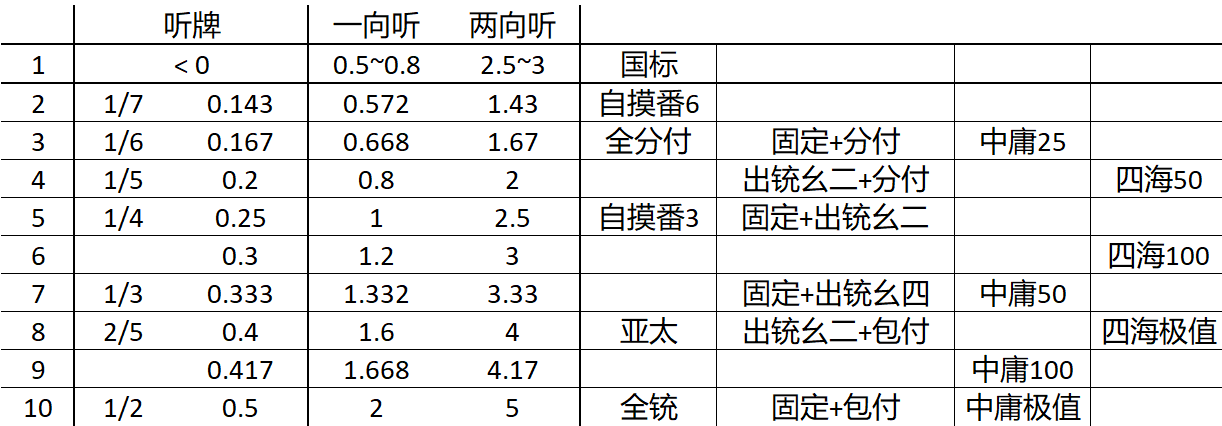
The final three columns show thresholds when ready, one tile away from ready, and two tiles away. The rows, from top to bottom, are Chinese Official; sixfold self-draw; equal sharing; discarder-double shared payment; triple self-draw and fixed-income 2:1:1 sharing; Four Seas at 100 points; fixed-income 4:1:1 sharing and Zung Jung at 50 points; Asia-Pacific payment and Four Seas' limiting case; Zung Jung at 100 points; and full discarder payment. Values and thresholds refer to the versions discussed in the original articles.
Because of its base payment, Chinese Official is among the most offensive systems. Players seldom prioritize avoiding a deal-in, producing a substantial imbalance. The other three systems that impose equal losses for self-draw and deal-in, together with sixfold self-draw, complete the five most offensive entries in the table.
How finely payment systems distinguish outcomes
Equal shared payment distinguishes neither the two ways of winning nor the discarder from other losers: self-draw and discard wins pay the same, and the three losers share the cost equally. It weakens defense, strategic depth, and competition. In effect, it reduces mahjong's six outcomes to the three results of a two-sided contest: win, loss, and draw.
Ideally, each of mahjong's six outcomes has a different difficulty or responsibility, and should receive a different score under the principle of matching reward to difficulty and cost to responsibility. Moving from draw C toward self-draw A increases the difficulty of success, so rewards should rise. Moving from draw C toward deal-in F increases responsibility for losing, so losses should also rise.
Giving adjacent outcomes the same score merges situations with different difficulty or responsibility. A player may then bear greater responsibility at less cost—for example, pay nothing as a non-discarding loser, as if the hand had been drawn, or pay only a self-draw loss despite causing a deal-in. Alternatively, a player may receive the same reward for a less difficult result, such as a discard win paying as much as self-draw. These arrangements blur the correspondence between rewards, difficulty, costs, and responsibility, weakening the rationale of the rules.
I define “payoff differentiation” as the number of distinct score categories assigned to mahjong's six outcomes. This measures how finely a system distinguishes them and appears in the final column of the table.
Lower differentiation means less precise scoring, making distorted incentives, extreme strategies, and moral hazard more likely, and potentially unbalancing offense and defense.
Higher differentiation indicates a more principled assignment of scores, better aligned with game design, appropriate incentives, risk, and responsibility. It also creates more decision points, helping balance offense and defense and deepen mahjong's skill and competitive character. The most reasonable payoff relationship therefore removes the equality signs:
a > b > 0 > −d > −e > −f
Equal sharing has differentiation 3, the simplest and least differentiated system. Riichi full discarder payment has differentiation 4: it merges self-draw with discard wins and draws with non-discarding losses, encouraging a defensive, conservative style. Chinese Official has differentiation 5 and the opposite character. It distinguishes self-draw, discard win, draw, and non-discarding loss, but merges losing to self-draw with dealing in, encouraging aggressive races to win. Zung Jung also has differentiation 5. Its innovative shared-payment threshold separates liability for small and large hands, but does not distinguish the two winning outcomes; below the threshold, equal sharing removes discarder liability entirely.
Of the systems analyzed here, only Four Seas reaches differentiation 6. It assigns a reasonable, distinct payoff to each result through a simple, practical mechanism, making it the most principled system from the perspective of individual-hand payoffs.
Mahjong is therefore more than a simple win/loss game. It is a multiplayer contest built around six outcomes: self-draw, discard win, exhaustive draw, another player's deal-in, another player's self-draw, and one's own deal-in. A reasonable payment system must consider not only how much the winner receives but also the differing responsibilities of the losers. Self-draw should reflect greater difficulty, dealing in should carry greater responsibility, and losing without dealing in should not be completely equivalent to a draw. A clear, continuous payoff ordering consistent with those responsibilities can avoid distorted incentives, foster balanced offense and defense, and improve mahjong's technical depth, competitive character, and gameplay.
Originally published in Chinese on Zhihu · Zhihu revision 2026-06-07